Category Astronomy/Space

Manipulating the Dark States of Superconducting Circuits in a Microwave Waveguide

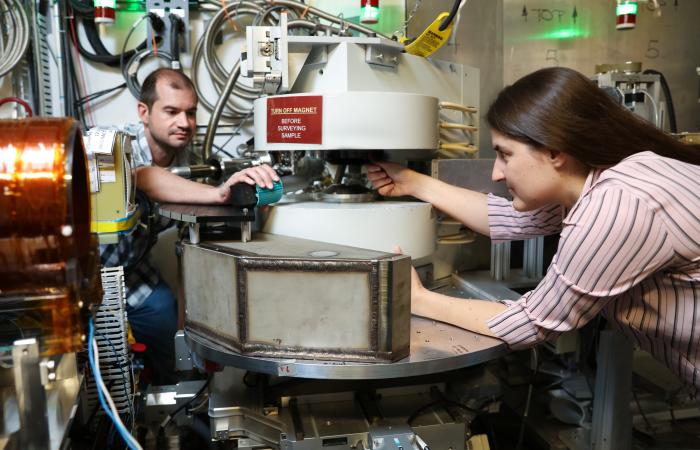
A team led by Gerhard Kirchmair has developed a system with which the dark states of superconducting circuits in a microwave waveguide can be manipulated from the outside. Credit: Mathieu Juan/University of Sherbrooke

Experimental physicists led by Gerhard Kirchmair, together with theoretical physicists at the University of Oulu, Finland, have succeeded for the first time in controlling protected quantum states—so-called dark states—in superconducting quantum bits. The entangled states are 500 times more robust and could be used in quantum simulations. The method could also be used on other technological platforms.

In Gerhard Kirchmair’s laboratory at the Institute of Quantum Optics and Quantum Information (IQOQI) of the Austrian Academy of Sciences in Innsbruck, Austria, superc...

Read More

Scientists Announce Discovery of Supermassive Binary Black Holes

Two supermassive black holes orbit one another in a binary system. They are 10 times closer to each other than the black holes in the only other known supermassive binary black hole system. Photo credit: Caltech/R. Hurt (IPAC)

Two black holes orbiting one another eventually will merge. A team of researchers from Purdue University and other institutions have discovered a supermassive black hole binary system, one of only two known such systems. The two black holes, which orbit each other, likely weigh 100 million suns each. One of the black holes powers a massive jet that moves outward at very close to the speed of light. The system is so far away that the visible light seen today was emitted 8.8 billion years ago.

The two are only between 200 AU and 2,000 AU apart (one AU is the di...

Read More

The New, Improved Dragonfly is a Galactic Gas Detector

This image zooms in on a newly forming tidal dwarf galaxy, which appears like a clump of gas at the edge of the disk of the M82 galaxy. Red regions are emissions from ionized gas. (Courtesy of the Dragonfly telescope team)

The Dragonfly telescope is undergoing a metamorphosis. For the past decade, the Dragonfly Telephoto Array — designed by Yale’s Pieter van Dokkum and the University of Toronto’s Roberto Abraham and located in New Mexico — has conducted groundbreaking science by detecting faint starlight within dimly lit parts of the night sky. The telescope uses clusters of telephoto lenses to create images, much the way a dragonfly’s eyes gather visual data.

The telescope has spotted previously unseen “fluffy” galaxies, diffuse dwarf galaxies, and galaxies with little or no dark m...

Read More

196 Lasers help Scientists Recreate the Conditions inside Gigantic Galaxy Clusters

A technician works at the National Ignition Facility. Scientists used the array of 196 lasers to create conditions similar to the hot gas inside gigantic galaxy clusters.

Experiments point the way to solving mystery that keeps clusters hot. Galaxies rarely live alone. Instead, dozens to thousands are drawn together by gravity, forming vast clusters that are the largest objects in the universe.

“Galaxy clusters are one of the most awe-inspiring things in the universe,” said Prof. Emeritus Don Lamb, a University of Chicago astrophysicist and co-author on a new paper published March 9 – one that may point the way towards solving a decades-long mystery.

Scientists have long known that the hydrogen gas in galaxy clusters is searingly hot – about 10 million degrees Kelvin, or roughly t...

Read More