Category Astronomy/Space

Death Spiral: A Black Hole Spins on its Side

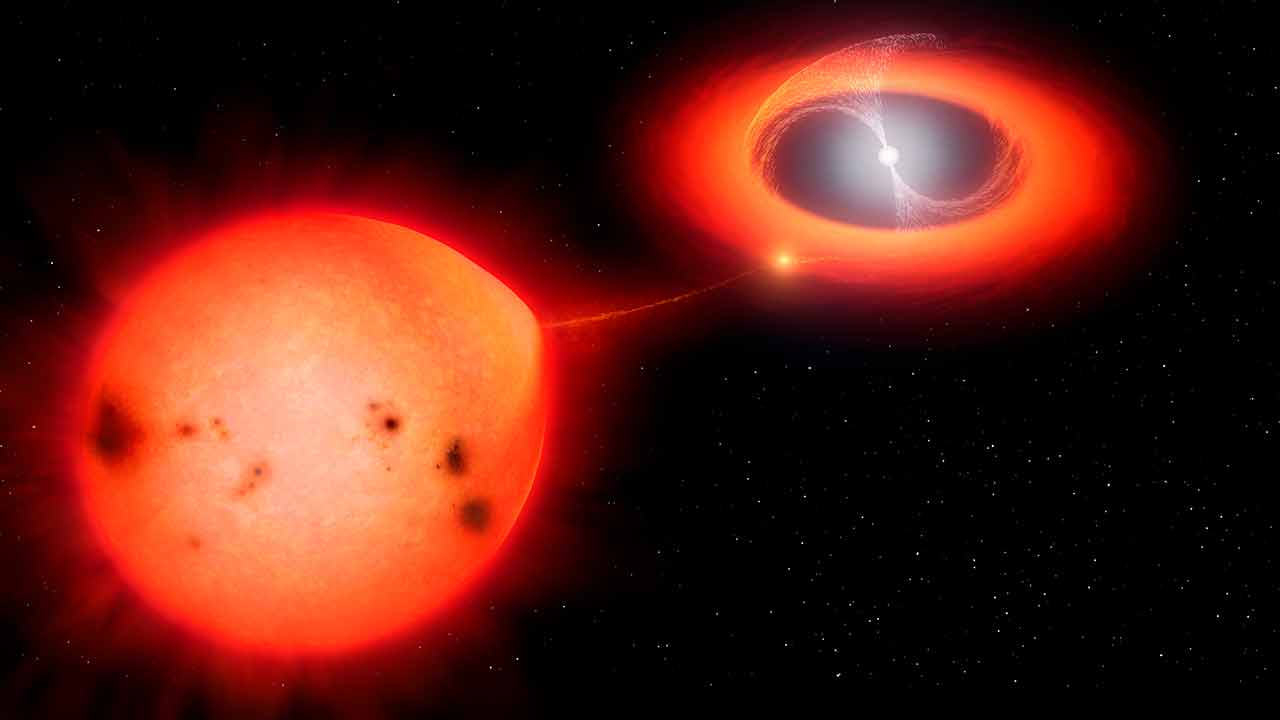
Researchers from the University of Turku, Finland, found that the axis of rotation of a black hole in a binary system is tilted more than 40 degrees relative to the axis of stellar orbit. The finding challenges current theoretical models of black hole formation.

The observation by the researchers from Tuorla Observatory in Finland is the first reliable measurement that shows a large difference between the axis of rotation of a black hole and the axis of a binary system orbit. The difference between the axes measured by the researchers in a binary star system called MAXI J1820+070 was more than 40 degrees.

Often for the space systems with smaller objects orbiting around the central massive body, the own rotation axis of this body is to a high degree aligned with the rotation axis...

Read More

Microscopic view on Asteroid Collisions could help us Understand Planet Formation

A new way of dating collisions between asteroids and planetary bodies throughout our Solar System’s history could help scientists reconstruct how and when planets were born.

A team of researchers, led by the University of Cambridge, combined dating and microscopic analysis of the Chelyabinsk meteorite — which fell to Earth and hit the headlines in 2013 — to get more accurate constraints on the timing of ancient impact events.

Their study, published in Communications Earth & Environment, looked at how minerals within the meteorite were damaged by different impacts over time, meaning they could identify the biggest and oldest events that may have been involved in planetary formation.

“Meteorite impact ages are often controversial: our work shows that we need to draw on multiple...

Read More

Cosmic Flashes pinpointed to a Surprising Location in Space

Astronomers have been surprised by the closest source of mysterious flashes in the sky called fast radio bursts. Precision measurements with radio telescopes reveal that the bursts are made among old stars, and in a way that no one was expecting. The source of the flashes, in nearby spiral galaxy M81, is the closest of its kind to Earth.

Fast radio bursts are unpredictable, extremely short flashes of light from space. Astronomers have struggled to understand them ever since they were first discovered in 2007. So far, they have only ever been seen by radio telescopes.

Each flash lasts only thousandths of a second. Yet each one sends out as much energy as the Sun gives out in a day. Several hundred flashes go off every day, and they have been seen all over the sky...

Read More

Dwarf Planet Ceres: Organic Chemistry and Salt Deposits in Urvara Impact Crater

Numerous large, striking craters are found on the surface of dwarf planet Ceres.      

The third-largest crater on the dwarf planet Ceres was geologically active at least once many millions of years after its formation. In a recent study published today in the journal Nature Communications, researchers from the Max Planck Institute for Solar System Research (MPS) in Göttingen, the University of Münster (WWU) and the National Institute of Science Education and Research (NISER) in Bhubaneswar, India present the most detailed study of Urvara crater to date. For the first time, they evaluated camera images from the last phase of NASA’s Dawn mission, which reveal geological structures only a few meters in size. The Dawn spacecraft entered orbit around the dwarf planet in 2015 and studied it up close for about three and a half years...

Read More