Category Astronomy/Space

Astronomers identify Potential Clue to Reinonization of Universe

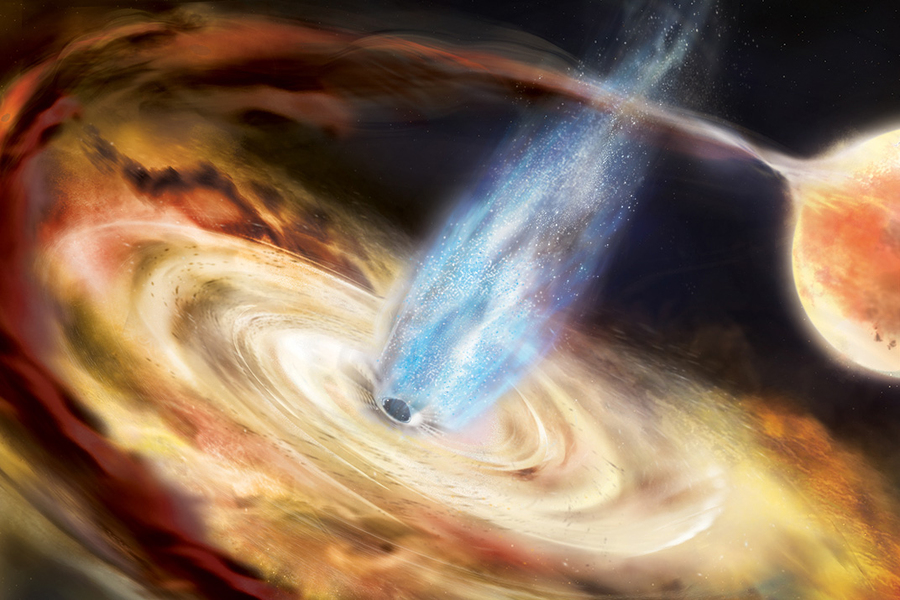
Astronomers have identified a potential clue to how the universe became reionized after the Big Bang. The researchers identified a black hole, a million times as bright as our sun, that may have been similar to the sources that powered the universe’s reionization.

About 400,000 years after the universe was created began a period called “The Epoch of Reionization.”

During this time, the once hotter universe began to cool and matter clumped together, forming the first stars and galaxies. As these stars and galaxies emerged, their energy heated the surrounding environment, reionizing some of the remaining hydrogen in the universe.

The universe’s reionization is well known, but determining how it happened has been tricky...

Read More

Eccentric Exoplanet discovered

TESS target pixel files of Sectors 14, 20, 21, and 26 that observed TOI-2257, generated by means of tpfplotter (Aller et al. 2020). The apertures used to extract the photometry by the SPOC pipeline are shown as red shaded regions. The Gaia DR2 catalog (Gaia Collaboration 2018) is over-plotted, with all sources of up to 6 magnitudes in contrast with TOI-2257 shown as red circles. We note that the symbol size scales with the magnitude contrast. While the star is relatively isolated, there is a small amount of contamination from outside sources, ranging from 2–5% of the total flux. Credit: DOI: 10.1051/0004-6361/202142280

Eccentric exoplanet discovered Led by the University of Bern, an international research team has discovered a sub-Neptune exoplanet orbiting a red dwarf star...

Read More

Astronomers capture Red Supergiant’s Death Throes

‘For the first time, we watched a red supergiant star explode,’ researcher says. For the first time ever, astronomers have imaged in real time the dramatic end to a red supergiant’s life – watching the massive star’s rapid self-destruction and final death throes before collapsing into a type II supernova.

Led by researchers at Northwestern University and the University of California, Berkeley (UC Berkeley), the team observed the red supergiant during its last 130 days leading up to its deadly detonation.

The discovery defies previous ideas of how red supergiant stars evolve right before exploding. Earlier observations showed that red supergiants were relatively quiescent before their deaths — with no evidence of violent eruptions or luminous emissions...

Read More

Earth Isn’t ‘Super’ because the Sun had Rings Before Planets

An illustration of three distinct, planetesimal-forming rings that could have produced the planets and other features of the solar system, according to a computational model from Rice University. The vaporization of solid silicates, water and carbon monoxide at “sublimation lines” (top) caused “pressure bumps” in the sun’s protoplanetary disk, trapping dust in three distinct rings. As the sun cooled, pressure bumps migrated sunward allowing trapped dust to accumulate into asteroid-sized planetesimals. The chemical composition of objects from the inner ring (NC) differs from the composition of middle- and outer-ring objects (CC)...
Read More