Category Astronomy/Space

Hubble Tension: Showing the Cracks in Gaussian Processes

Correlations between H(z=0) and H(zi) across a host of Matérn class kernels. The increase in the strength of correlations is directly reflected in the decreasing errors in Table 2 as Î½
ν is increased

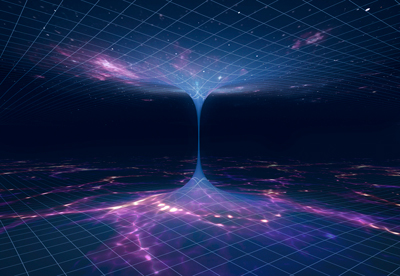
A new analysis of the Hubble constant to show that the Gaussian Processes data reconstruction technique may not actually be independent of all cosmological models — and that it may be time to question the validity of model independence itself.

The technique of Gaussian Processes (GP) is widely used to reconstruct cosmological parameters, most notably the expansion rate of the universe, using observational data. For many cosmologists, the crowning achievement of this approach is its ‘model independence’ — meaning it can be applied universally across all models...

Read More

Simulations provide Clue to Missing Planets Mystery

Simulations provide clue to missing planets mystery
A protoplanetary disk as observed by ALMA (left), and a protoplanetary disk during planetary migration, as obtained from the ATERUI II simulation (right). The dashed line in the simulation represents the orbit of a planet, and the gray area indicates a region not covered by the computational domain of the simulation. Credit: Kazuhiro Kanagawa, ALMA(ESO/NAOJ/NRAO)

Forming planets are one possible explanation for the rings and gaps observed in disks of gas and dust around young stars. But this theory has trouble explaining why it is rare to find planets associated with rings. New supercomputer simulations show that after creating a ring, a planet can move away and leave the ring behind...

Read More

Near-Earth Asteroid might be a Lost Fragment of the Moon

The Earth, the asteroid Kamo`oalewa and the moon
An artist’s impression of Earth quasi-satellite Kamo`oalewa near the Earth-moon system. Using the Large Binocular Telescope, astronomers have shown that it might be a lost fragment of the moon.Addy Graham/University of Arizona

A near-Earth asteroid named Kamo`oalewa could be a fragment of our moon, according to a new paper published in Nature Communications Earth and Environment by a team of astronomers led by the University of Arizona.

Kamooalewa is a quasi-satellite -- a subcategory of near-Earth asteroids that orbit the sun but remain relatively close to Earth. Little is known about these objects because they are faint and difficult to observe. Kamooalewa was discovered by the PanSTARRS telescope in Hawaii in 2016, and the name — found in a Hawaiian creation chant — alludes to an...

Read More

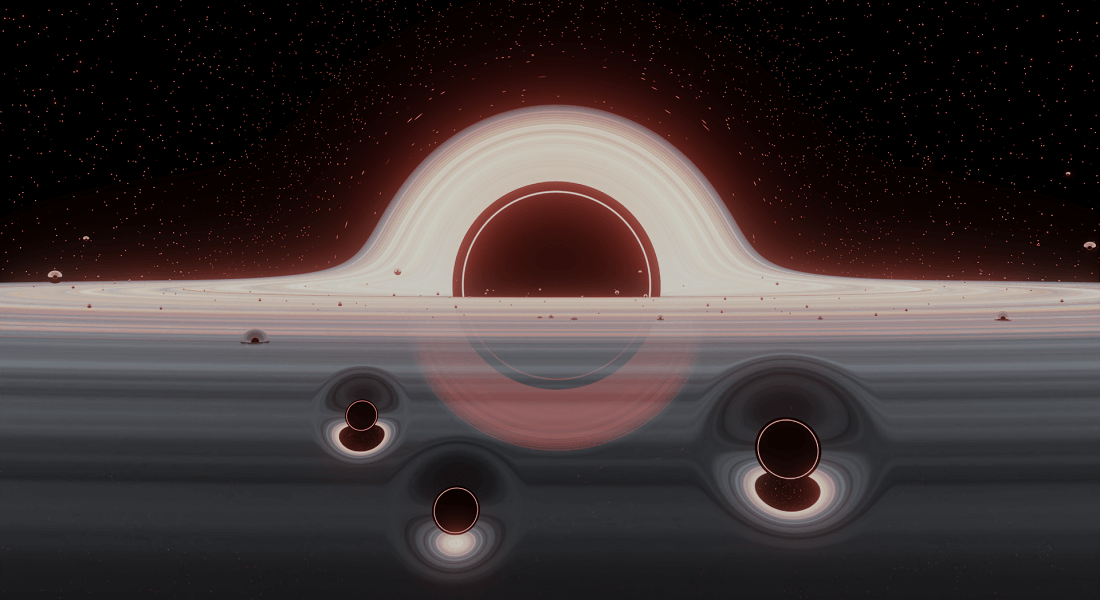
Black Hole found Hiding in Star Cluster Outside Our Galaxy

undefined
Using the European Southern Observatory’s Very Large Telescope (ESO’s VLT), astronomers have discovered a small black hole outside the Milky Way by looking at how it influences the motion of a star in its close vicinity. This is the first time this detection method has been used to reveal the presence of a black hole outside of our galaxy. The method could be key to unveiling hidden black holes in the Milky Way and nearby galaxies, and to help shed light on how these mysterious objects form and evolve.

Using the European Southern Observatory’s Very Large Telescope (ESO’s VLT), astronomers have discovered a small black hole outside the Milky Way by looking at how it influences the motion of a star in its close vicinity...

Read More