Category Astronomy/Space

Neutron Star Collisions are ‘Goldmine’ of Heavy Elements, study finds

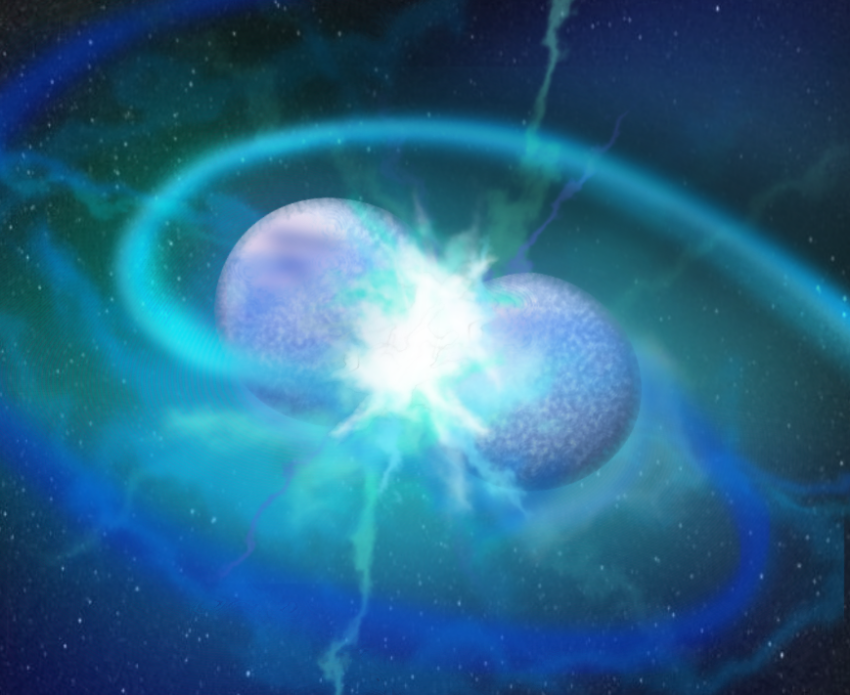
Illustration shows two white cloud-like structures spiraling together to form a sphere circled by a ring of smaller gold particles

Mergers between two neutron stars have produced more heavy elements in last 2.5 billion years than mergers between neutron stars and black holes. Most elements lighter than iron are forged in the cores of stars. A star’s white-hot center fuels the fusion of protons, squeezing them together to build progressively heavier elements. But beyond iron, scientists have puzzled over what could give rise to gold, platinum, and the rest of the universe’s heavy elements, whose formation requires more energy than a star can muster.

A new study by researchers at MIT and the University of New Hampshire finds that of two long-suspected sources of heavy metals, one is more of a goldmine than the other.

The study, published today in Astrophysical Journal Letters, reports that in the last 2...

Read More

Astronomers may have discovered the First Planet Outside of our Galaxy

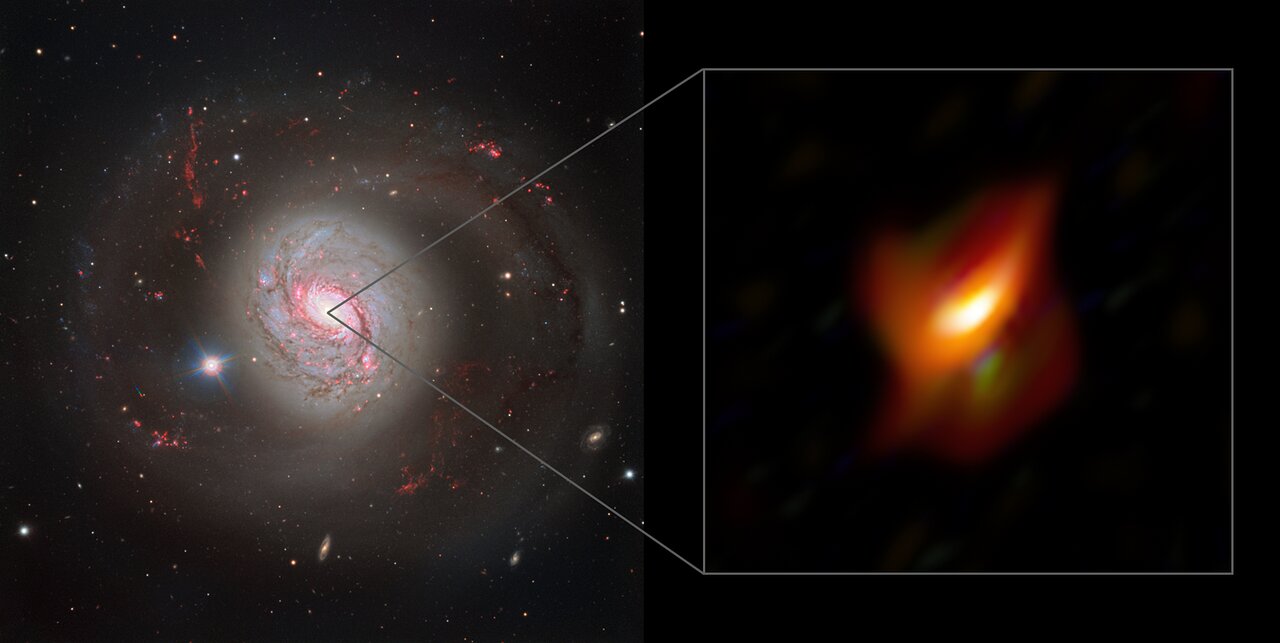
Signs of a planet transiting a star outside of the Milky Way galaxy may have been detected for the first time. This intriguing result, using NASA’s Chandra X-ray Observatory, opens up a new window to search for exoplanets at greater distances than ever before.

The possible exoplanet candidate is located in the spiral galaxy Messier 51 (M51), also called the Whirlpool Galaxy because of its distinctive profile.

Exoplanets are defined as planets outside of our Solar System. Until now, astronomers have found all other known exoplanets and exoplanet candidates in the Milky Way galaxy, almost all of them less than about 3,000 light-years from Earth...

Read More

Astrophysicists reveal Largest-ever Suite of Universe Simulations

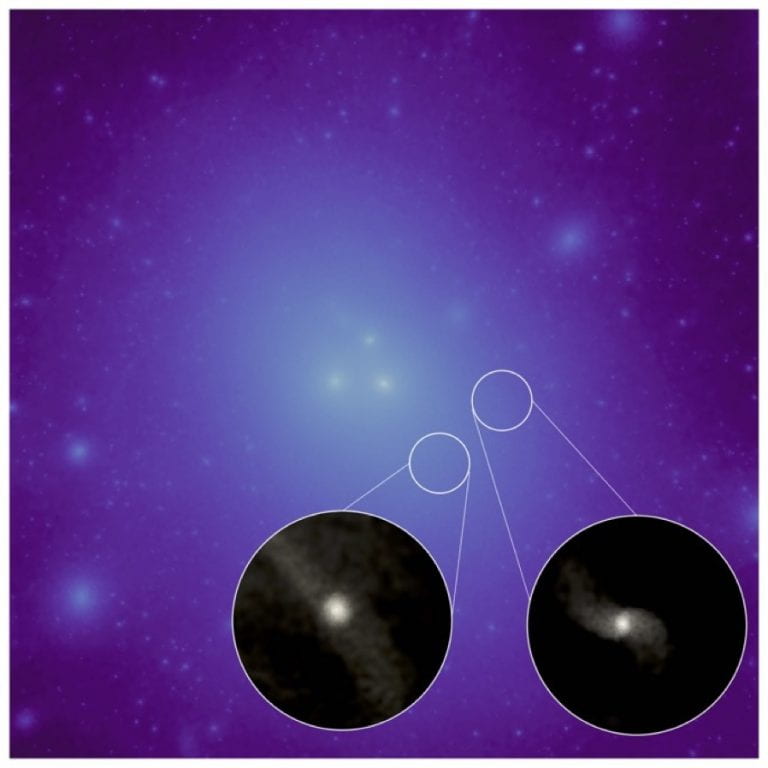
Astrophysicists reveal largest-ever suite of universe simulations
A snapshot measuring 10 billion light-years across of one of the AbacusSummit simulations. Credit: The AbacusSummit Team

Collectively clocking in at nearly 60 trillion particles, a newly released set of cosmological simulations is by far the biggest ever produced.

The simulation suite, dubbed AbacusSummit, will be instrumental in extracting secrets of the universe from upcoming surveys of the cosmos, its creators predict. They present AbacusSummit in several papers published October 25 in Monthly Notices of the Royal Astronomical Society.

AbacusSummit was produced by researchers at the Flatiron Institute’s Center for Computational Astrophysics (CCA) in New York City and the Center for Astrophysics | Harvard & Smithsonian...

Read More

Astronomers provide ‘Field Guide’ to Exoplanets known as Hot Jupiters

The turbulent atmosphere of a hot, gaseous planet known as HD 80606b is shown in this simulation based on data from NASA’s Spitzer Space Telescope. The planet spends most of its time far away from its star, but every 111 days, it swings extremely close to the star, experiencing a massive burst of heat. NASA/JPL-CalTech

Hot Jupiters — giant gas planets that race around their host stars in extremely tight orbits — have become a little bit less mysterious thanks to a new study combining theoretical modeling with observations by the Hubble Space Telescope.

While previous studies mostly focused on individual worlds classified as “hot Jupiters” due to their superficial similarity to the gas giant in our own solar system, the new study is the first to look at a broader population of the st...

Read More