Category Astronomy/Space

Strange Radio Waves emerge from the direction of the Galactic Center

Artist's impression of ASKAP J173608.2-321635 by Sebastian Zentilomo
Artist’s impression of ASKAP J173608.2-321635 by Sebastian Zentilomo

A variable signal aligned to the heart of the Milky Way is tantalising scientists. Astronomers have discovered unusual signals coming from the direction of the Milky Way’s centre. The radio waves fit no currently understood pattern of variable radio source and could suggest a new class of stellar object.

“The strangest property of this new signal is that it is has a very high polarisation. This means its light oscillates in only one direction, but that direction rotates with time,” said Ziteng Wang, lead author of the new study and a PhD student in the School of Physics at the University of Sydney.

“The brightness of the object also varies dramatically, by a factor of 100, and the signal switches on and off appa...

Read More

Nature of unknown Gamma-ray Sources revealed

LAMOST observations reveal nature of unknown gamma-ray sources
Fig. 1 Artistic representation of an active galaxy jet. Credit: M. Kornmesser/ESO

An international team of astronomers has unveiled the nature of hundreds of gamma-ray emitting sources, discovering that most of them belong to the class of active galaxies known as blazars.

Their recent study was published in The Astronomical Journal.

One of the most intriguing challenges in modern gamma-ray astronomy is searching for low-energy counterparts of unidentified gamma-ray sources. Unidentified sources constitute about 1/3 of all celestial objects detected by the Fermi satellite to date, the most recent gamma-ray mission with unprecedented capabilities for observing the high energy sky.

Since the largest population of known gamma-ray sources are blazars, astronomers believe they can a...

Read More

Radio Signals from Distant Stars Suggest Hidden Planets

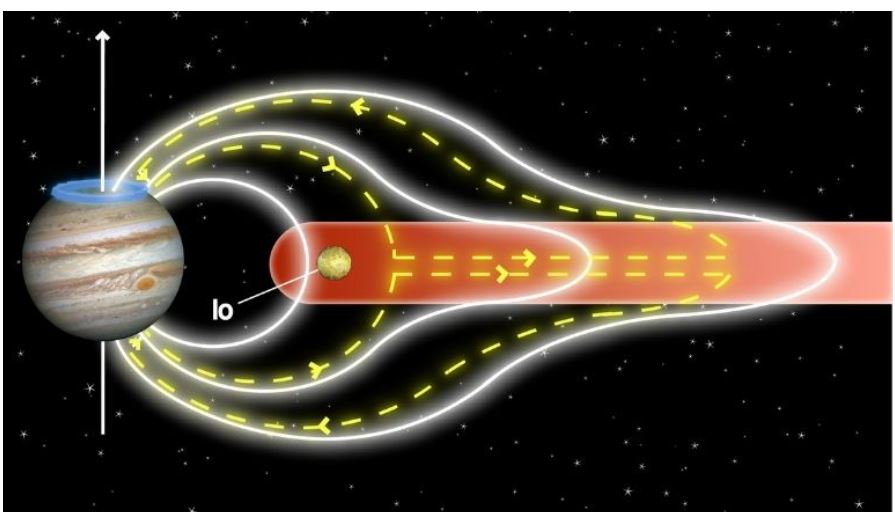
Using the world’s most powerful radio antenna, scientists have discovered stars unexpectedly blasting out radio waves, possibly indicating the existence of hidden planets.

The University of Queensland’s Dr Benjamin Pope and colleagues at the Dutch national observatory ASTRON have been searching for planets using the world’s most powerful radio telescope Low Frequency Array (LOFAR) situated in the Netherlands.

“We’ve discovered signals from 19 distant red dwarf stars, four of which are best explained by the existence of planets orbiting them,” Dr Pope said.

“We’ve long known that the planets of our own solar system emit powerful radio waves as their magnetic fields interact with the solar wind, but radio signals from planets outside our solar system had yet to be picked up.

...Read More

Rover Images confirm Jezero Crater is an Ancient Martian Lake

Jezero crater is an ancient Martian lake
Caption:Images from the Perseverance rover confirm that Jezero crater is an ancient Martian lake, researchers say. This Mastcam-Z enhanced color photo mosaic shows a butte near Jezero crater informally dubbed “Kodiak” by the rover team.
Credits:Credit: NASA/JPL-Caltech/LANL/CNES/CNRS/ASU/MSSS

The findings include signs of flash flooding that carried huge boulders downstream into the lakebed. The first scientific analysis of images taken by NASA’s Perseverance rover has now confirmed that Mars’ Jezero crater — which today is a dry, wind-eroded depression — was once a quiet lake, fed steadily by a small river some 3.7 billion years ago.

The images also reveal evidence that the crater endured flash floods...

Read More