Category Astronomy/Space

Unveiling Galaxies at Cosmic Dawn that were Hiding Behind the Dust

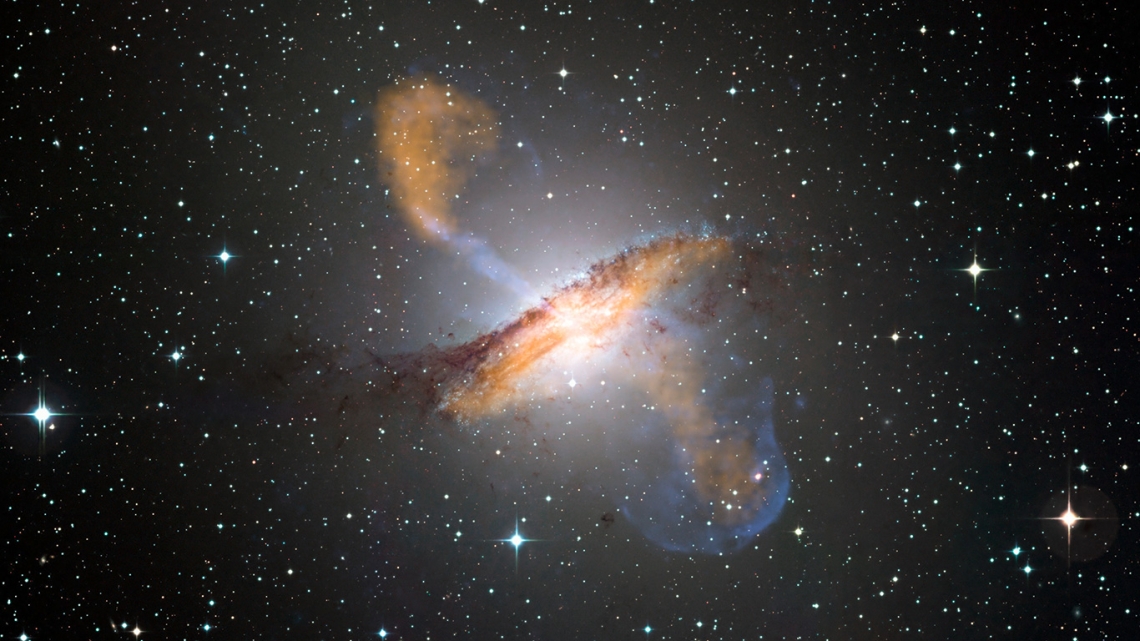
Scientists serendipitously discover two heavily dust-enshrouded galaxies that formed when the Universe was only 5% of its present age. When astronomers peer deep into the night sky, they observe what the Universe looked like a long time ago. Because the speed of light is finite, studying the most distant observable galaxies allows us to glimpse billions of years into the past when the Universe was very young and galaxies had just started to form stars. Studying this “early Universe” is one of the last frontiers in astronomy and is essential for constructing accurate and consistent astrophysics models. A key goal of scientists is to identify all the galaxies in the first billion years of cosmic history and to measure the rate at which galaxies were growing by forming new stars.

Vari...

Read More

Gigantic Cavity in Space Sheds New Light on how Stars Form

Alyssa Goodman/Center for Astrophysics | Harvard & Smithsonian

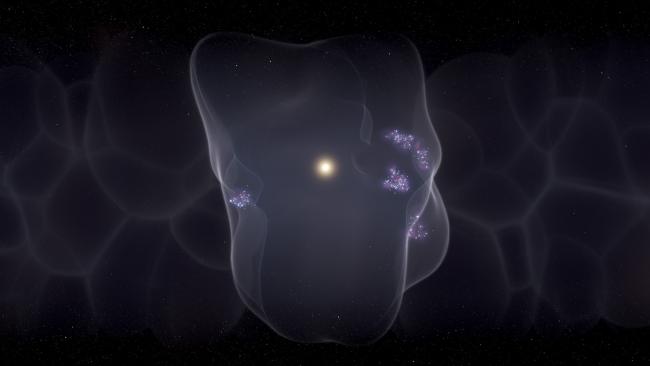
Astronomers analyzing 3D maps of the shapes and sizes of nearby molecular clouds have discovered a gigantic cavity in space.

The sphere-shaped void, described today in the Astrophysical Journal Letters, spans about 150 parsecs — nearly 500 light years — and is located on the sky among the constellations Perseus and Taurus. The research team, which is based at the Center for Astrophysics | Harvard & Smithsonian, believes the cavity was formed by ancient supernovae that went off some 10 million years ago.

The mysterious cavity is surrounded by the Perseus and Taurus molecular clouds — regions in space where stars form.

“Hundreds of stars are forming or exist already at the surface of this giant bubble,” says Shmuel B...

Read More

NASA’s Ingenuity Helicopter Captures a Mars Rock feature in 3D

This 3D view of a rock mound called Faillefeu was created from data collected by NASA's Ingenuity Mars Helicopter during its 13th flight at Mars on September 4, 2021.
This 3D view of a rock mound called Faillefeu was created from data collected by NASA’s Ingenuity Mars Helicopter during its 13th flight at Mars on September 4, 2021. 
Credit: NASA/JPL-Caltech 

NASA’s Ingenuity Mars Helicopter provided a 3D view of a rock-covered mound during its 13th flight on Sept. 4. The plan for this reconnaissance mission into the “South Seítah” region of Mars’ Jezero Crater was to capture images of this geologic target—nicknamed “Faillefeu” (after a medieval abbey in the French Alps) by the agency’s Perseverance rover team—and to obtain the color pictures from a lower altitude than ever before: 26 feet (8 meters).

About 33 feet (10 meters) wide, the mound is visible just north of the center of the image, with some large rocks casting shadows...

Read More

Mars Habitability Limited by its Small Size, Isotope study suggests

Water is essential for life on Earth and other planets, and scientists have found ample evidence of water in Mars’ early history. But Mars has no liquid water on its surface today. New research from Washington University in St. Louis suggests a fundamental reason: Mars may be just too small to hold onto large amounts of water.

Remote sensing studies and analyses of Martian meteorites dating back to the 1980s posit that Mars was once water-rich, compared with Earth. NASA’s Viking orbiter s1pacecraft—and, more recently, the Curiosity and Perseverance rovers on the ground—returned dramatic images of Martian landscapes marked by river valleys and flood channels.

Despite this evidence, no liquid water remains on the surface...

Read More