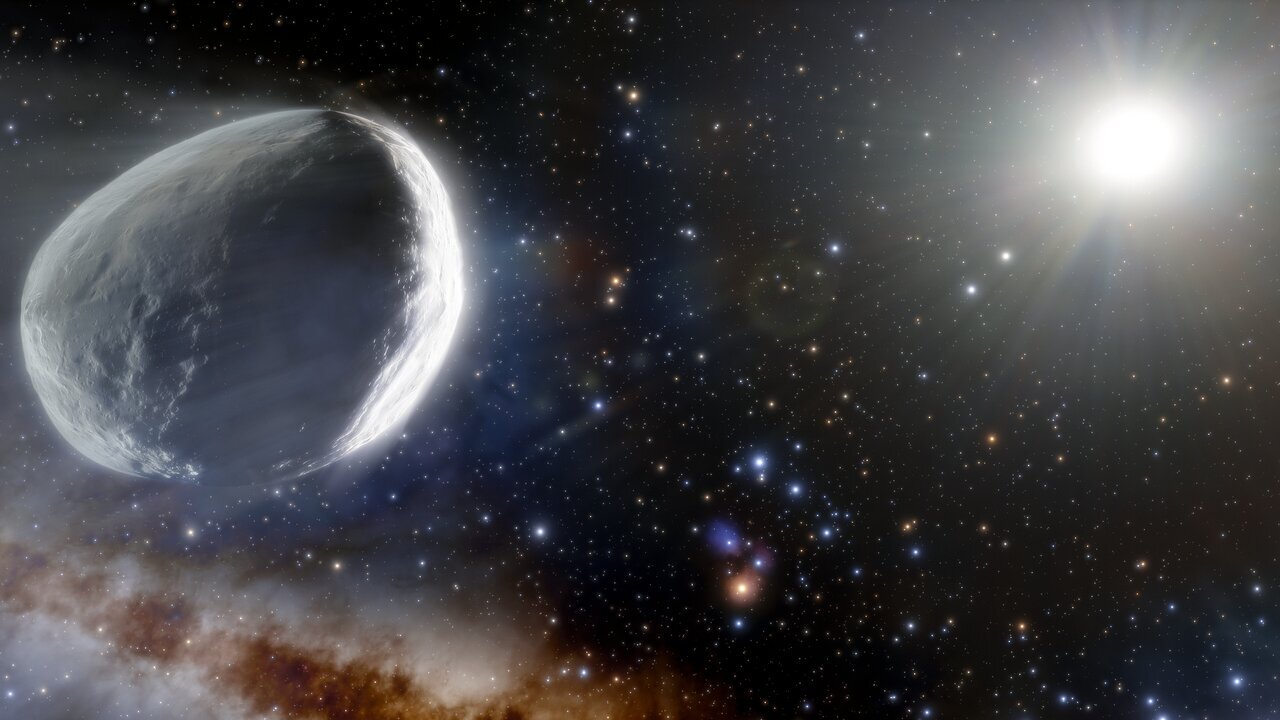
The comet Bernardinelli-Bernstein (BB), represented in this artist rendition as it might look in the outer Solar System, is estimated to be about 1000 times more massive than a typical comet. The largest comet discovered in modern times, it is among the most distant comets to be discovered with a coma, which means ice within the comet is vaporizing and forming an envelope of dust and vapor around the comet’s core. Credit: NOIRLab / NSF / AURA / J. da Silva / Spaceengine
A new study by University of Maryland astronomers shows that comet Bernardinelli-Bernstein (BB), the largest comet ever discovered, was active long before previously thought, meaning the ice within it is vaporizing and forming an envelope of dust and vapor known as a coma...
Data from ESA’s Gaia mission is re-writing the history of our galaxy, the Milky Way. What had traditionally been thought of as satellite galaxies to the Milky Way are now revealed to be mostly newcomers to our galactic environment.
A dwarf galaxy is a collection of between thousand and several billion stars. For decades it has been widely believed that the dwarf galaxies that surround the Milky Way are satellites, meaning that they are caught in orbit around our galaxy, and have been our constant companions for many billions of years. Now the motions of these dwarf galaxies have been computed with unprecedented precision thanks to data from Gaia’s early third data release and the results are surprising.
NASA’s Mars mission InSight probes the geology of the Elysium Planitia, finding alternate layers of basalt and sediments. An international team of scientists compares on-the-ground data with data from models, which helps to understand, e.g., the surface’s load-bearing capacity and trafficability.
Seismic data collected in Elysium Planitia, the second largest volcanic region on Mars, suggest the presence of a shallow sedimentary layer sandwiched between lava flows beneath the planet’s surface. These findings were gained in the framework of NASA’s InSight mission (Interior Exploration using Seismic Investigations, Geodesy and Heat Transport), in which several international research partners, including the University of Cologne, collaborate...
Researchers have developed a jelly-like material that can withstand the equivalent of an elephant standing on it, and completely recover to its original shape, even though it’s 80% water.
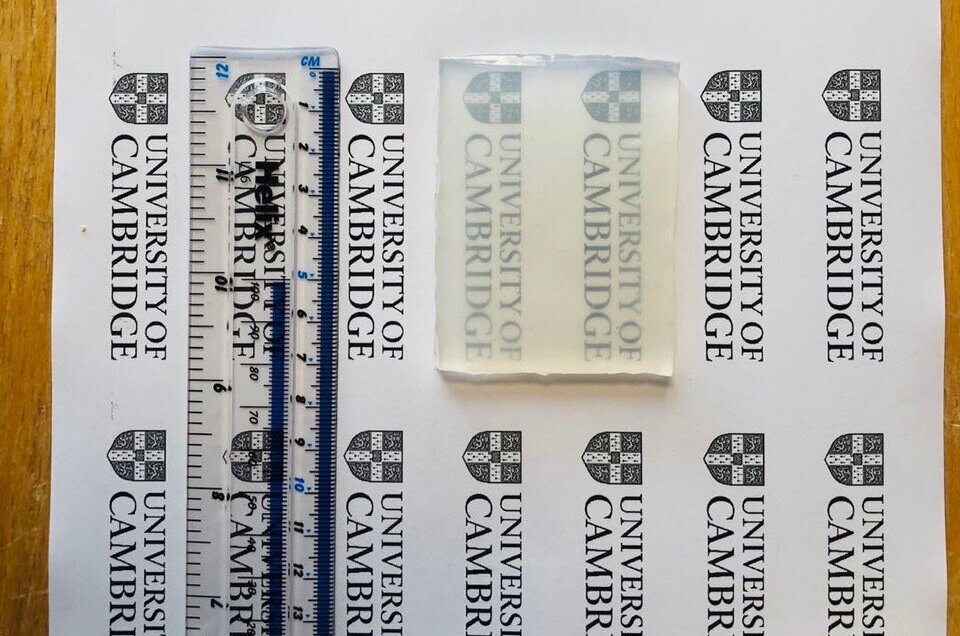
The soft-yet-strong material, developed by a team at the University of Cambridge, looks and feels like a squishy jelly, but acts like an ultra-hard, shatterproof glass when compressed, despite its high water content.
The non-water portion of the material is a network of polymers held together by reversible on/off interactions that control the material’s mechanical properties. This is the first time that such significant resistance to compression has been incorporated into a soft material.
The ‘super jelly’ could be used for a wide range of potential applications, including soft robotics,...







Recent Comments