Category Astronomy/Space

Deep Oceans Dissolve the Rocky Shell of Water-Ice Planets

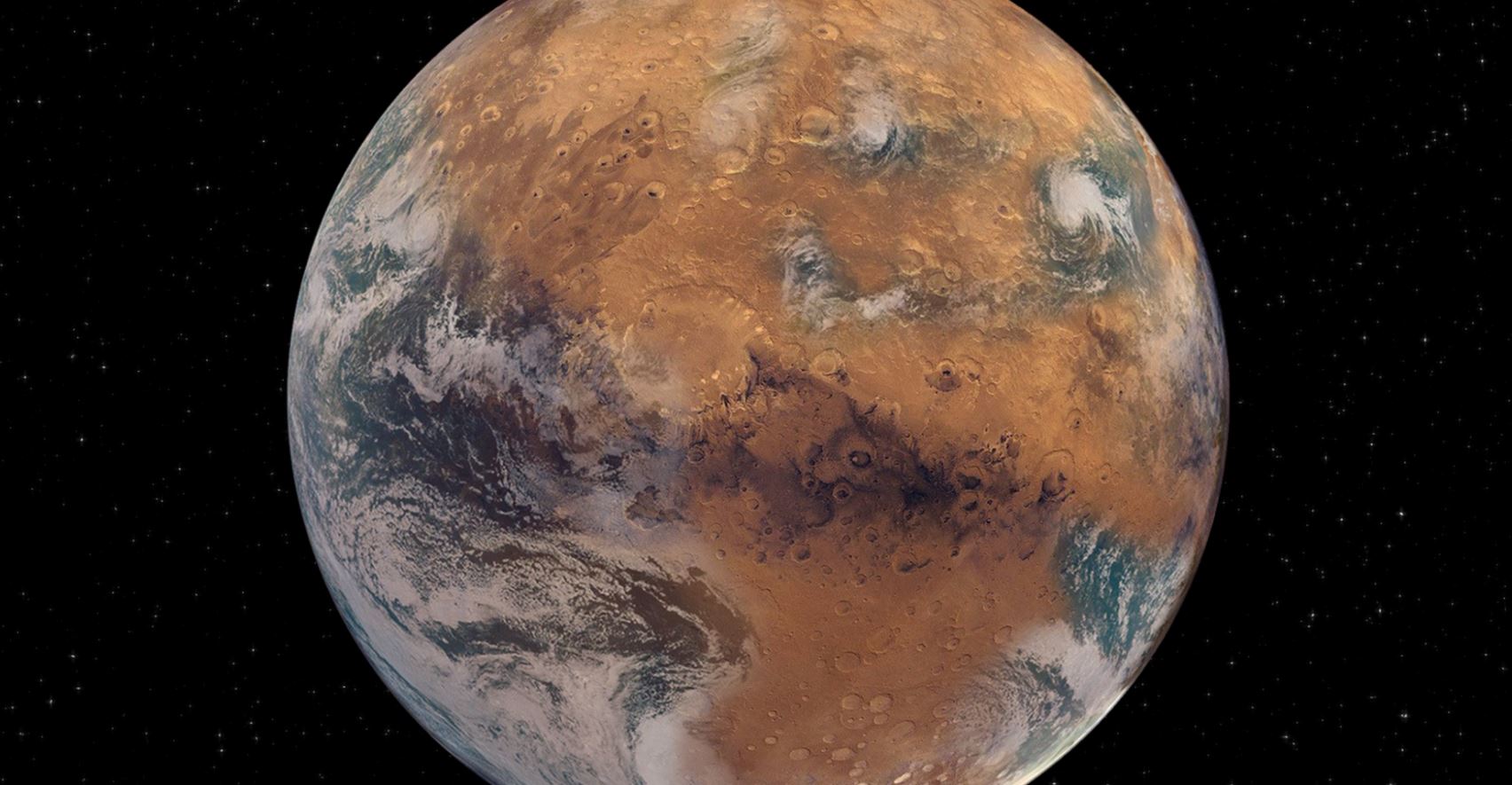
Cut-away diagram of a water-rich sub-Neptune exo-planet highlighting, in orange color, the interaction region between a deep H2O layer and the underlying rocky mantle
CREDIT
S. Speziale/ GFZ

Laboratory experiments allow insights into the processes under the extreme pressure and temperature conditions of distant worlds. What is happening deep beneath the surface of ice planets? Is there liquid water, and if so, how does it interact with the planetary rocky “seafloor”? New experiments show that on water-ice planets between the size of our Earth and up to six times this size, water selectively leaches magnesium from typical rock minerals...

Read More

Detailed cross-section of another galaxy reveals surprising similarities to our home. The first detailed cross-section of a galaxy broadly similar to the Milky Way, published today, reveals that our galaxy evolved gradually, instead of being the result of a violent mash-up. The finding throws the origin story of our home into doubt.

The galaxy, dubbed UGC 10738, turns out to have distinct ‘thick’ and ‘thin’ discs similar to those of the Milky Way. This suggests, contrary to previous theories, that such structures are not the result of a rare long-ago collision with a smaller galaxy. They appear to be the product of more peaceful change.

And that is a game-changer. It means that our spiral galaxy home isn’t the product of a freak accident. Instead, it is typical.

The finding w...

Read More

36 Dwarf Galaxies had simultaneous ‘Baby Boom’ of New Stars

Dwarf galaxies
The Milky Way-like galaxy NGC 1232 (center) shows the Milky Way’s location and relative size. Images of dwarf galaxies are centered close to their true locations but have been magnified for visibility. Credit: Charlotte Olsen

Surprising finding challenges current theories on how galaxies grow. Three dozen dwarf galaxies far from each other had a simultaneous “baby boom” of new stars, an unexpected discovery that challenges current theories on how galaxies grow and may enhance our understanding of the universe.

Galaxies more than 1 million light-years apart should have completely independent lives in terms of when they give birth to new stars...

Read More

Plasma Jets reveal Magnetic Fields far, far away

A black hole (marked by the red x) at the centre of galaxy MRC 0600-399 emits a jet of particles that bends into a ‘double-scythe’ T-shape that follows the magnetic field lines at the galaxy subcluster’s boundary.
(Image Credit: Modified from Chibueze, Sakemi, Ohmura et al. (2021) Nature Fig. 1(b))

Radio telescope images enable a new way to study magnetic fields in galaxy clusters millions of light years away. For the first time, researchers have observed plasma jets interacting with magnetic fields in a massive galaxy cluster 600 million light years away, thanks to the help of radio telescopes and supercomputer simulations. The findings, published in the journal Nature, can help clarify how such galaxy clusters evolve.

Galaxy clusters can contain up to thousands of galaxies bound to...

Read More