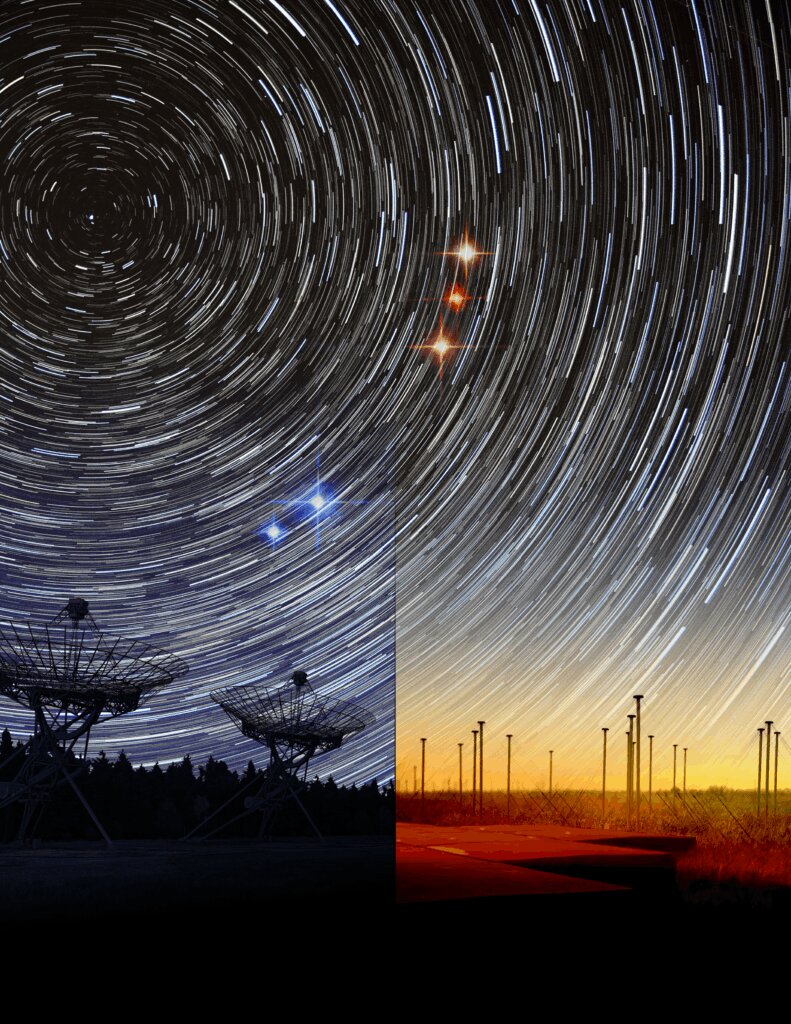
Westerbork dishes (left) detected a periodic, short fast radio burst in the blue, high-frequency radio sky. Time passed, the steady background stars turned into trails. Only much later did the same source emit in the red, low-frequency radio sky. The LOFAR telescope (right) now detected these for the first time. This chromatic behaviour shows the bursts are not periodically blocked by binary star winds. Credit: Joeri van Leeuwen
By connecting two of the biggest radio telescopes in the world, astronomers have discovered that a simple binary wind cannot cause the puzzling periodicity of a fast radio burst after all. The bursts may come from a highly magnetized, isolated neutron star...
A new class of exoplanet very different to our own, but which could support life, has been identified by astronomers, which could greatly accelerate the search for life outside our Solar System.
In the search for life elsewhere, astronomers have mostly looked for planets of a similar size, mass, temperature and atmospheric composition to Earth. However, astronomers from the University of Cambridge believe there are more promising possibilities out there.
The researchers have identified a new class of habitable planets, dubbed ‘Hycean’ planets—hot, ocean-covered planets with hydrogen-rich atmospheres—which are more numerous and observable than Earth-like planets.
The researchers say the results, reported in The Astrophysical Journal, could mean that finding biosignatures o...
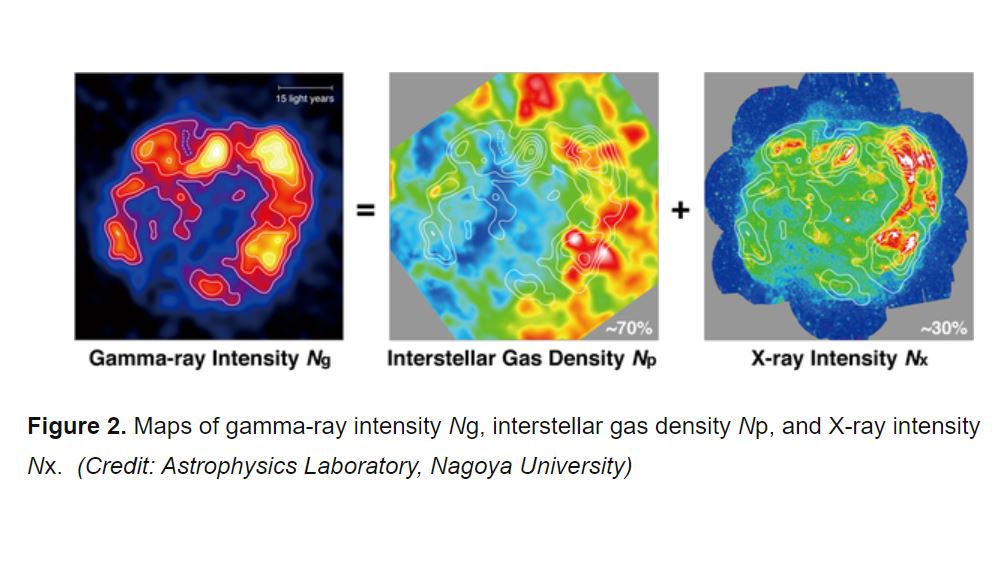
Astronomers have succeeded for the first time in quantifying the proton and electron components of cosmic rays in a supernova remnant. At least 70% of the very-high-energy gamma rays emitted from cosmic rays are due to relativistic protons, according to the novel imaging analysis of radio, X-ray, and gamma-ray radiation. The acceleration site of protons, the main components of cosmic rays, has been a 100-year mystery in modern astrophysics, this is the first time that the amount of cosmic rays being produced in a supernova remnant has been quantitatively shown and is an epoch-making step in the elucidation of the origin of cosmic rays.
The origin of cosmic rays, the particles with the highest energy in the universe, has been a great mystery since their discovery in 1912...
Dusty snow dug up by NASA’s Phoenix Mars Lander, a few centimeters below the surface. The blue box represents ice and the red box represents soil. Credit: NASA/JPL-Caltech/University of Arizona/Texas A&M University
Over the last two decades, scientists have found ice in many locations on Mars. Most Martian ice has been observed from orbital satellites like NASA’s Mars Reconnaissance Orbiter. But determining the grain size and dust content of the ice from that far above the surface is challenging. And those aspects of the ice are crucial in helping scientists determine how old the ice is and how it was deposited.
So planetary scientists Aditya Khuller and Philip Christensen of Arizona State University, with Stephen Warren, an Earth ice and snow expert from the University of Washing...







Recent Comments