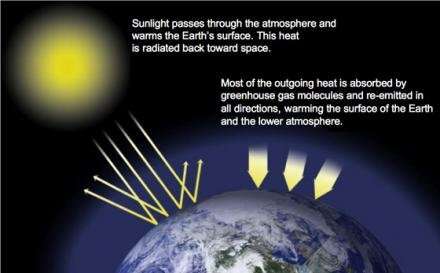
Greenhouse gases trap energy from the sun in the lower atmosphere. Without these gases, the Earth would be a chilly minus 18 degrees Centigrade. In contrast, the atmosphere on Mars is almost entirely made of carbon dioxide, but it has a very thin atmosphere and little to no methane or water vapour, producing a weaker greenhouse effect. Credit: NASA
Very high atmospheric CO2 levels can explain the high temperatures on the still young Earth three to four billion years ago. At the time, our Sun shone with only 70 to 80 percent of its present intensity. Nevertheless, the climate on the young Earth was apparently quite warm because there was hardly any glacial ice. This phenomenon is known as the ‘paradox of the young weak Sun...
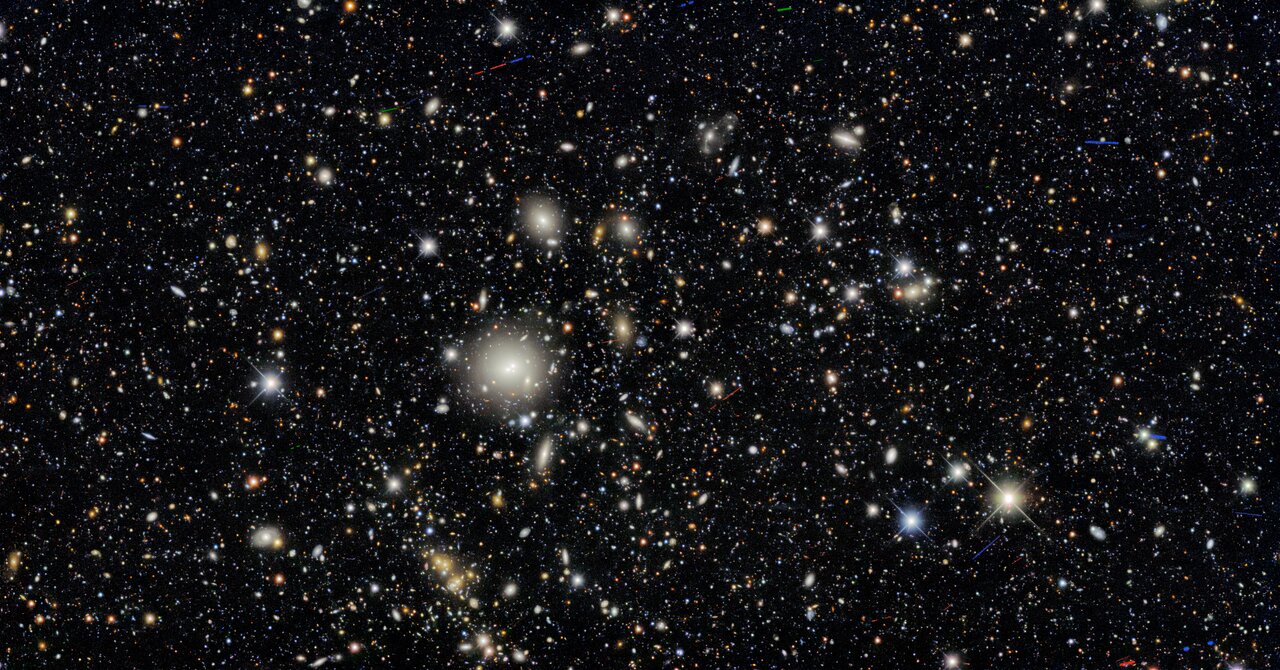
In 29 new scientific papers, the Dark Energy Survey examines the largest-ever maps of galaxy distribution and shapes, extending more than 7 billion light-years across the Universe. The extraordinarily precise analysis, which includes data from the survey’s first three years, contributes to the most powerful test of the current best model of the Universe, the standard cosmological model. However, hints remain from earlier DES data and other experiments that matter in the Universe today is a few percent less clumpy than predicted.
First three years of survey data uses observations of 226 million galaxies over 1/8 of the sky...
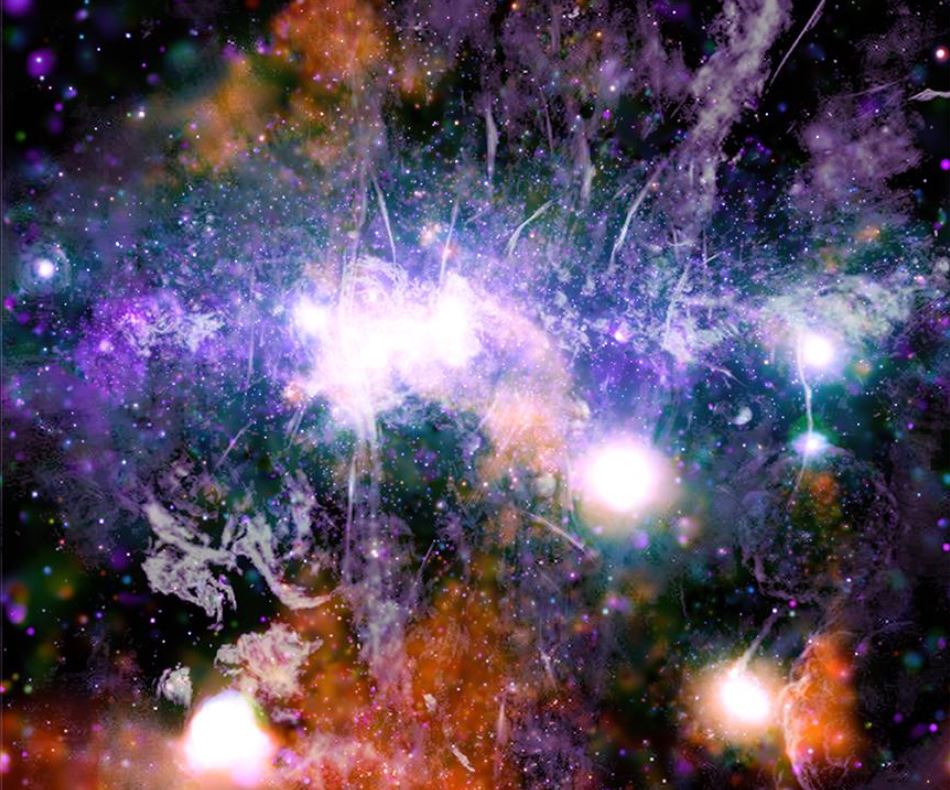
Panorama of the galactic center showing plumes and threads. Credit: X-ray: NASA/CXC/UMass/Q.D. Wang; Radio: NRF/SARAO/MeerKAT
New image made using NASA’s Chandra X-Ray Observatory hints at previously unknown interstellar energy source at the Milky Way center. New research by University of Massachusetts Amherst astronomer Daniel Wang reveals, with unprecedented clarity, details of violent phenomena in the center of our galaxy. The images, published recently in Monthly Notices of the Royal Astronomical Society, document an X-ray thread, G0.17-0.41, which hints at a previously unknown interstellar mechanism that may govern the energy flow and potentially the evolution of the Milky Way.
“The galaxy is like an ecosystem,” says Wang, a professor in UMass Amherst’s astronomy department, wh...
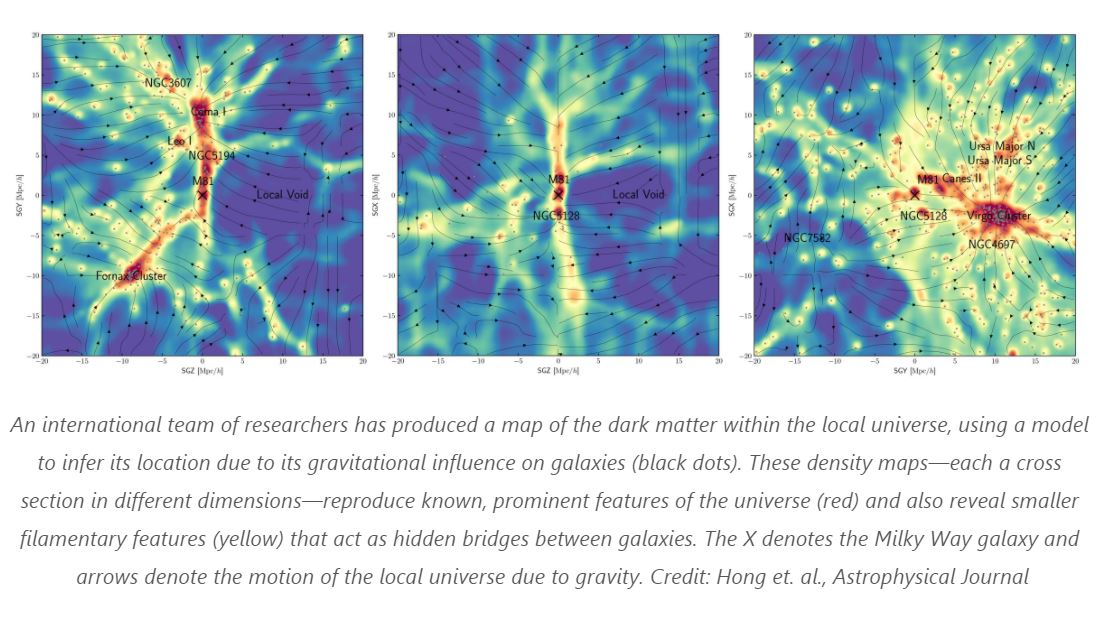
A new map of dark matter in the local universe reveals several previously undiscovered filamentary structures connecting galaxies. The map, developed using machine learning by an international team including a Penn State astrophysicist, could enable studies about the nature of dark matter as well as about the history and future of our local universe.
Dark matter is an elusive substance that makes up 80% of the universe. It also provides the skeleton for what cosmologists call the cosmic web, the large-scale structure of the universe that, due to its gravitational influence, dictates the motion of galaxies and other cosmic material. However, the distribution of local dark matter is currently unknown because it cannot be measured directly...





Recent Comments