Nitrogen-bearing, Earth-like planets can be formed if their feedstock material grows quickly to around moon- and Mars-sized planetary embryos before separating into core-mantle-crust-atmosphere, according to Rice University scientists. If metal-silicate differentiation is faster than the growth of planetary embryo-sized bodies, then solid reservoirs fail to retain much nitrogen and planets growing from such feedstock become extremely nitrogen-poor. Credit: Amrita P. Vyas/Rice University
The prospects for life on a given planet depend not only on where it forms but also how, according to Rice University scientists.
Planets like Earth that orbit within a solar system’s Goldilocks zone, with conditions supporting liquid water and a rich atmosphere, are more likely to harbor life...
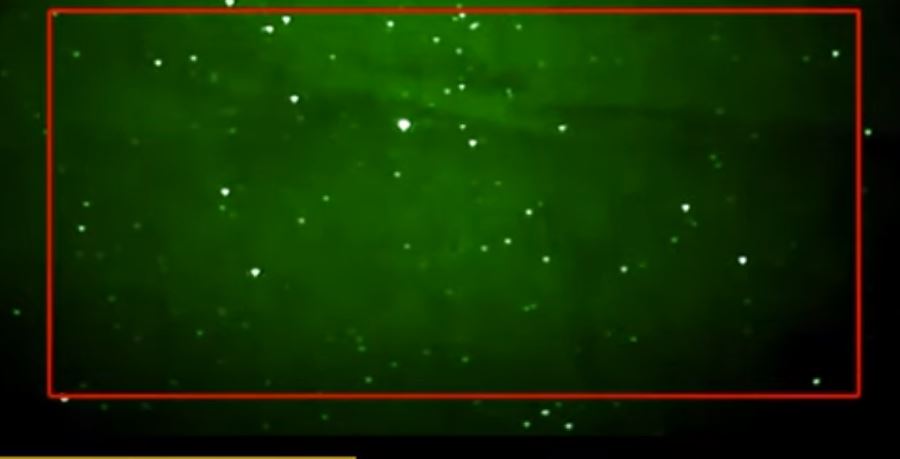
Discovery comes from reanalysis of two-decade-old video. The famed northern and southern lights have been studied for millennia, but they still hold secrets. Physicists describe a new phenomenon they call ‘diffuse auroral erasers,’ in which patches of the background glow are blotted out, then suddenly intensify and reappear.
For millennia, humans in the high latitudes have been enthralled by auroras — the northern and southern lights. Yet even after all that time, it appears the ethereal, dancing ribbons of light above Earth still hold some secrets.
In a new study, physicists led by the University of Iowa report a new feature to Earth’s atmospheric light show...
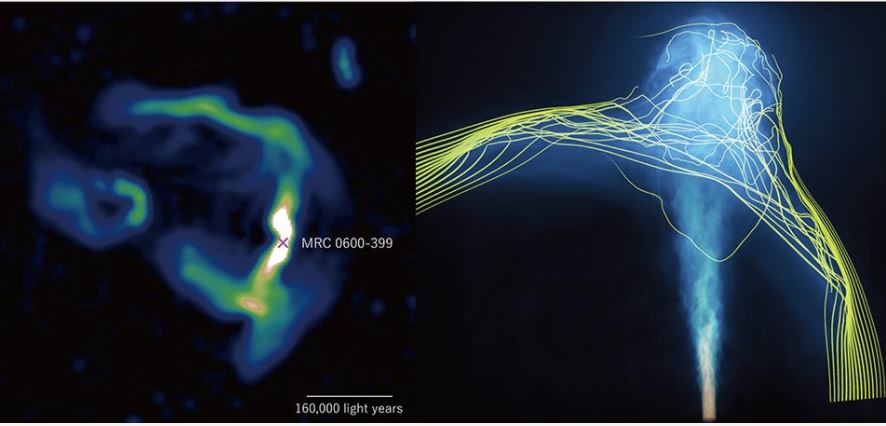
The bent jet structures emitted from MRC 0600-399 as observed by the MeerKAT radio telescope (left) are well reproduced by the simulation conducted on ATERUI II (right). The nearby galaxy B visible in the left part of the MeerKAT image is not affecting the jet and has been excluded in the simulation. (Credit: Chibueze, Sakemi, Ohmura et al. (MeerKAT image); Takumi Ohmura, Mami Machida, Hirotaka Nakayama, 4D2U Project, NAOJ (ATERUI II image))
New observations and simulations show that jets of high-energy particles emitted from the central massive black hole in the brightest galaxy in galaxy clusters can be used to map the structure of invisible inter-cluster magnetic fields...
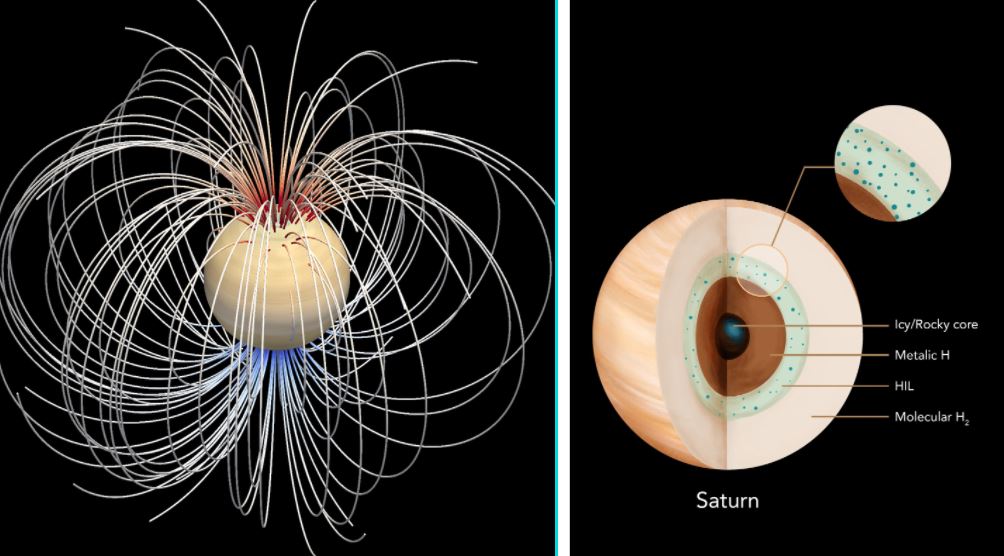
Left: The magnetic field of Saturn seen at the surface. Image: Ankit Barik/Johns Hopkins University. Right: Saturn’s interior with stably stratified Helium Insoluble Layer. Image: Yi Zheng (HEMI/MICA Extreme Arts Program)
New Johns Hopkins University simulations offer an intriguing look into Saturn’s interior, suggesting that a thick layer of helium rain influences the planet’s magnetic field.
The models, published this week in AGU Advances, also indicate that Saturn’s interior may feature higher temperatures at the equatorial region, with lower temperatures at the high latitudes at the top of the helium rain layer.
It is notoriously difficult to study the interior structures of large gaseous planets, and the findings advance the effort to map Saturn’s hidden regions.





Recent Comments