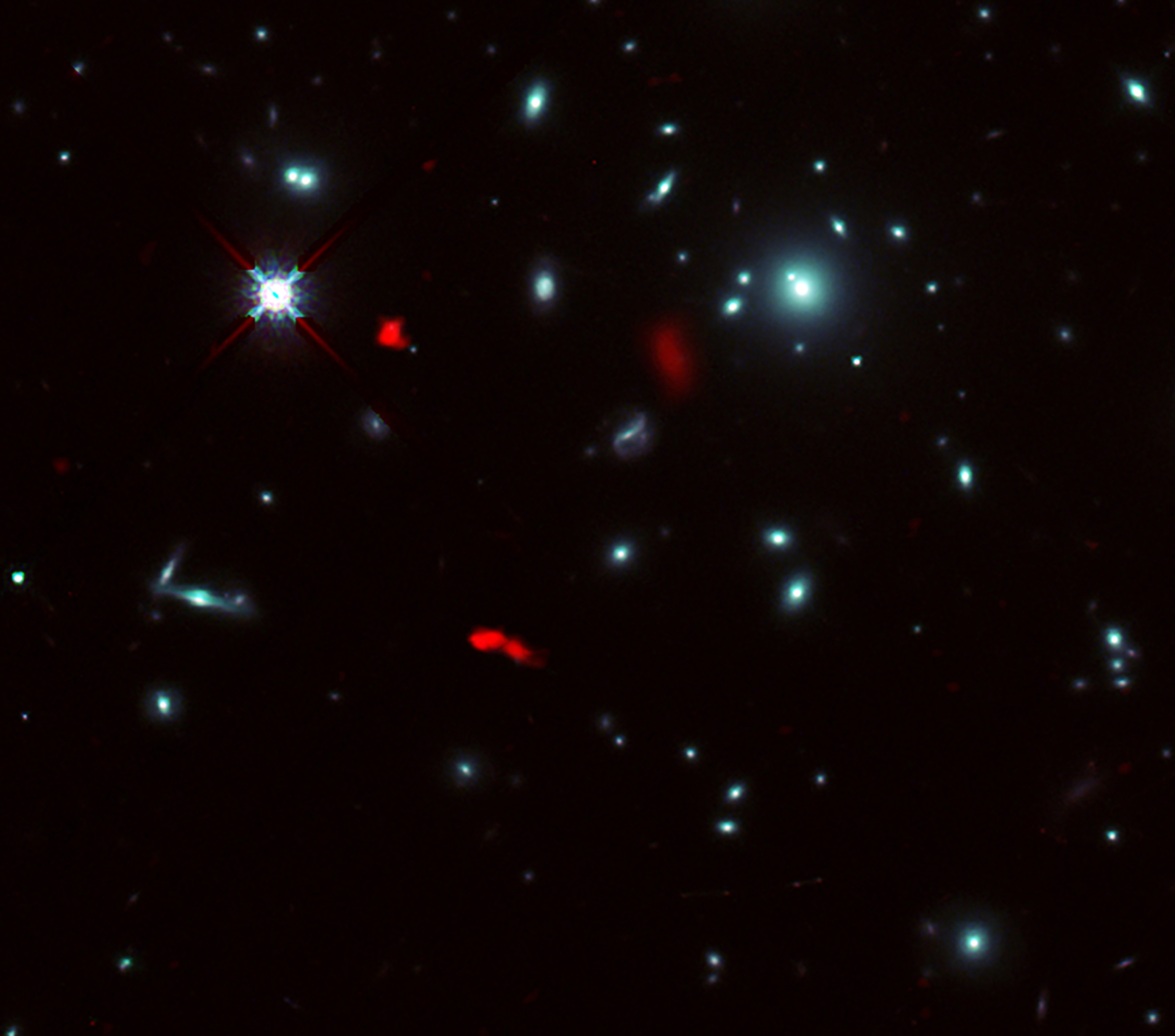
Image of the galaxy cluster RXCJ0600-2007 taken by the NASA/ESA Hubble Space Telescope, combined with gravitational lensing images of the distant galaxy RXCJ0600-z6, 12.4 billion light-years away, observed by ALMA (shown in red). Due to the gravitational lensing effect by the galaxy cluster, the image of RXCJ0600-z6 was intensified and magnified, and appeared to be divided into three or more parts. Credit: ALMA (ESO/NAOJ/NRAO), Fujimoto et al., NASA/ESA Hubble Space Telescope
Using the Atacama Large Millimeter/submillimeter Array (ALMA), astronomers found a rotating baby galaxy 1/100th the size of the Milky Way at a time when the Universe was only seven percent of its present age...
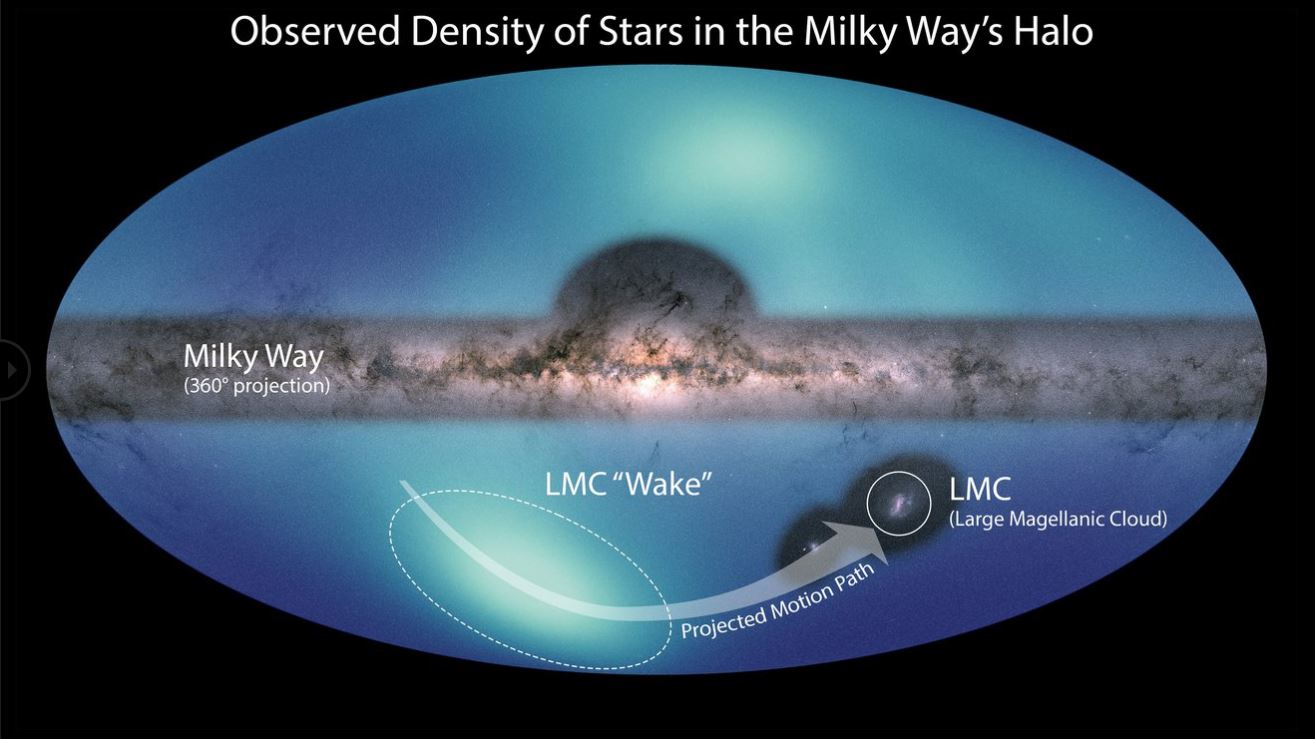
Images of the Milky Way and the Large Magellanic Cloud (LMC) are overlaid on a map of the surrounding galactic halo. The smaller structure is a wake created by the LMC’s motion through this region. The larger light-blue feature corresponds to a high density of stars observed in the northern hemisphere of our galaxy. Credit: NASA/ESA/JPL-Caltech/Conroy et. al. 2021
The highlight of the new chart is a wake of stars, stirred up by a small galaxy set to collide with the Milky Way. The map could also offer a new test of dark matter theories. Astronomers using data from NASA and ESA (European Space Agency) telescopes have released a new all-sky map of the outermost region of our galaxy. [Editor’s note: See Related Multimedia link below...
MOXIE Lowered into Rover: Technicians in the clean room are carefully lowering the Mars Oxygen In-Situ Resource Utilization Experiment (MOXIE) instrument into the belly of the Perseverance rover. Credit: NASA/JPL-Caltech
The milestone, which the MOXIE instrument achieved by converting CO2 into O2, points the way to future human exploration of the Red Planet. The growing list of “firsts” for Perseverance, NASA’s newest six-wheeled robot on the Martian surface, includes converting some of the Red Planet’s thin, carbon dioxide-rich atmosphere into oxygen. A toaster-size, experimental instrument aboard Perseverance called the Mars Oxygen In-Situ Resource Utilization Experiment (MOXIE) accomplished the task...
Fast radio bursts shown to include lower frequency radio waves than previously detected
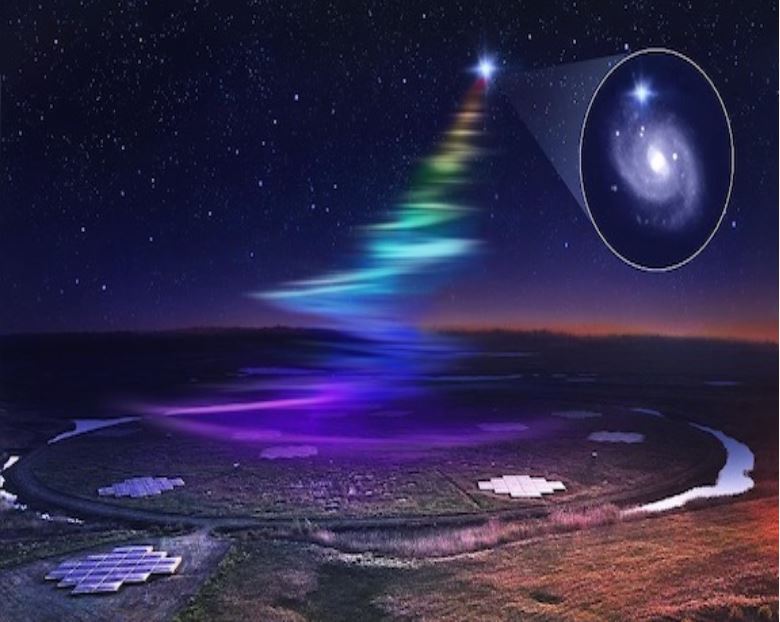
A team of researchers has established that fast radio bursts (FRBs) include radio waves at frequencies lower than ever detected before, a discovery that redraws the boundaries for theoretical astrophysicists trying to put their finger on the source of FRBs.
Since fast radio bursts (FRBs) were first discovered over a decade ago, scientists have puzzled over what could be generating these intense flashes of radio waves from outside of our galaxy. In a gradual process of elimination, the field of possible explanations has narrowed as new pieces of information are gathered about FRBs — how long they last, the frequencies of the radio waves detected, and so on.






Recent Comments