Category Astronomy/Space

Spiders in Space: Without Gravity, Light becomes key to Orientation

A black and white picture of a spider in its web in the experimental container on board the ISS
A specimen of the spider species Trichonephila clavipes on board the international space station ISS. (Photo: BioServe Space Technologies, University of Colorado Boulder

Humans have taken spiders into space more than once to study the importance of gravity to their web-building. What originally began as a somewhat unsuccessful PR experiment for high school students has yielded the surprising insight that light plays a larger role in arachnid orientation than previously thought.

The spider experiment by the US space agency NASA is a lesson in the frustrating failures and happy accidents that sometimes lead to unexpected research findings. The question was relatively simple: on Earth, spiders build asymmetrical webs with the center displaced towards the upper edge...

Read More

New Sunspot Cycle could be one of the Strongest on Record, new research predicts

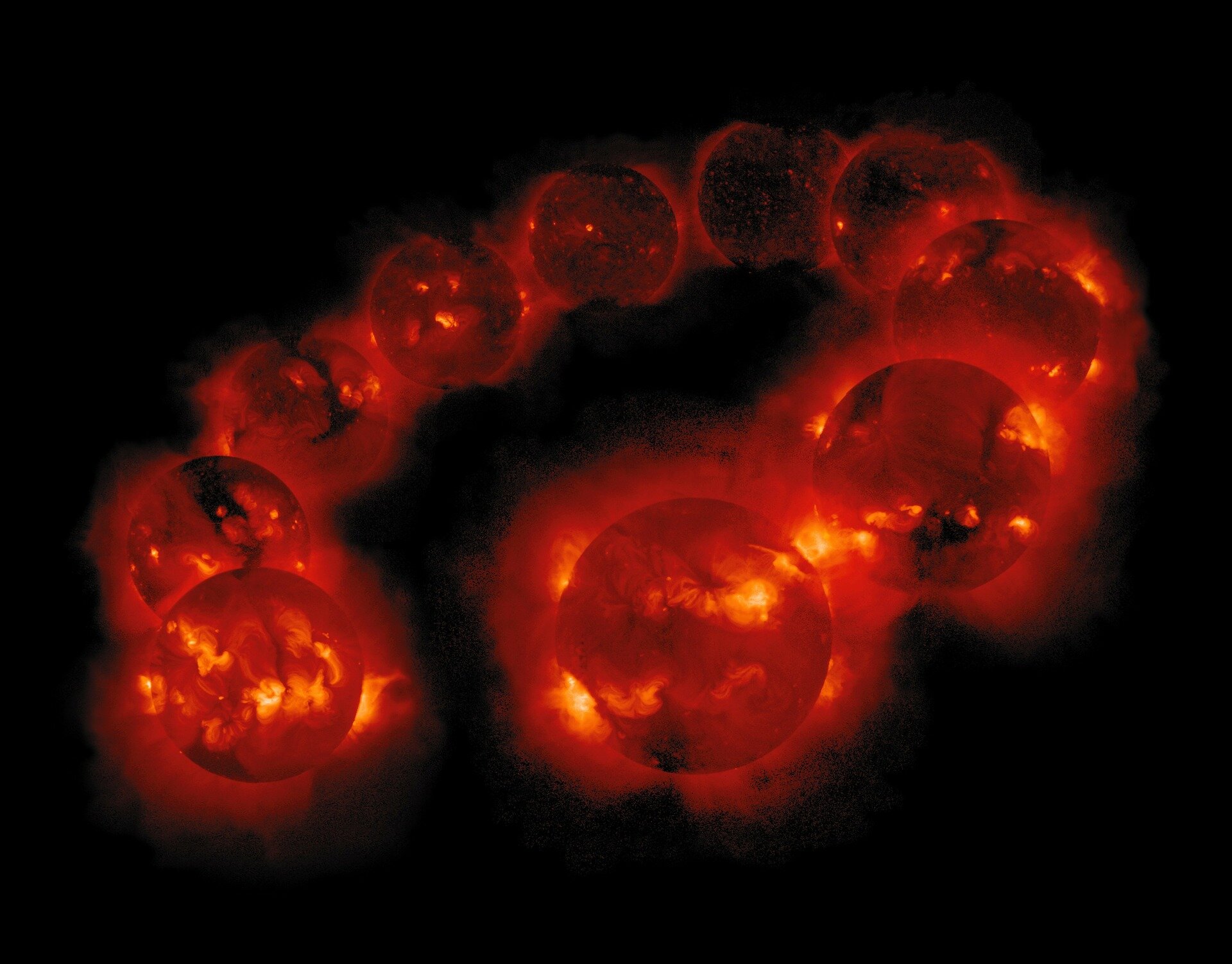
A visualization of the magnetic bands moving toward the equator and "terminating"
LEFT: Oppositely charged magnetic bands, represented in red and blue, march toward the equator over a 22-year period. When they meet at the equator, they annihilate one another.

RIGHT: The top animation shows the total sunspot number (black) and the contributions from the north (red) and south (blue) hemispheres. The bottom shows the location of the spots.

Scientists use an extended, 22-year solar cycle to make the forecast. In direct contradiction to the official forecast, a team of scientists led by the National Center for Atmospheric Research (NCAR) is predicting that the Sunspot Cycle that started this fall could be one of the strongest since record-keeping began.

In a new article published in Solar Physics, the research team predicts that Sunspot Cycle 25 will peak with a maximu...

Read More

Key Building Block for Organic Molecules discovered in Meteorites

The symmetric chemical structure of hexamethylenetetramine (HMT, left) and its electrostatic potential (right). (Yasuhiro Oba, et al. Nature Communications. December 7, 2020).

Scientists from Japan and the USA have confirmed the presence in meteorites of a key organic molecule which may have been used to build other organic molecules, including some used by life. The discovery validates theories of the formation of organic compounds in extraterrestrial environments.

The chemistry of life runs on organic compounds, molecules containing carbon and hydrogen, which also may include oxygen, nitrogen and other elements. While commonly associated with life, organic molecules also can be created by non-biological processes and are not necessarily indicators of life...

Read More

Researchers uncover key clues about the Solar System’s History

illustration of winds whipping around the sun.
Illustration of solar wind flowing over asteroids in the early solar system. The magnetic field of the solar wind (white line/arrows) magnetizes the asteroid (red arrow). Researchers at the University of Rochester used magnetism to determine, for the first time, when carbonaceous chondrite asteroids first arrived in the inner solar system. (University of Rochester illustration / Michael Osadciw)

In a new paper published in the journal Nature Communications Earth and Environment, researchers at the University of Rochester were able to use magnetism to determine, for the first time, when carbonaceous chondrite asteroids—asteroids that are rich in water and amino acids—first arrived in the inner solar system...

Read More