Category Astronomy/Space

Titan’s Lakes can Stratify like those on Earth

Saturn’s moon Titan hosts numerous small lakes, dried lakebeds, and disappearing lakes.
Credit: NASA/JPL-Caltech/ASI/USGS (Modified from original)

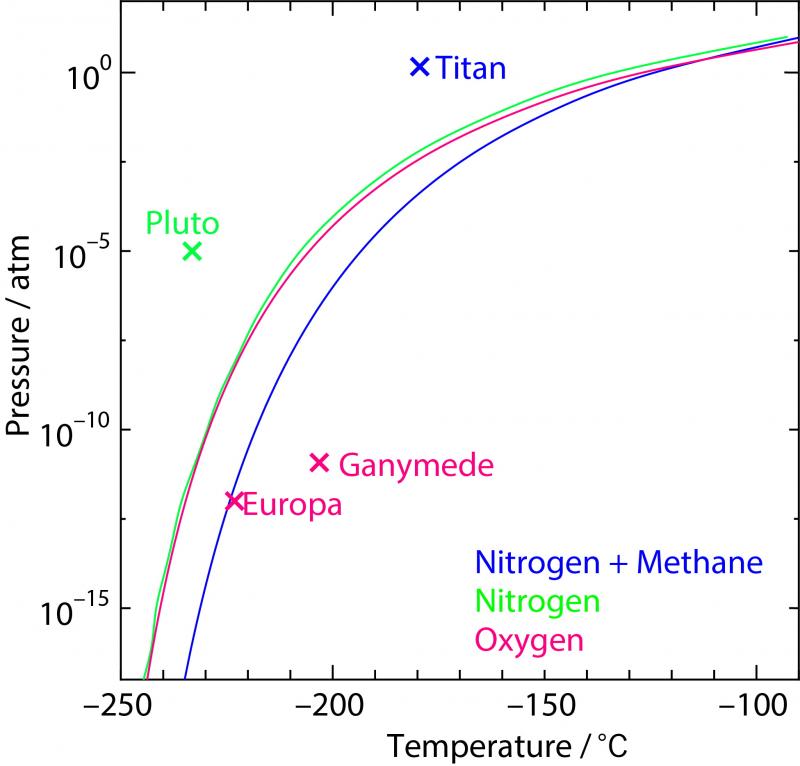
Lakes on Saturn’s moon Titan, composed of methane, ethane, and nitrogen rather than water, experience density driven stratification, forming layers similar to lakes on Earth. However, whereas lakes on Earth stratify in response to temperature, Titan’s lakes stratify solely due to the strange chemical interactions between its surface liquids and atmosphere, says a paper by Planetary Science Institute Research Scientist Jordan Steckloff.

Stratification occurs when different parts of a lake have different densities, with the less dense layer floating atop the denser layer...

Read More

Scientists Precisely Measure Total Amount of Matter in the Universe

The team determined that matter makes up about 31% of the total amount of matter and energy in the universe. Cosmologists believe about 20% of the total matter is made of regular — or “baryonic” matter — which includes stars, galaxies, atoms, and life, while about 80% is made of dark matter, whose mysterious nature is not yet known but may consist of some as-yet-undiscovered subatomic particle. (UCR/Mohamed Abdullah)

A top goal in cosmology is to precisely measure the total amount of matter in the universe, a daunting exercise for even the most mathematically proficient. A team led by scientists at the University of California, Riverside, has now done just that

Reporting in the Astrophysical Journal, the team determined that matter makes up 31% of the total amount of matter ...

Read More

First Candidate for an Extragalactic Planet identified

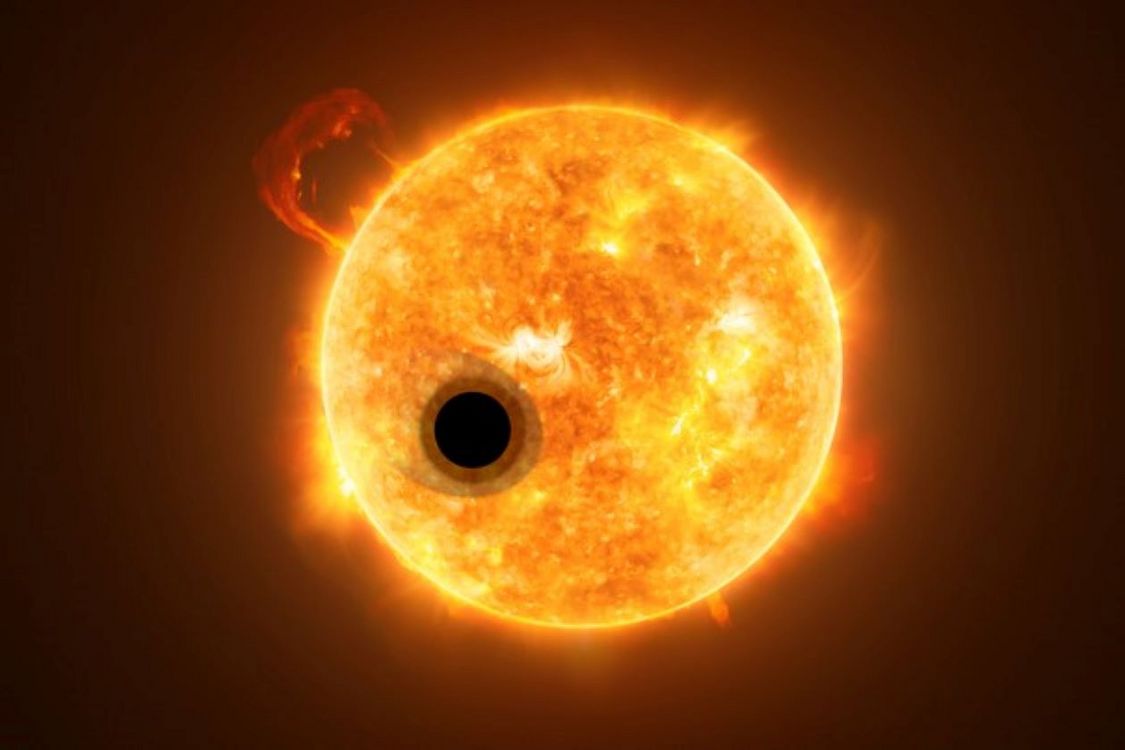
First candidate for a planet in an different galaxy identified
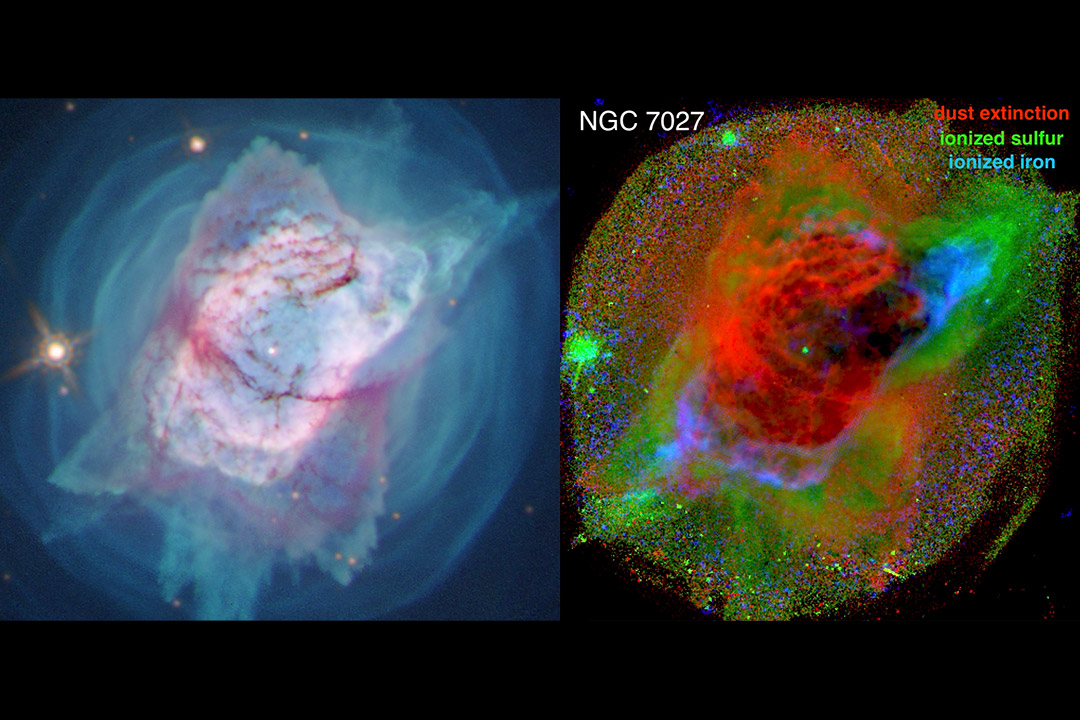
Left: false RGB stacked Chandra/ACIS-S image of the Whirlpool Galaxy, M 51 (total exposure of ≈850 ks). Colored points are XRSs: Red is 0.3-1 keV; green is 1-2 keV; blue is 2-7 keV. M 51-ULS1 is the orange source at the center of the 60” × 60” dashed white box. Diffuse emission is from hot gas. Right: HST image of the area defined by the white box in the top image. Red is the F814W band; green is F555W; blue is F435W. The magenta circle marks the X-ray position of M 51-ULS, which lies at the edge of a young star cluster. The source is located at right ascension and declination 13:29:43.30, +47:11:34.7, respectively. Credit: arXiv:2009.08987 [astro-ph.HE]

A team of researchers from the U.S. and China has found the first evidence for a candidate planet in another galaxy...

Read More

Shadow of Black Hole in M87 galaxy is wobbling and has been for a while

“Monitoring the Morphology of M87* in 2009-2017 with the Event Horizon Telescope,” M. Wielgus et al. 2020, Sept. 23, The Astrophysical Journal.

Analysis of previously unpublished data from observations of M87* between 2009 and 2013 by scientists at the Event Horizon Telescope (EHT) has revealed that the crescent shadow of the black hole is wobbling, and has rotated significantly over the past ten years of observation. Published today in The Astrophysical Journal, and led by scientists from the Center for Astrophysics | Harvard & Smithsonian (CfA), the study focused on the morphology of the black hole over time, and was made possible by advances in analysis and ml
“EHT can detect changes in the M87 morphology on timescales as short as a few days, but its general geometry should be constan...

Read More