This image combines 678 separate images taken by NSF–DOE Vera C. Rubin Observatory in just over seven hours of observing time. Combining many images in this way clearly reveals otherwise faint or invisible details, such as the clouds of gas and dust that comprise the Trifid nebula (top) and the Lagoon nebula, which are several thousand light-years away from Earth. More information about this image is available on RubinObservatory.org. Download Trifid and Lagoon at full resolution (24.14GB) Credit: NSF–DOE Vera C. Rubin Observatory
When you look up at the night sky, it appears unchanging. But if you look deep enough you will find that the sky is in fact constantly shifting. Satellites, asteroids and interstellar objects pass by...
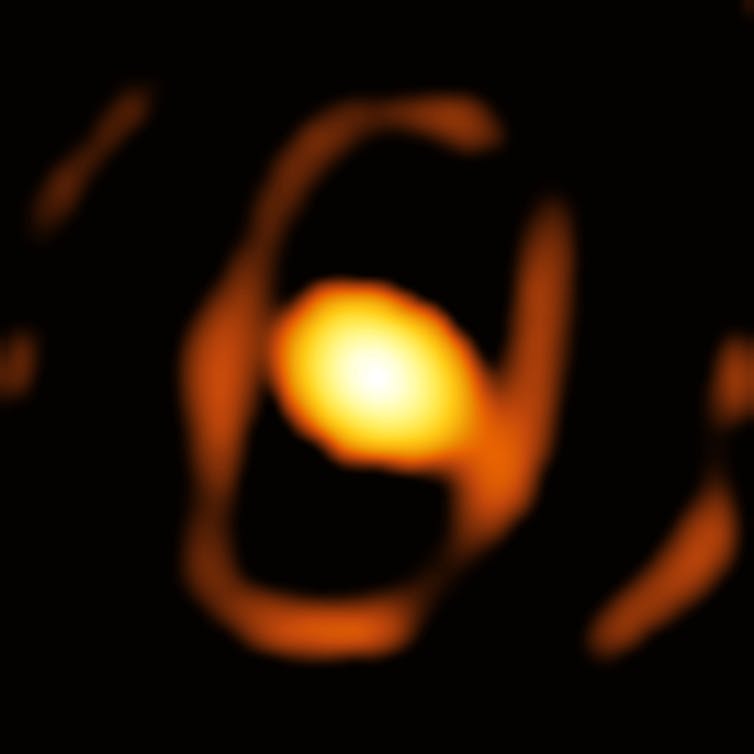
Image of WOH G64, taken by the GRAVITY instrument on the European Southern Observatory’s Very Large Telescope Interferometer (ESO’s VLTI). ESO/K. Ohnaka et al.
One of the largest known stars in the universe underwent a dramatic transformation in 2014, new research shows, and may be preparing to explode. A study led by Gonzalo Muñoz-Sanchez at the National Observatory of Athens, published in Nature Astronomy today, argues that the enormous star WOH G64 has transitioned from a red supergiant to a rare yellow hypergiant—in what may be evidence of an impending supernova.
The evidence suggests we may be witnessing, in real time, a massive star shedding its outer layers, shrinking as it heats up, and moving closer to the end of its short life.
Researchers, from left, Rebecca Booth, Anna Ordog and Alex Hill next to the telescope used to collect the data for their study. National Research Council of Canada/ Conseil National de Recherches Canada
A stunning new map of the Milky Way reveals a dramatic magnetic flip hiding in plain sight. Deep inside the Milky Way, an invisible force is quietly holding everything together — its magnetic field. Now, researchers have created one of the most detailed maps ever of this hidden structure, revealing surprising twists in how it flows through our galaxy.
For generations, scientists have studied the stars and planets to better understand how our galaxy works. Now, Dr. Jo-Anne Brown, PhD, is focused on charting something we cannot see at all: the Milky Way’s magnetic field.
Southwest Research Institute was part of an international team that demonstrated how complex organic molecules (COMs), key chemical precursors to life, could have been incorporated into Jupiter’s Galilean moons during their formation. The team’s findings have resulted in complementary studies published in The Planetary Science Journal and Monthly Notices of the Royal Astronomical Society, offering new insights into the potential for life in the Jovian system.
How complex organics can form Carbon-rich compounds containing oxygen, nitrogen and other elements are necessary for living matter to form...






Recent Comments