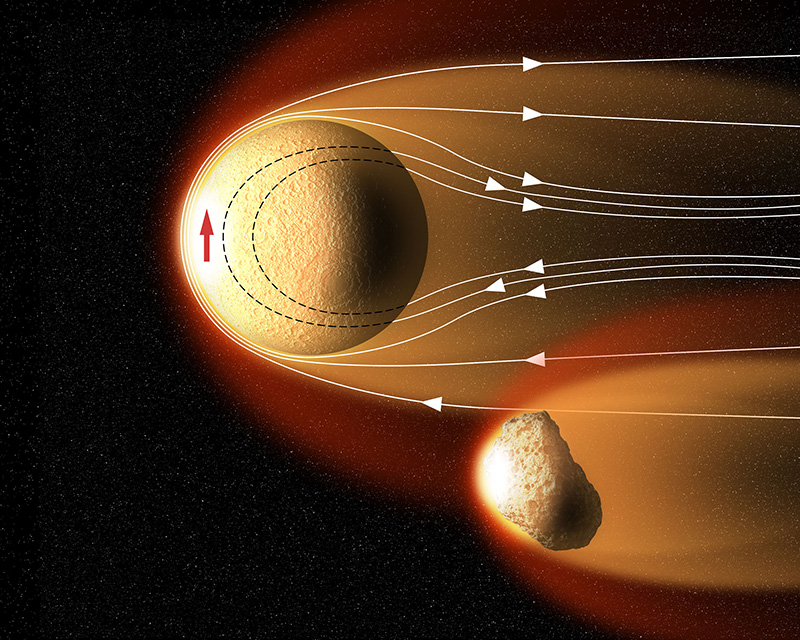
Illustration of solar wind flowing over asteroids in the early solar system. The magnetic field of the solar wind (white line/arrows) magnetizes the asteroid (red arrow). Researchers at the University of Rochester used magnetism to determine, for the first time, when carbonaceous chondrite asteroids first arrived in the inner solar system. (University of Rochester illustration / Michael Osadciw)
In a new paper published in the journal Nature Communications Earth and Environment, researchers at the University of Rochester were able to use magnetism to determine, for the first time, when carbonaceous chondrite asteroids—asteroids that are rich in water and amino acids—first arrived in the inner solar system...
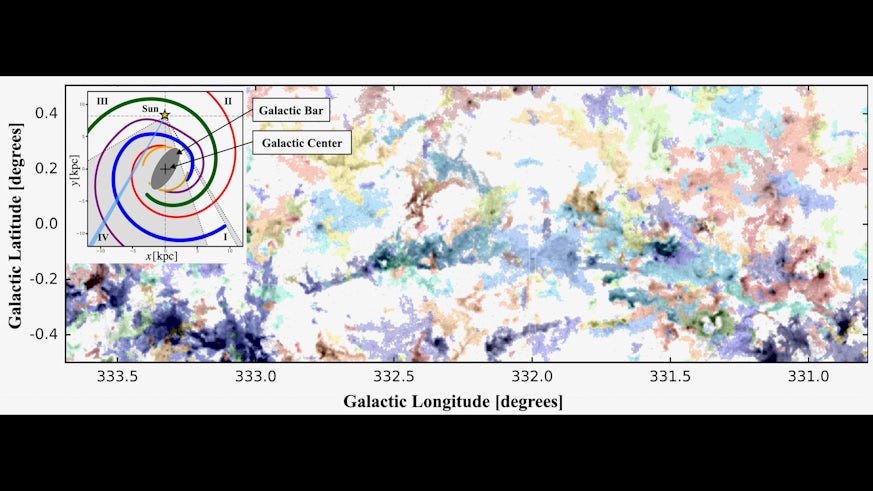
Survey of the sky pushes the boundaries of what we know about the structure of our galaxy. Scientists from Cardiff University have helped produce a brand-new, three-dimensional survey of our galaxy, allowing them to peer into the inner structure and observe its star-forming processes in unprecedented detail.
The large-scale survey, called SEDIGISM (Structure, Excitation and Dynamics of the Inner Galactic Interstellar Medium), has revealed a wide range of structures within the Milky Way, from individual star-forming clumps to giant molecular clouds and complexes, that will allow astronomers to start pushing the boundaries of what we know about the structure of our galaxy.
SEDIGISM has been unveiled today through the publication of three separate papers in the Monthly Notices of t...
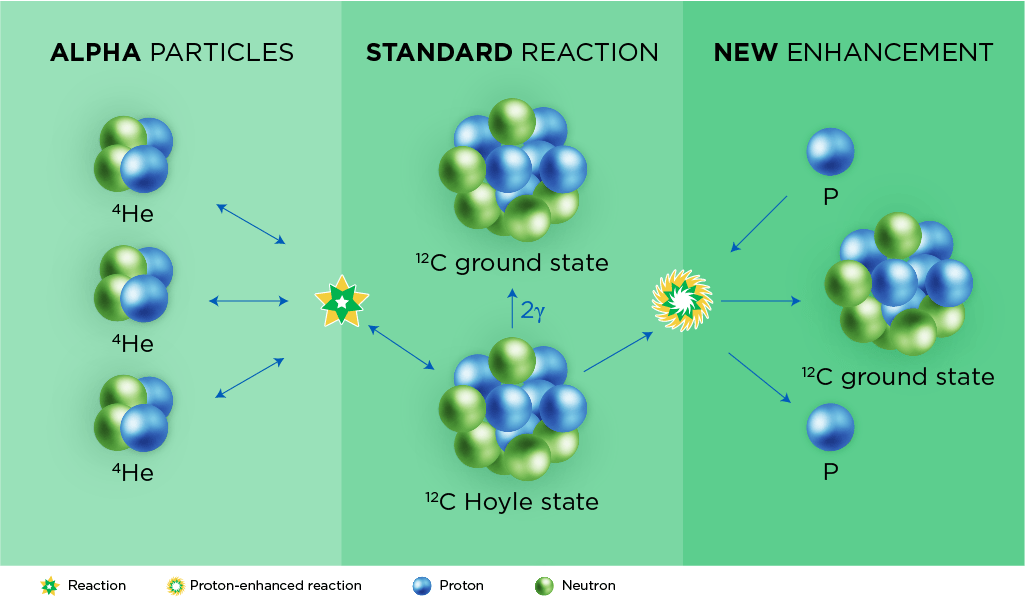
In the triple-alpha process, stars fuse three helium nuclei, also called alpha particles together (left) to create a single carbon atom with a surplus of energy, known as a Hoyle state. That Hoyle state can split back into three alpha particles or relax to the ground state of stable carbon by releasing a couple gamma rays (center). Inside supernovae, however, the creation of stable carbon can be enhanced with the help of extra protons (right). Credit: Facility for Rare Isotope Beams
Michigan State University (MSU) researchers have discovered that one of the most important reactions in the universe can get a huge and unexpected boost inside exploding star – supernovae.
This finding also challenges ideas behind how some of the Earth’s heavy elements are made...
Researchers led by the University of Tsukuba devise a new approach to show how ghost-like neutrinos helped shape the Universe
New approach to show how ghost-like neutrinos helped shape the Universe. Computer simulations have struggled to capture the impact of elusive particles called neutrinos on the formation and growth of the large-scale structure of the Universe. But now, a research team from Japan has developed a method that overcomes this hurdle.
In a study published this month in The Astrophysical Journal, researchers led by the University of Tsukuba present simulations that accurately depict the role of neutrinos in the evolution of the Universe.
Why are these simulations important? One key reason is that they can set constraints on a currently unknown quantity: the neutri...






Recent Comments