Category Astronomy/Space

New Cosmic Magnetic Field structures discovered in Galaxy NGC 4217

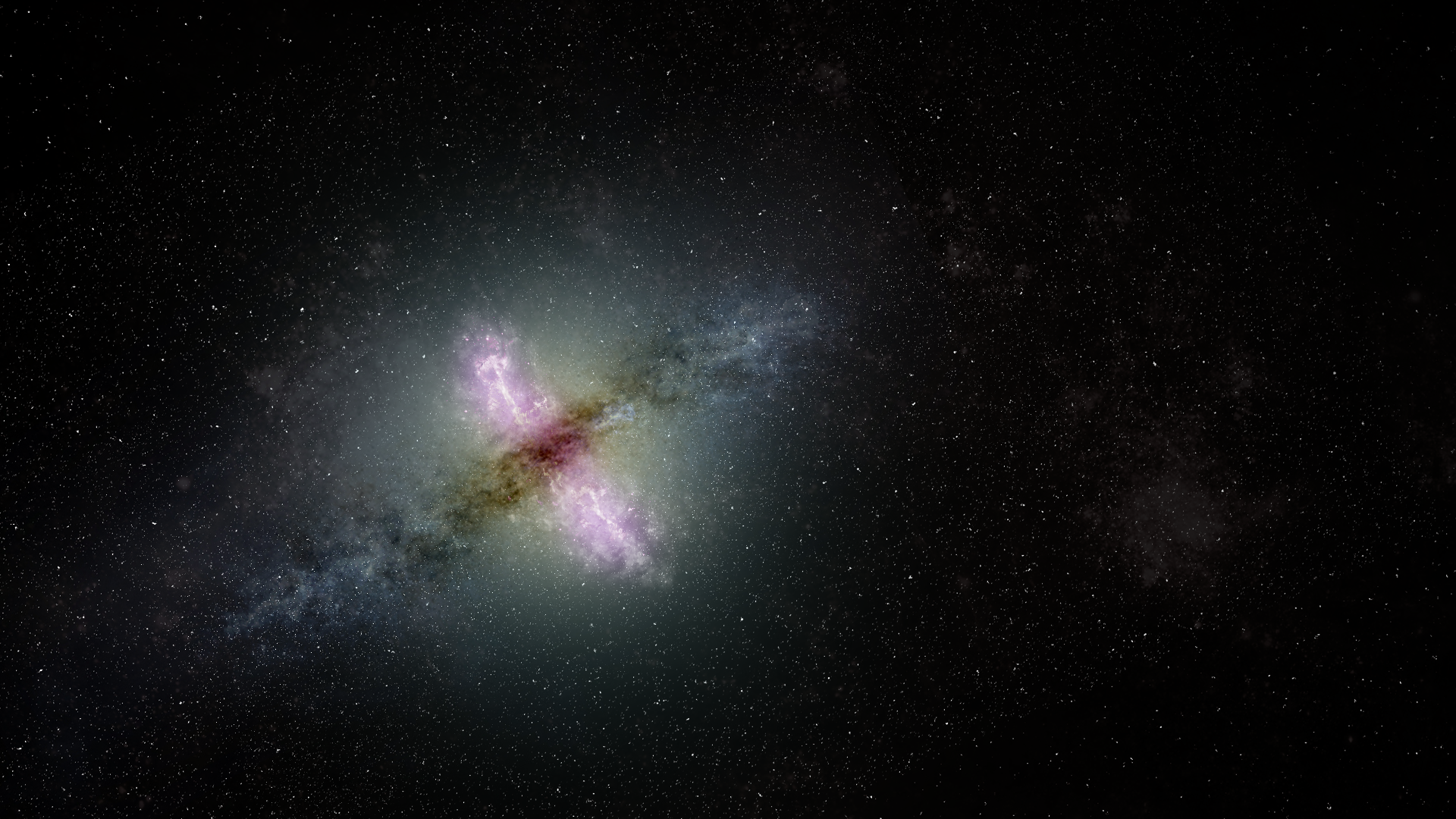
The spiral galaxy NGC 4217 has a huge magnetic field that is shown here as green lines. The data for this visualisation were recorded with the radio telescope Karl G. Jansky Very Large Array (VLA) of the National Science Foundation. The image of the galaxy shown from the side is taken from data from the Sloan Digital Sky Survey and Kitt Peak National Observatory.

Superbubbles, giant loops and X-shaped magnetic field structures – this galaxy boasts a veritable wealth of shapes. Spiral galaxies such as our Milky Way can have sprawling magnetic fields. There are various theories about their formation, but so far the process is not well understood...

Read More

Scientists discover Volcanoes on Venus are still Active

In the global map of Venus above, active coronae appear in red and inactive coronae appear in white. (Image courtesy Anna Gülcher)
In the global map of Venus, active coronae appear in red and inactive coronae appear in white (Image courtesy of Anna Gulcher)

New 3D model provides evidence that Venus is churning inside. A new study identified 37 recently active volcanic structures on Venus. The study provides some of the best evidence yet that Venus is still a geologically active planet. A research paper on the work, which was conducted by researchers at the University of Maryland and the Institute of Geophysics at ETH Zurich, Switzerland, was published in the journal Nature Geoscience on July 20, 2020.

“This is the first time we are able to point to specific structures and say ‘Look, this is not an ancient volcano but one that is active today, dormant perhaps, but not dead,'” said Laurent Montési, a professor of...

Read More

Could Mini-Neptunes be Irradiated Ocean Planets?

Mini-Neptune

New research suggests that the low density of mini-Neptunes could be explained simply by the presence of a thick layer of water. Many exoplanets known today are ‘super-Earths’, with a radius 1.3 times that of Earth, and ‘mini-Neptunes’, with 2.4 Earth radii. Mini-Neptunes, which are less dense, were long thought to be gas planets, made up of hydrogen and helium.

Now, scientists at the Laboratoire d’Astrophysique de Marseille (CNRS/Aix-Marseille Université/Cnes)(1) have examined a new possibility, namely that the low density of mini-Neptunes could be explained simply by the presence of a thick layer of water that experiences an intense greenhouse effect caused by the irradiation from their host star.

These findings, recently published in The Astrophysical Journal Let...

Read More

New insight into the Origin of Water on the Earth

Organic matter in nebula could be the source of terrestrial water. Photo: NASA, ESA, and the Hubble Heritage Team (STScI/AURA)

Scientists have found the interstellar organic matter could produce an abundant supply of water by heating, suggesting that organic matter could be the source of terrestrial water.

There remains a number of mysteries on our planet including the elusive origin of water on the earth. Active studies suggested that terrestrial water had been delivered by icy comets or meteorites containing hydrous silicates that came from outside the “snow line” – the boundary beyond which ice can condense due the low temperatures...

Read More