Category Astronomy/Space

Gigantic, Red and full of Spots

Three Paths to Red Giants with Spots. (Image: MPs) 

About eight percent of red giants are covered by sunspot-like, dark areas; these stars rotate faster than others of their kind. Starspots are more common among red giant stars than previously thought. Astronomers report that approximately eight percent of red giants exhibit such spots. Although red giants are generally regarded as slowly rotating stars, those with starspots are apparently an exception. The new publication offers a comprehensive analysis of the reasons for their short rotation periods.

Among the Sun’s most striking features are its sunspots, relatively darker areas compared to the rest of the surface, some of which are visible from Earth even without magnification...

Read More

Scientists propose plan to determine if Planet Nine is a Primordial Black Hole

Artist’s conception of accretion flares resulting from the encounter of an Oort-cloud comet and a hypothesized black hole in the outer solar system..
Credit: M. Weiss

Scientists at Harvard University and the Black Hole Initiative (BHI) have developed a new method to find black holes in the outer solar system, and along with it, determine once-and-for-all the true nature of the hypothesized Planet Nine. The paper, accepted to The Astrophysical Journal Letters, highlights the ability of the future Legacy Survey of Space and Time (LSST) mission to observe accretion flares, the presence of which could prove or rule out Planet Nine as a black hole.

Dr. Avi Loeb, Frank B. Baird Jr...

Read More

Two bizarre Brown Dwarfs found with Citizen Scientists’ help

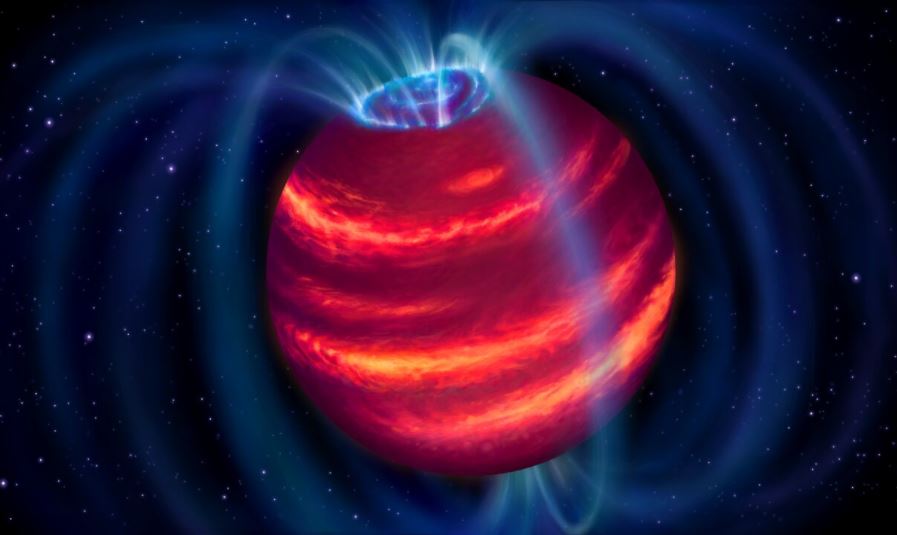
This is an illustration of a brown dwarf. Despite their name, brown dwarfs would appear magenta or orange-red to the human eye if seen close up. Credits: William Pendrill

With the help of citizen scientists, astronomers have discovered two highly unusual brown dwarfs, balls of gas that are not massive enough to power themselves the way stars do.

Participants in the NASA-funded Backyard Worlds: Planet 9 project helped lead scientists to these bizarre objects, using data from NASA’s Near-Earth Object Wide-Field Infrared Survey Explorer (NEOWISE) satellite along with all-sky observations collected between 2009 and 2011 under its previous moniker, WISE...

Read More

A New Telescope to Study Solar Flares

Credit: CC0 Public Domain

The cold, dark chaos of space is filled with mystery. Fortunately, the ways in which we can peer into the mists of the void are increasing, and now include Kyoto University’s 3.8 meter Seimei telescope.

Using this new instrument—located on a hilltop in Okayama to the west of Kyoto—astronomers from Kyoto University’s Graduate School of Science and the National Astronomical Observatory of Japan have succeeded in detecting 12 stellar flare phenomena on AD Leonis, a red dwarf 16 light years away. In particular, one of these flares was 20 times larger than those emitted by our own sun.

“Solar flares are sudden explosions that emanate from the surfaces of stars, including our own sun,” explains first author Kosuke Namekata.

“On rare occasions, an extrem...

Read More