Category Astronomy/Space

Monster Black Hole found in the Early Universe

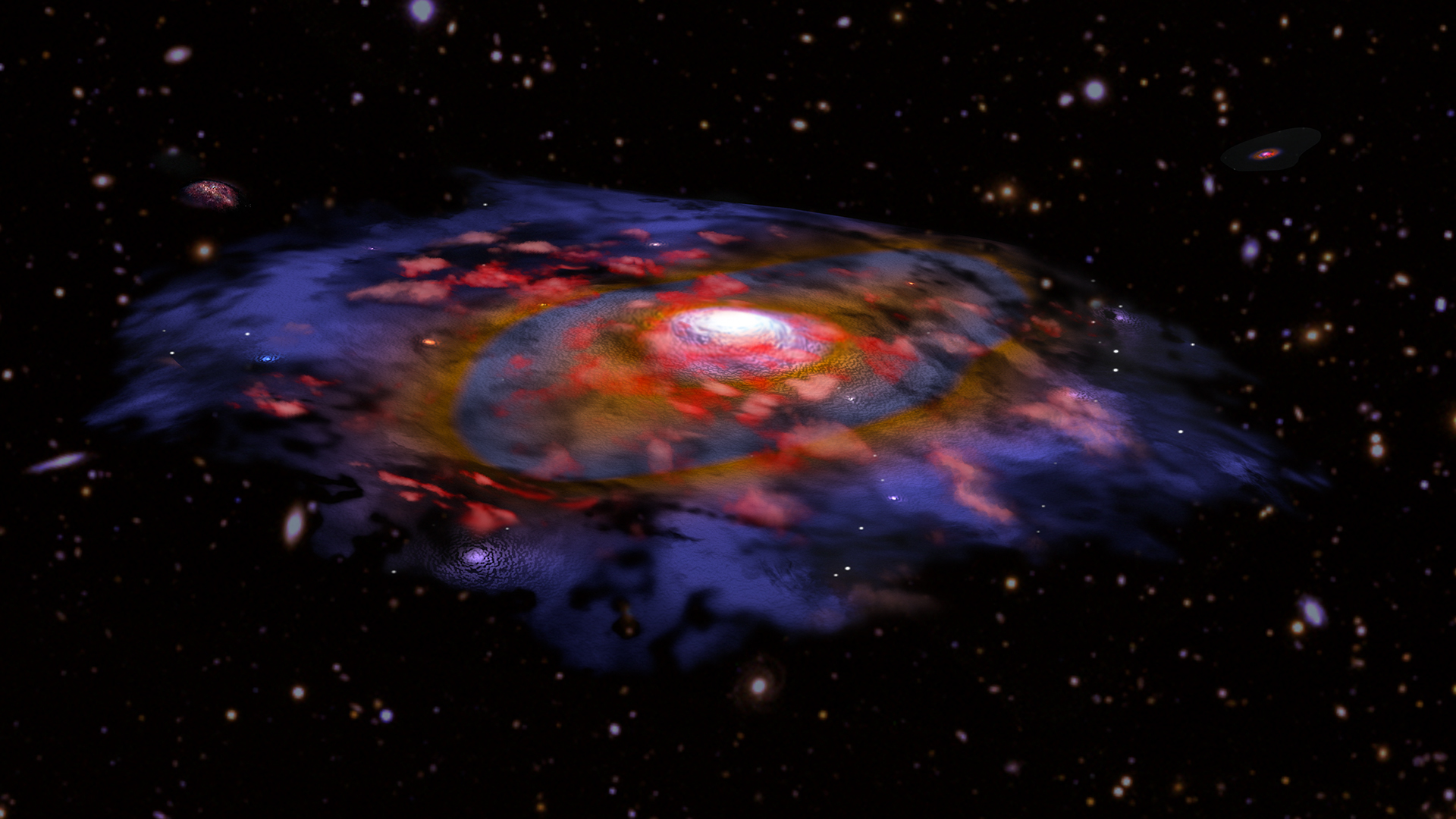
QUASAR J1007+2115, OR PŌNIUĀʻENA
Credit: International Gemini Observatory/NOIRLab/NSF/AURA/P. Marenfeld

The second-most distant quasar ever discovered now has a Hawaiian name. Astronomers have discovered the second-most distant quasar ever found using three Maunakea Observatories in Hawai’i: W. M. Keck Observatory, the international Gemini Observatory, a Program of NSF’s NOIRLab, and the University of Hawai’i-owned United Kingdom Infrared Telescope (UKIRT). It is the first quasar to receive an indigenous Hawaiian name, Poniua’ena, which means “unseen spinning source of creation, surrounded with brilliance” in the Hawaiian language.

Poniua’ena is only the second quasar yet detected at a distance calculated at a cosmological redshift greater than 7...

Read More

‘Mystery Object’ in space may be Smallest Black Hole

An artistic rendering shows a mysterious object roughly 800 million light-years from Earth detected using gravitational wave sensors, which is either one of the smallest black holes or one of the largest neutron stars so far discovered. The Advanced Virgo detector at the European Gravitational Observatory (EGO) in Italy and two wave observatories in the US discovered the object last year and calculated it to weigh around 2.6 times our own Sun. /AFP

Read more: https://technology.inquirer.net/101448/mystery-object-in-space-may-be-smallest-black-hole#ixzz6Qn1BZtG1
Follow us: @inquirerdotnet on Twitter | inquirerdotnet on Facebook

A mysterious object roughly 800 million light-years from Earth detected using gravitational wave sensors is either one of the smallest black holes or one of the la...

Read More

Hubble watches the ‘Flapping’ of Cosmic Bat Shadow in the Serpens Nebula

The young star HBC 672 is known by its nickname of Bat Shadow because of its wing-like shadow feature. The NASA/ESA Hubble Space Telescope has now observed a curious “flapping” motion in the shadow of the star’s disc for the first time. The star resides in a stellar nursery called the Serpens Nebula, about 1300 light-years away.

The young star HBC 672 is known by its nickname of Bat Shadow because of its wing-like shadow feature. The NASA/ESA Hubble Space Telescope has now observed a curious “flapping” motion in the shadow of the star’s disc for the first time. The star resides in a stellar nursery called the Serpens Nebula, about 1300 light-years away.

The Hubble Space Telescope captured a striking observation of the fledgling star’s unseen, planet-forming disc in 2018...

Read More

Origin of Life: Which Came First?

Proteins with primitive arginine-based proteins (right) might have been capable of self-assembly and phase separation to create cell-like droplets

An experiment in recreating primordial proteins solves a long-standing riddle. What did the very first proteins look like — those that appeared on Earth around 3.7 billion years ago? Prof. Dan Tawfik of the Weizmann Institute of Science and Prof. Norman Metanis of the Hebrew University of Jerusalem have reconstructed protein sequences that may well resemble those ancestors of modern proteins, and their research suggests a way that these primitive proteins could have progressed to forming living cells. Their findings were published in the Proceedings of the National Academy of Sciences (PNAS).

The proteins encoded in a cell’s genet...

Read More