Category Astronomy/Space

Astronomers detect Most Energetic Outflow from a Distant Quasar

noirlab2009a. The image at left shows an artist’s conception of the central portion of the galaxy that hosts the quasar SDSS J135246.37+423923.5 viewed at optical wavelengths. Thick winds obscure our view, and imprint signatures of the energetic outflow on the SDSS spectrum. The image at right shows the same artist’s view at infrared wavelengths, as seen by the Gemini GNIRS detector. The thick outflow is transparent at infrared wavelengths, giving us a clear line of sight to the quasar. The infrared spectrum yields the quasar redshift, and from that reference frame, we measured the record-breaking outflow velocity. Credit: International Gemini Observatory/NOIRLab/NSF/AURA/P. Marenfeld

Researchers using the Gemini North telescope on Hawai’i’s Maunakea have detected the most energeti...

Read More

NASA missions help reveal the power of Shock waves in a Nova Explosion

V906 Carinae (circled) shines near peak brightness in this image taken on March 23, 2018, three days after the nova was discovered. The beautiful cloud of gas and dust dominating the picture is part of the Carina Nebula.
Credits: Copyright 2018 by A. Maury and J. Fabrega, used with permission

Unprecedented observations of a nova outburst in 2018 by a trio of satellites, including two NASA missions, have captured the first direct evidence that most of the explosion’s visible light arose from shock waves — abrupt changes of pressure and temperature formed in the explosion debris.

A nova is a sudden, short-lived brightening of an otherwise inconspicuous star...

Read More

Scientists discover Supernova that Outshines all others

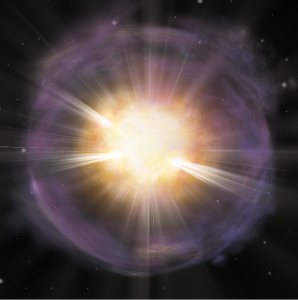
Artist’s impression of a supernova. Credit: Aaron Geller (Northwestern University)

A supernova at least twice as bright and energetic, and likely much more massive than any yet recorded has been identified by an international team of astronomers, led by the University of Birmingham.

The team, which included experts from Harvard, Northwestern University and Ohio University, believe the supernova, dubbed SN2016aps, could be an example of an extremely rare ‘pulsational pair-instability’ supernova, possibly formed from two massive stars that merged before the explosion. Their findings are published today in Nature Astronomy.

Such an event so far only exists in theory and has never been confirmed through astronomical observations.

Dr...

Read More

New images reveal Fine Threads of Million-degree Plasma Woven throughout the Sun’s Atmosphere

Credit: University of Central Lancashire

Researchers at the University of Central Lancashire (UCLan) unveil highest-ever resolution images of the Sun from NASA’s solar sounding rocket mission

Newly released images of the Sun have revealed that its outer layer is filled with previously unseen, incredibly fine magnetic threads filled with extremely hot, million-degree plasma. The high-resolution observations have been analysed by researchers at UCLan alongside collaborators from NASA’s Marshall Space Flight Centre (MSFC) and will provide astronomers with a better understanding of how the Sun’s magnetised atmosphere exists, and what it is comprised of.

Until now, certain parts of the Sun’s atmosphere had appeared dark or mostly empty, but new images have revealed strands that are ar...

Read More