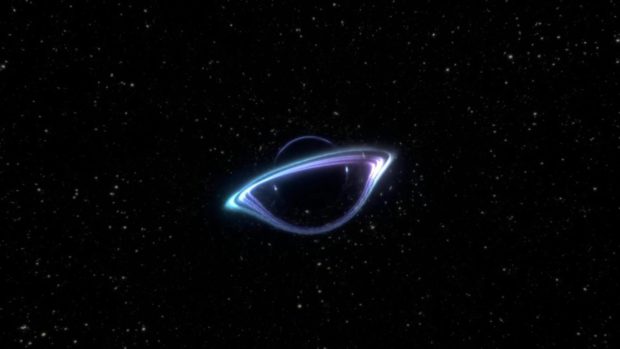
An artistic rendering shows a mysterious object roughly 800 million light-years from Earth detected using gravitational wave sensors, which is either one of the smallest black holes or one of the largest neutron stars so far discovered. The Advanced Virgo detector at the European Gravitational Observatory (EGO) in Italy and two wave observatories in the US discovered the object last year and calculated it to weigh around 2.6 times our own Sun. /AFP
A mysterious object roughly 800 million light-years from Earth detected using gravitational wave sensors is either one of the smallest black holes or one of the la...
The young star HBC 672 is known by its nickname of Bat Shadow because of its wing-like shadow feature. The NASA/ESA Hubble Space Telescope has now observed a curious “flapping” motion in the shadow of the star’s disc for the first time. The star resides in a stellar nursery called the Serpens Nebula, about 1300 light-years away.
The young star HBC 672 is known by its nickname of Bat Shadow because of its wing-like shadow feature. The NASA/ESA Hubble Space Telescope has now observed a curious “flapping” motion in the shadow of the star’s disc for the first time. The star resides in a stellar nursery called the Serpens Nebula, about 1300 light-years away.
The Hubble Space Telescope captured a striking observation of the fledgling star’s unseen, planet-forming disc in 2018...
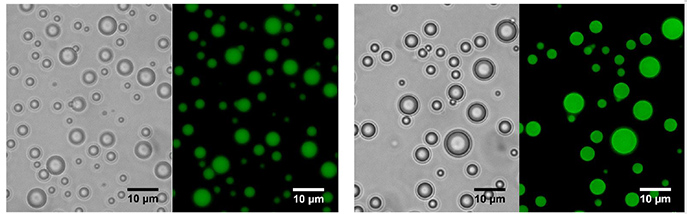
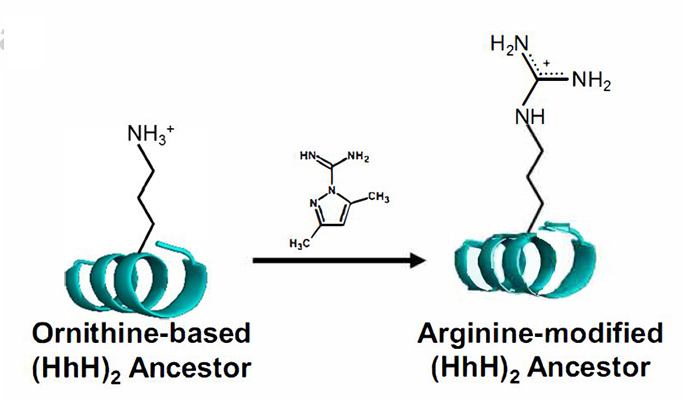
Proteins with primitive arginine-based proteins (right) might have been capable of self-assembly and phase separation to create cell-like droplets
An experiment in recreating primordial proteins solves a long-standing riddle. What did the very first proteins look like — those that appeared on Earth around 3.7 billion years ago? Prof. Dan Tawfik of the Weizmann Institute of Science and Prof. Norman Metanis of the Hebrew University of Jerusalem have reconstructed protein sequences that may well resemble those ancestors of modern proteins, and their research suggests a way that these primitive proteins could have progressed to forming living cells. Their findings were published in the Proceedings of the National Academy of Sciences (PNAS).
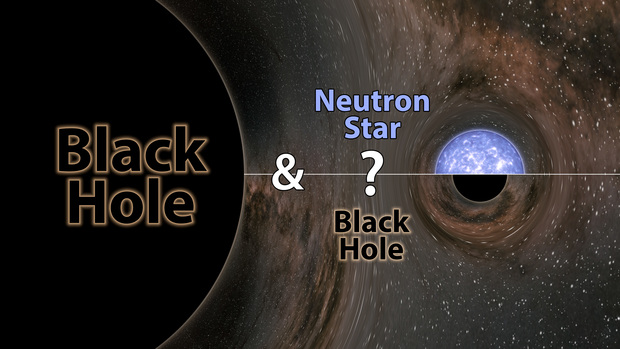
In August of 2019, the LIGO-Virgo gravitational-wave network witnessed the merger of a black hole with 23 times the mass of our sun and a mystery object 2.6 times the mass of the sun. Scientists do not know if the mystery object was a neutron star or black hole, but either way it set a record as being either the heaviest known neutron star or the lightest known black hole. Image credit: LIGO/Caltech/MIT/R. Hurt (IPAC)
Researchers have discovered what is either the heaviest known neutron star, or the lightest black hole. When the most massive stars die, they collapse under their own gravity and leave behind black holes; when stars that are a bit less massive die, they explode in supernovas and leave behind dense, dead remnants of stars called neutron stars...






Recent Comments