Category Astronomy/Space

Researchers make new discoveries set to reveal the Geology of Planets Outside our Solar System

Dispersed Matter Planet Project target selection area

Three OU astronomers today announced groundbreaking discoveries allowing scientists to understand planets outside the solar system. Professor Carole Haswell, Dr. Daniel Staab and Dr. John Barnes discovered three, new, nearby planetary systems. Research led by Professor Haswell found the exoplanets—planets outside the solar system—as part of the Dispersed Matter Planet Project (DMPP).

The project was funded by the UK Science and Technology Facilities Council and includes an international team of researchers. The project team used the High Accuracy Radial Velocity Planet Searcher (HARPS), a high-precision planet-finding spectrograph, on the European Southern Observatory’s 3...

Read More

Massive Gas Disk raises questions about Planet Formation Theory

20191223_Higuchi_49Ceti_ALMA_separated_E
ALMA image of the debris disk around the young star 49 Ceti. The distribution of dust is shown in red; the distribution of carbon monoxide is shown in green; and the distribution of carbon atoms is shown in blue.
Credit: ALMA (ESO/NAOJ/NRAO), Higuchi et al.

Astronomers using the Atacama Large Millimeter/submillimeter Array (ALMA) found a young star surrounded by an astonishing mass of gas. The star, called 49 Ceti, is 40 million years old and conventional theories of planet formation predict that the gas should have disappeared by that age. The enigmatically large amount of gas requests a reconsideration of our current understanding of planet formation.

Planets are formed in gaseous dusty disks called protoplanetary disks around young stars...

Read More

Nightside Barrier gently Brakes ‘Bursty’ Plasma Bubbles

An image from a magnetohydrodynamic simulation by the Gamera project at the Johns Hopkins Applied Physics Laboratory shows bursty flows (in red and brown) in the plasma sheet. Rice University space plasma physicists developed algorithms to measure the buoyancy waves that appear in thin filaments of magnetic flux on Earth’s nightside. Credit: K. Sorathia/JHUAPL

Physicists extend Rice Convection Model with details of magnetospheric buoyancy waves. The solar wind that pummels the Earth’s dayside magnetosphere causes turbulence, like air over a wing. Physicists at Rice University have developed new methods to characterize how that influences space weather on the nightside.

It’s rarely quiet up there...

Read More

Spitzer studies a Stellar Playground with a Long History

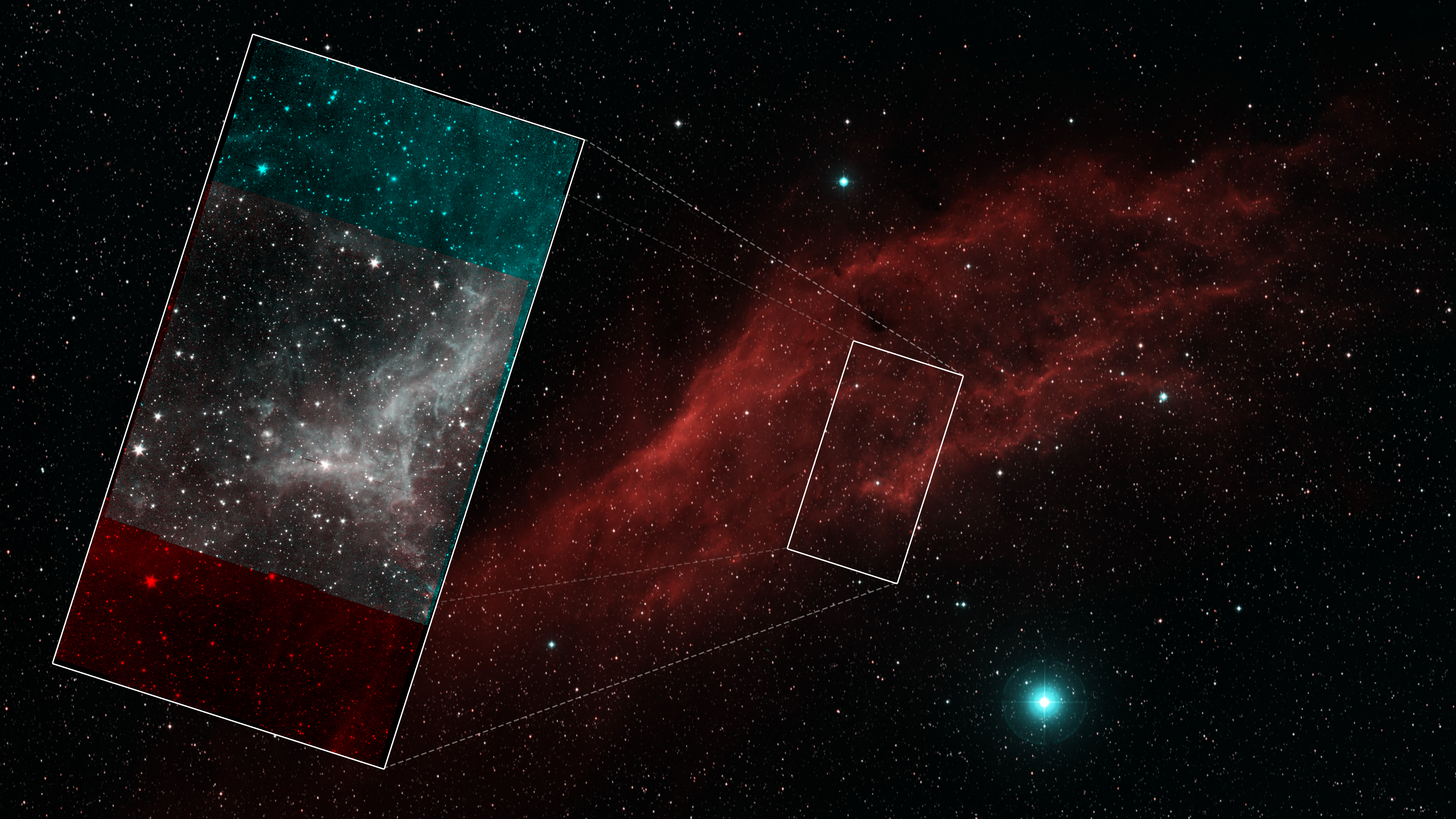
A collection of gas and dust over 500 light-years across, the Perseus Molecular Cloud hosts an abundance of young stars. It was imaged here by the NASA’s Spitzer Space Telescope. Credit: NASA/JPL-Caltech

This image from NASA’s Spitzer Space Telescope shows the Perseus Molecular Cloud, a massive collection of gas and dust that stretches over 500 light-years across. Home to an abundance of young stars, it has drawn the attention of astronomers for decades.

Spitzer’s Multiband Imaging Photometer (MIPS) instrument took this image during Spitzer’s “cold mission,” which ran from the spacecraft’s launch in 2003 until 2009, when the space telescope exhausted its supply of liquid helium coolant. (This marked the beginning of Spitzer’s “warm mission...

Read More