Category Astronomy/Space

Mapping our Galaxy’s Magnetic Field

A representation of how our Galaxy would look in the sky if we could see magnetic fields. The plane of the Galaxy runs horizontally through the middle, and the Galactic centre direction is the middle of the map. Red–pink colours show increasing Galactic magnetic field strengths where the direction is pointing towards the Earth. Blue–purple colours show increasing Galactic magnetic field strengths where the direction is pointing away from the Earth. The background shows the signal reconstructed using sources outside our Galaxy. The points show the current measurements for pulsars. The squares show the measurements from this work using LOFAR pulsar observations. Credit: Freshscience

Astronomers from CSIRO and Curtin University have used pulsars to probe the Milky Way’s magnetic fie...

Read More

A surprisingly Big Black Hole might have Swallowed a Star from the Inside Out, and scientists are baffled

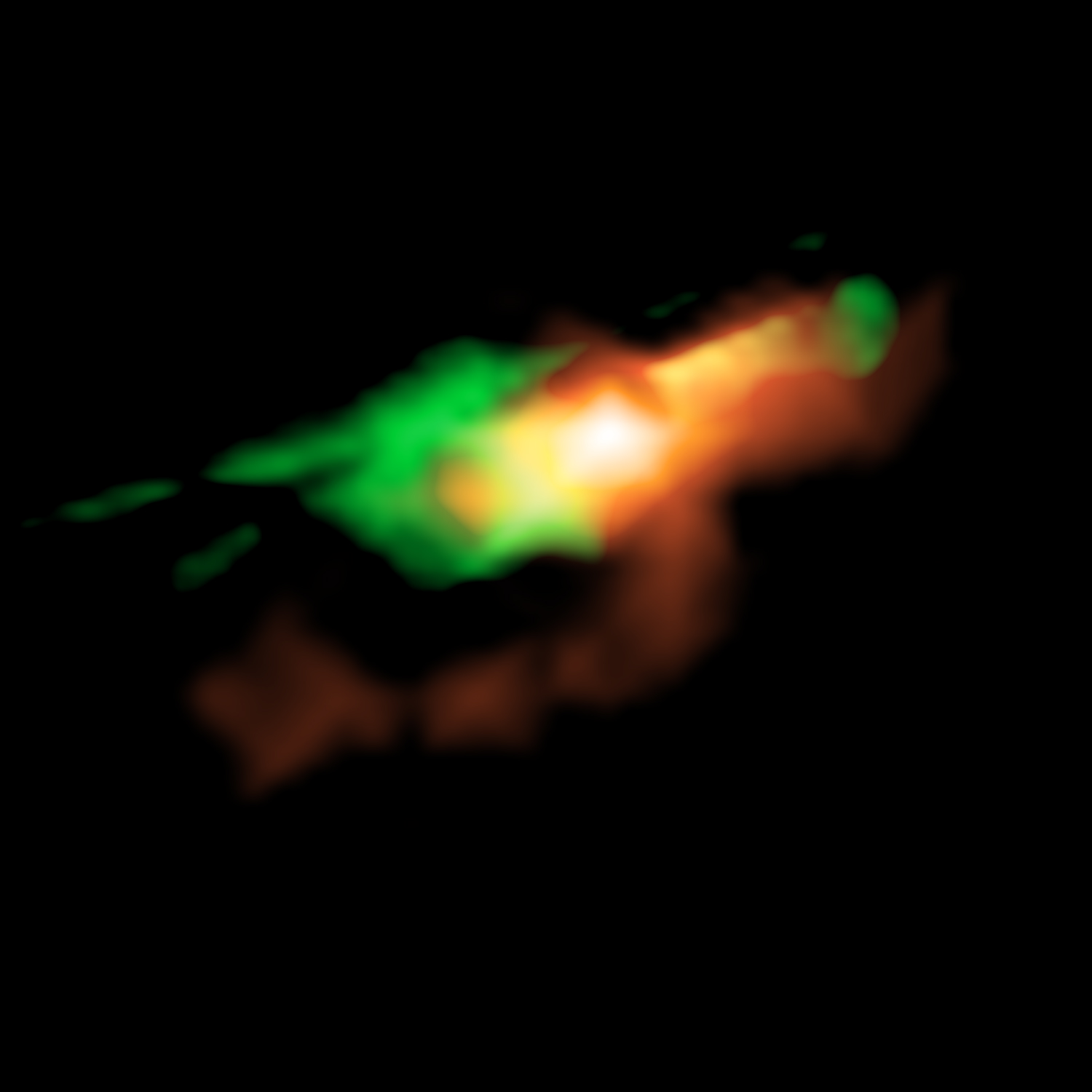
A recently discovered black hole – found by the way it makes a nearby star wobble – is hard to square with our understanding of how these dark cosmic objects form. Credit: NAOC, Chinese Academy of Sciences

About 15,000 light years away, in a distant spiral arm of the Milky Way, there is a black hole about 70 times as heavy as the Sun. The black hole seems too big to be the product of a single star collapsing, which poses questions for our theories of how black holes form.

Our team, led by Professor Jifeng Liu at the National Astronomical Observatories, Chinese Academy of Sciences, has dubbed the mysterious object LB-1.

Astronomers estimate that our galaxy alone contains about 100 million black holes, created when massive stars have collapsed over the past 13 billion years.

...Read More

A new theory for how Black Holes and Neutron Stars Shine Bright

Here, a massive super-computer simulation shows the strong particle density fluctuations that occur in the extreme turbulent environments that host black holes and neutron stars. Dark blue regions are low particle density regions, while yellow regions are strongly over-dense regions. Particles are accelerated to extremely high speeds due to the interactions with strongly turbulence fluctuations in this environment. Credit: Image from published study

Astrophysicists employed massive super-computer simulations to calculate the mechanisms that accelerate charged particles in extreme environments. They concluded their energization is powered by the interplay of chaotic motion and reconnection of super-strong magnetic fields.

For decades, scientists have speculated about the origin of ...

Read More

Hints of a Volcanically Active Exo-Moon

Artist’s composition of a volcanic exo-Io undergoing extreme mass loss. The hidden exomoon is enshrouded in an irradiated gas cloud shining in bright orange-yellow, as would be seen with a sodium filter. Patches of sodium clouds are seen to trail the lunar orbit, possibly driven by the gas giant’s magnetosphere.© University of Bern, Illustration: Thibaut Roger

A rocky extrasolar moon (exomoon) with bubbling lava may orbit a planet 550 light-years away from us. This is suggested by an international team of researchers on the basis of theoretical predictions matching observations. The ‘exo-Io’ would appear to be an extreme version of Jupiter’s moon Io.

Jupiter’s moon Io is the most volcanically active body in our solar system...

Read More