Category Astronomy/Space

Supernova observation first of its kind using NASA Satellite

Supernova Explosion, ASASSN-18tb

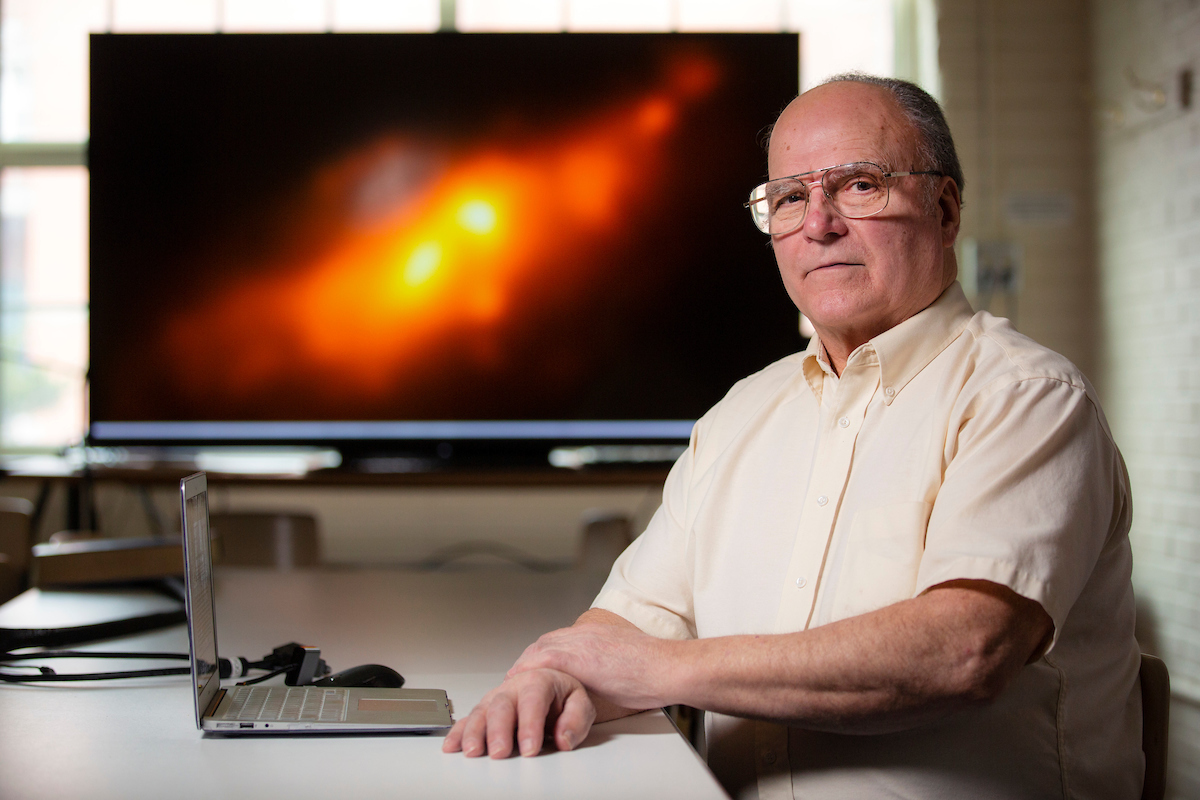
Data offer new clues about why stars explode. A team of astronomers at The Ohio State University showed that the satellite survey TESS, could be used to monitor a particular type of supernova, giving scientists more clues about what causes white dwarf stars to explode – and about the elements those explosions leave behind.

“We have known for years that these stars explode, but we have terrible ideas of why they explode,” said Patrick Vallely, lead author of the study and an Ohio State astronomy graduate student...

Read More

A material way to make Mars Habitable

Mars north pole illustration (stock image).
Credit: © Dan Marsh / Adobe Stock

Silica aerogel could warm the Martian surface similar to the way greenhouse gasses keep Earth warm. New research suggests that regions of the Martian surface could be made habitable with a material – silica aerogel – that mimics Earth’s atmospheric greenhouse effect. Through modeling and experiments, the researchers show that a 2- to 3-centimeter-thick shield of silica aerogel could transmit enough visible light for photosynthesis, block hazardous UV radiation, and raise temperatures underneath permanently above the melting point of water, all without the need for any internal heat source.

Carl Sagan was the first outside of the realm of science fiction to propose terraforming...

Read More

Alternating Currents cause Jupiter’s Aurora

Magnetic field perturbations and electron observations
Magnetic field perturbations δBϕ (shown in white) and electron observations (JADE and JEDI) between 0.1 keV and 1 MeV obtained during PJ6 from 06:42 to 07:07 ut. a, Electron differential number flux (or intensity) as function of energy versus time summed over all JADE-E and JEDI look directions. JADE-E is the JADE sensor measuring energies from 0.1 keV to 100 keV. The black vertical arrows represent upward respectively downward currents in the regions separated by the vertical dashed lines based on the Birkeland current model on Fig. 3. b, Pitch angle versus time spectrogram summed over all JADE-E energies (0.1 keV to 100 keV). c, Pitch angle versus time spectrogram summed over all JEDI energies (30 keV to 1 MeV).
Magnetic field perturbations and electron observations.

An international research team has measured the system of currents that generates Jupiter’s aurora. The scientists found out that sulphur dioxide gas from the gas giant’s Moon Io is the cause of the system of currents. Using data transmitted to Earth by NASA’s Juno spacecraft, they showed that the direct currents were much weaker than expected and that alternating currents must therefore play a special role. On Earth, on the other hand, a direct current system creates its aurora. Jupiter’s electric current system is kept going in particular by large centrifugal forces, which hurl ionized sulfur dioxide gas from the gas giant’s moon Io through the magnetosphere.

Professor Dr Joachim Saur from the Institute of Geophysics and Me...

Read More

Exactly how Fast is the Universe Expanding?

Radio wave observations and model of fireball from neutron star collision
The collision of two neutron stars flung out an extraordinary fireball of material and energy that is allowing a Princeton-led team of astrophysicists to calculate the Hubble constant, the speed of the universe’s expansion. They used a super-high-resolution radio “movie” (left) that they compared to a computer model (right)

Astrophysicists are closing in on the Hubble constant. The collision of two neutron stars (GW170817) flung out an extraordinary fireball of material and energy that is allowing a a team of astrophysicists to calculate a more precise value for the Hubble constant, the speed of the universe’s expansion. Previous estimates put the value between 66 and 90 km/s/Mpc, which this team refined to between 65.3 and 75.6 km/s/Mpc.

Exactly how fast is the universe e...

Read More