Category Astronomy/Space

Galaxy Blazes with New Stars born from close encounter

New image of irregular galaxy NGC 4485 captured by Hubble’s Wide Field Camera 3 (WFC3) and Advanced Camera for Surveys (ACS).
Credit: NASA and ESA; Acknowledgment: T. Roberts (Durham University, UK), D. Calzetti (University of Massachusetts) and the LEGUS Team, R. Tully (University of Hawaii), and R. Chandar (University of Toledo)

The irregular galaxy NGC 4485 shows all the signs of having been involved in a hit-and-run accident with a bypassing galaxy. Rather than destroying the galaxy, the chance encounter is spawning a new generation of stars, and presumably planets.

The right side of the galaxy is ablaze with star formation, shown in the plethora of young blue stars and star-incubating pinkish nebulas. The left side, however, looks intact...

Read More

ALMA discovers Aluminum around young star

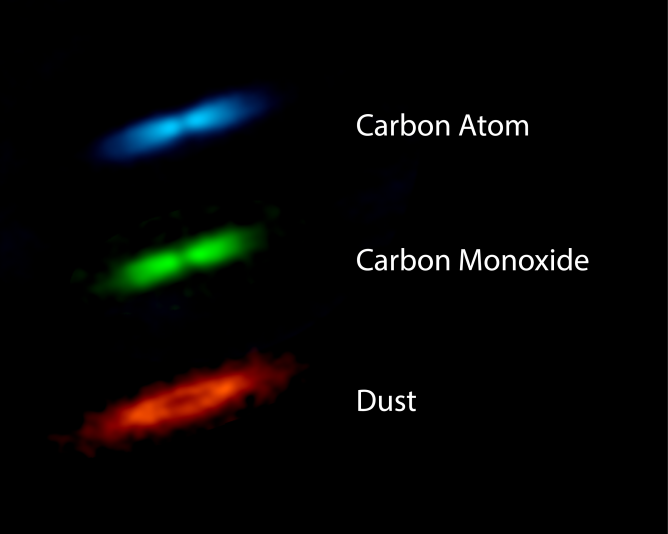
ALMA image of the distributions of AlO molecules (color) and warm dust particles (contours). The molecular outflow (not shown in this image) extends from the center to the top-left and bottom-right

Researchers using ALMA data discovered an aluminum-bearing molecule for the first time around a young star. Aluminum rich inclusions found in meteorites are some of the oldest solid objects formed in the Solar System, but their formation process and stage is still poorly linked to star and planet formation. The discovery of aluminum oxide around a young star provides a crucial chance to study the early formation process of meteorites and planets like Earth.

Young stars are surrounded by disks of gas...

Read More

Small, Hardy Planets most likely to Survive Death of their Stars

White dwarf illustration.
Credit: © Dreamframer / Adobe Stock

Small, hardy planets packed with dense elements have the best chance of avoiding being crushed and swallowed up when their host star dies, new research from the University of Warwick has found.

Astrophysicists from the Astronomy and Astrophysics Group have modelled the chances of different planets being destroyed by tidal forces when their host stars become white dwarfs and have determined the most significant factors that decide whether they avoid destruction.

Their ‘survival guide’ for exoplanets could help guide astronomers locate potential exoplanets around white dwarf stars, as a new generation of even more powerful telescopes is being developed to search for them...

Read More

New Water Cycle on Mars discovered

Billions of years ago, Mars could have looked like this with an ocean covering part of its surface. Credit: NASA/GSFC

Approximately every two Earth years, when it is summer on the southern hemisphere of Mars, a window opens: Only in this season can water vapor efficiently rise from the lower into the upper Martian atmosphere. There, winds carry the rare gas to the north pole. While part of the water vapor decays and escapes into space, the rest sinks back down near the poles. Researchers from the Moscow Institute of Physics and Technology and the Max Planck Institute for Solar System Research (MPS) in Germany describe this unusual Martian water cycle in a current issue of the Geophysical Research Letters...

Read More