
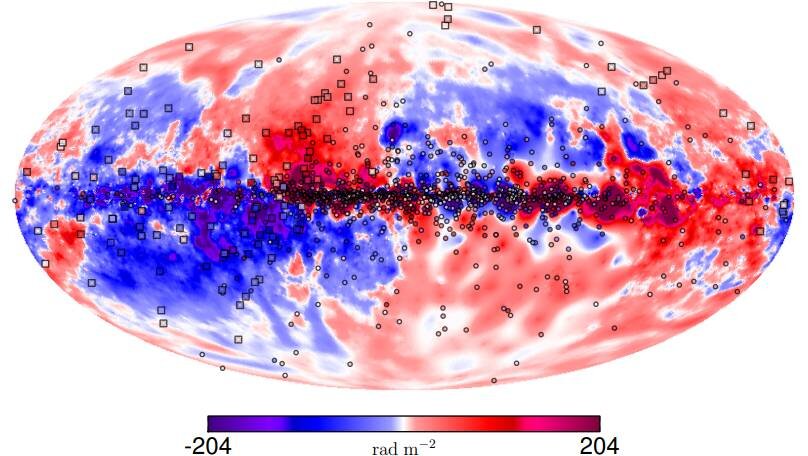
Astronomers from CSIRO and Curtin University have used pulsars to probe the Milky Way’s magnetic fie...
Read More

December 2, 2019,
 Astronomy/Space
Astronomers from CSIRO and Curtin University have used pulsars to probe the Milky Way’s magnetic fie...
Read More
December 2, 2019,
Astronomy/Space
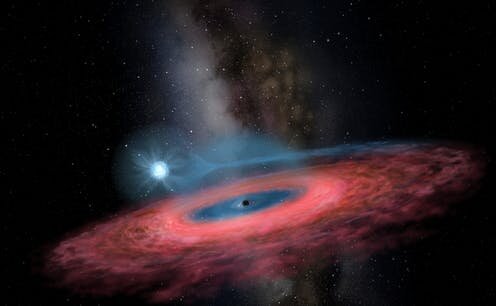
About 15,000 light years away, in a distant spiral arm of the Milky Way, there is a black hole about 70 times as heavy as the Sun. The black hole seems too big to be the product of a single star collapsing, which poses questions for our theories of how black holes form.
Our team, led by Professor Jifeng Liu at the National Astronomical Observatories, Chinese Academy of Sciences, has dubbed the mysterious object LB-1.
Astronomers estimate that our galaxy alone contains about 100 million black holes, created when massive stars have collapsed over the past 13 billion years.
...Read More
Astrophysicists employed massive super-computer simulations to calculate the mechanisms that accelerate charged particles in extreme environments. They concluded their energization is powered by the interplay of chaotic motion and reconnection of super-strong magnetic fields.
For decades, scientists have speculated about the origin of ...
Read More
August 30, 2019,
Astronomy/Space

A rocky extrasolar moon (exomoon) with bubbling lava may orbit a planet 550 light-years away from us. This is suggested by an international team of researchers on the basis of theoretical predictions matching observations. The ‘exo-Io’ would appear to be an extreme version of Jupiter’s moon Io.
Jupiter’s moon Io is the most volcanically active body in our solar system...
Read More
Recent Comments