Category Astronomy/Space

Mercury has a Solid Inner Core: New Evidence

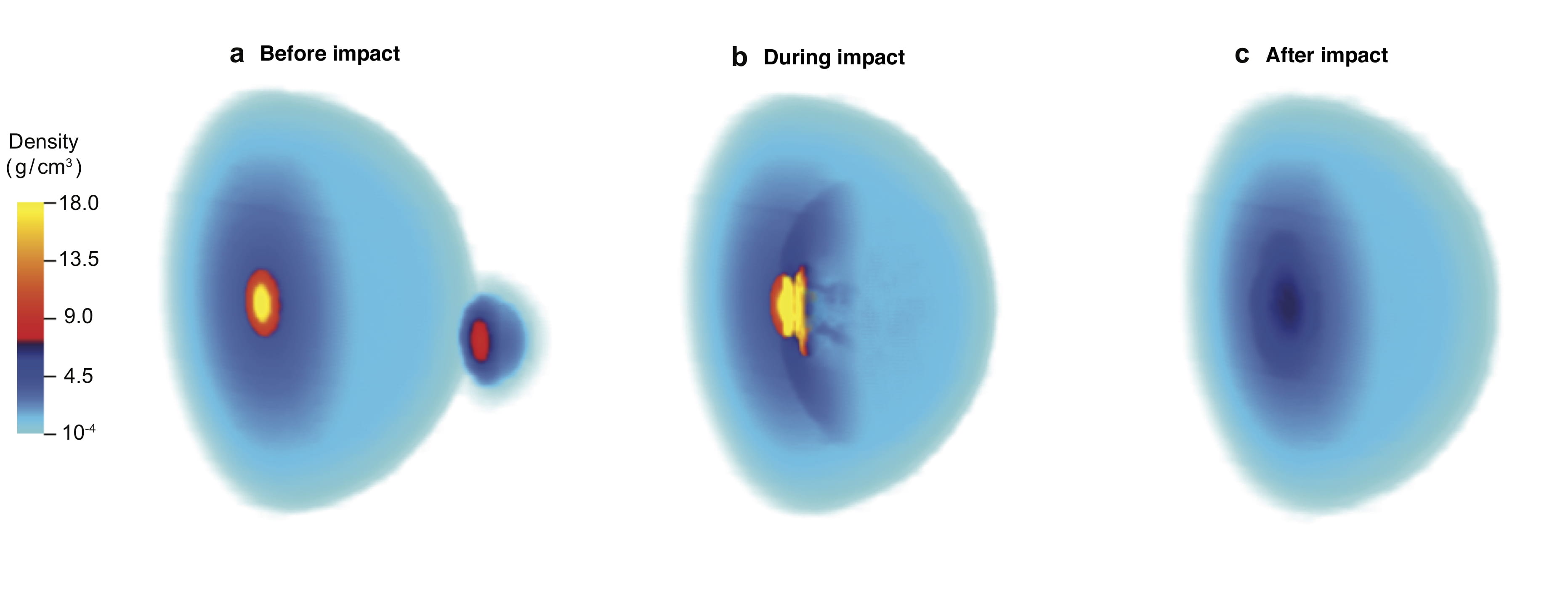
An illustration of Mercury’s interior based on new research that shows the planet has a solid inner core.
Credit: Antonio Genova

Scientists have long known that Earth and Mercury have metallic cores. Like Earth, Mercury’s outer core is composed of liquid metal, but there have only been hints that Mercury’s innermost core is solid. Now, in a new study, scientists report evidence that Mercury’s inner core is indeed solid and that it is very nearly the same size as Earth’s solid inner core.

Some scientists compare Mercury to a cannonball because its metal core fills nearly 85% of the volume of the planet. This large core – huge compared to the other rocky planets in our solar system – has long been one of the most intriguing mysteries about Mercury...

Read More

Astronomers discover 3rd planet in the Kepler-47 Circumbinary system


This is an artistic rendition of the Kepler-47 circumbinary planet system. The three planets with the large middle planet being the newly discovered Kepler47d.
Credit: NASA/JPLCaltech/T. Pyle

Astronomers have discovered a third planet in the Kepler-47 system, securing the system’s title as the most interesting of the binary-star worlds. Using data from NASA’s Kepler space telescope, a team of researchers, led by astronomers at San Diego State University, detected the new Neptune-to-Saturn-size planet orbiting between two previously known planets.

With its three planets orbiting two suns, Kepler-47 is the only known multi-planet circumbinary system. Circumbinary planets are those that orbit two stars.

The planets in the Kepler-47 system were detected via the “transit method...

Read More

TESS finds its 1st Earth-sized Planet

This is an artist’s conception of HD 21749c, the first Earth-sized planet found by NASA’s Transiting Exoplanets Survey Satellite (TESS), as well as its sibling, HD 21749b, a warm sub-Neptune-sized world.
Credit: Illustration by Robin Dienel, courtesy of the Carnegie Institution for Science

A nearby system hosts the first Earth-sized planet discovered by NASA’s Transiting Exoplanets Survey Satellite, as well as a warm sub-Neptune-sized world, according to a new paper from a team of astronomers that includes Carnegie’s Johanna Teske, Paul Butler, Steve Shectman, Jeff Crane, and Sharon Wang.

“It’s so exciting that TESS, which launched just about a year ago, is already a game-changer in the planet-hunting business,” said Teske, who is second author on the paper...

Read More

NASA’s landmark Twins Study reveals Resilience of Human Body in space

Results from NASA’s landmark Twins Study, which took place from 2015-2016, were published Thursday in Science. The integrated paper – encompassing work from 10 research teams – reveals some interesting, surprising and reassuring data about how one human body adapted to – and recovered from – the extreme environment of space.

The Twins Study provides the first integrated biomolecular view into how the human body responds to the spaceflight environment, and serves as a genomic stepping stone to better understand how to maintain crew health during human expeditions to the Moon and Mars.

Retired NASA astronauts Scott Kelly and his identical twin brother Mark, participated in the investigation, conducted by NASA’s Human Research Program...

Read More