

Astronomers have obtained the sharp...
Read More

January 6, 2026,
 Astronomy/Space
Astronomers have obtained the sharp...
Read More
January 6, 2026,
Astronomy/Space
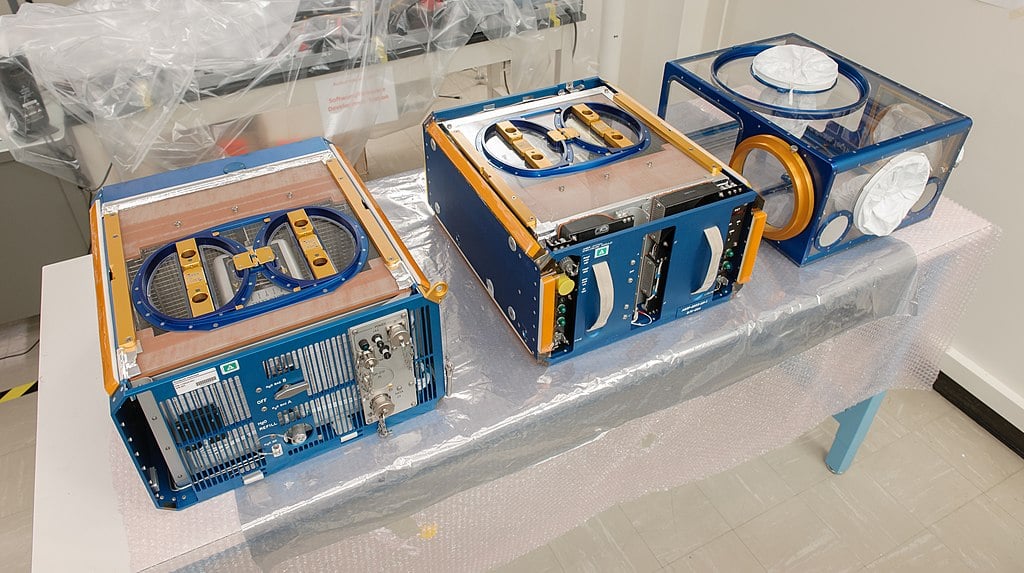
Four mice went to space as astronauts. One came back and became a mother. And that simple fact might matter more than you’d think for humanity’s future beyond Earth.
On 31 October, China launched four mice numbered 6, 98, 154, and 186, aboard the Shenzhou-21 spacecraft to the country’s space station, roughly 400 kilometers above Earth. For two weeks, the rodents lived in microgravity, exposed to space radiation and the peculiar conditions of orbital life. They returned safely on 14 November. Then, on 10 December, one of the females gave birth to nine healthy pups.
In a previous study, sperm from mice that had been in space had been used to fertilize female mice back ...
Read More
January 5, 2026,
Astronomy/Space

The only way astronomers have been able to detect rogue planets is through microlensing events caused by the slight gravitational effect of an object on background light. This occurs when the light from a distant star suddenly appears magnified to an observer (telescopes on Earth), as if a lens were placed in front of it. The magnification of light lets astronomers know that something has passed in front of the distant star.
Theoretically, microlensing can allow for the calculation of the mass of the object passing in front of the star by analyzing how much the light was bent and thus magnified...
Read More
January 2, 2026,
Astronomy/Space

Dark matter is an elusive type of matter that does not emit, absorb or reflect light, interacting very weakly with ordinary matter. These characteristics make it impossible to detect using conventional technologies used by physicists to study matter particles.
As it has never been observed before, the exact composition of dark matter remains unknown. One proposed theory is that this elusive type of matter is comprised of light particles with very small masses, below 1 eV (electronvolt), which behave more like waves than particles.
Researchers at the University of Tokyo and Chuo University recently explored the possibility of searching for sub-GeV dark matter using quantum sensors, advanced systems that rely on quantum mechanical effects to detect ex...
Read More
Recent Comments