This gigantic image of the Triangulum Galaxy – also known as Messier 33 – is a composite of about 54 different pointings with Hubble’s Advanced Camera for Surveys. With a staggering size of 34 372 times 19 345 pixels, it is the second-largest image ever released by Hubble. It is only dwarfed by the image of the Andromeda Galaxy, released in 2016. Credit: NASA, ESA, and M. Durbin, J. Dalcanton, and B. F. Williams (University of Washington)
The NASA/ESA Hubble Space Telescope has captured the most detailed image yet of a close neighbour of the Milky Way – the Triangulum Galaxy, a spiral galaxy located at a distance of only 3 million light-years...
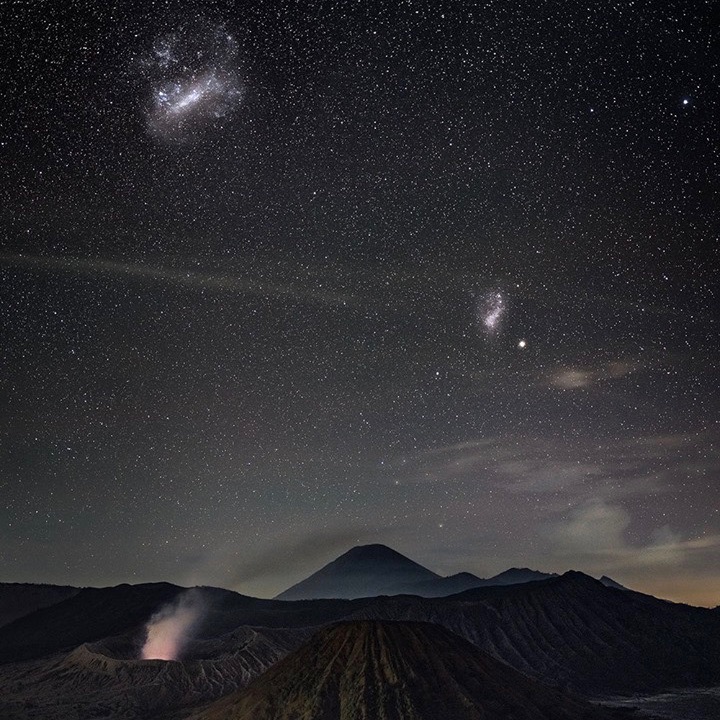
New research led by astrophysicists at Durham University, UK, predicts that the Large Magellanic Cloud (LMC) could hit the Milky Way in two billion years’ time. The collision could occur much earlier than the predicted impact between the Milky Way and another neighbouring galaxy, Andromeda, which scientists say will hit our galaxy in eight billion years.
The catastrophic coming together with the Large Magellanic Cloud could wake up our galaxy’s dormant black hole, which would begin devouring surrounding gas and increase in size by up to ten times.
As it feeds, the now-active black hole would throw out high-energy radiation and while these cosmic fireworks are unlikely to a...
In the coming decades, massive segmented space telescopes may be launched to peer even closer in on far-out exoplanets and their atmospheres. To keep these mega-scopes stable, MIT researchers say that small satellites can follow along, and act as “guide stars,” by pointing a laser back at a telescope to calibrate the system, to produce better, more accurate images of distant worlds. In the coming decades, massive segmented space telescopes may be launched to peer even closer in on far-out exoplanets and their atmospheres. To keep these mega-scopes stable, MIT researchers say that small satellites can follow along, and act as “guide stars,” by pointing a laser back at a telescope to calibrate the system, to produce better, more accurate images of distant worlds. Credit: Christine D...Read More
Rice University graduate student Tom Langin makes an adjustment to an experiment that uses 10 lasers of varying wavelengths to laser-cool ions in a neutral plasma. Credit: Photo by Brandon Martin/Rice University
Rice University physicists have created the world’s first laser-cooled neutral plasma, completing a 20-year quest that sets the stage for simulators that re-create exotic states of matter found inside Jupiter and white dwarf stars. The findings are detailed this week in the journal Science and involve new techniques for laser cooling clouds of rapidly expanding plasma to temperatures about 50 times colder than deep space.
“We don’t know the practical payoff yet, but every time physicists have laser cooled a new kind of thing, it has opened a whole world of possibilities,” said ...






Recent Comments