Category Astronomy/Space

Massive Astrophysical Objects Governed by Subatomic Equation

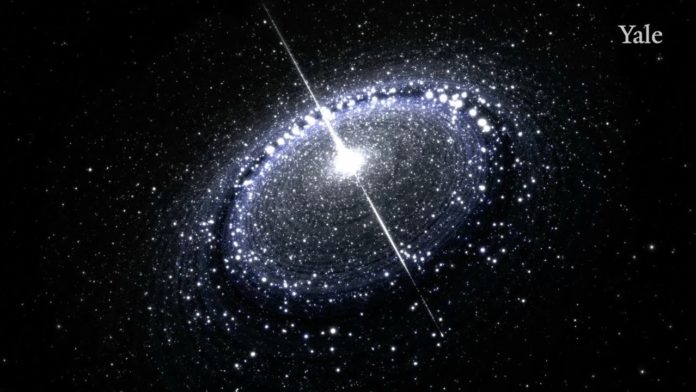
Schrödinger in Space: An artist's impression of research presented in Batygin (2018), MNRAS 475, 4. Propagation of waves through an astrophysical disk can be understood using Schrödinger's equation - a cornerstone of quantum mechanics. Credit: James Tuttle Keane, California Institute of Technology

Schrödinger in Space: An artist’s impression of research presented in Batygin (2018), MNRAS 475, 4. Propagation of waves through an astrophysical disk can be understood using Schrödinger’s equation – a cornerstone of quantum mechanics. Credit: James Tuttle Keane, California Institute of Technology

A surprising new discovery from a Caltech researcher suggests that the Schrödinger Equation – the fundamental equation of quantum mechanics – is remarkably useful in describing the long-term evolution of certain astronomical structures. Massive astronomical objects are frequently encircled by groups of smaller objects that revolve around them, like the planets around the sun...

Read More

When do Aging Brown Dwarfs Sweep the Clouds away?

Artist's conception of a different brown dwarf to the one studied by Jonathan Gagné and his team. The brown dwarf depicted here is also part of a moving group, although a different one than AB Doradus. Credit: NASA/JPL, slightly modified by Jonathan Gagné

Artist’s conception of a different brown dwarf to the one studied by Jonathan Gagné and his team. The brown dwarf depicted here is also part of a moving group, although a different one than AB Doradus. Credit: NASA/JPL, slightly modified by Jonathan Gagné

Astronomers measure temperature at which brown dwarfs go from cloudy to cloudless. Brown dwarfs, the larger cousins of giant planets, undergo atmospheric changes from cloudy to cloudless as they age and cool. A team of astronomers measured for the first time the temperature at which this shift happens in young brown dwarfs. Their findings may help them better understand how gas giant planets like our own Solar System’s Jupiter evolved.

Brown dwarfs are too small to sustain the hydrogen fusion process that fuels stars and allows them to ...

Read More

Can strongly Lensed Type 1a Supernovae resolve cosmology’s biggest controversy?

Image - This composite of two astrophysics simulations shows a Type Ia supernova (purple disc) expanding over different microlensing magnification patterns (colored fields). Because individual stars in the lensing galaxy can significantly change the brightness of a lensed event regions of the supernova can experience varying amounts of brightening and dimming, which scientists believed would be a problem for cosmologists measuring time delays. Using detailed computer simulations at NERSC, astrophysicists showed that this would have a small effect on time-delay cosmology. (Credit: Danny Goldstein/UC Berkeley)

This composite of two astrophysics simulations shows a Type Ia supernova (purple disc) expanding over different microlensing magnification patterns (colored fields). Because individual stars in the lensing galaxy can significantly change the brightness of a lensed event, regions of the supernova can experience varying amounts of brightening and dimming, which scientists believed would be a problem for cosmologists measuring time delays. Using detailed computer simulations at NERSC, astrophysicists showed that this would have a small effect on time-delay cosmology. (Credit: Danny Goldstein/UC Berkeley)

Researchers think so – and they’re using NERSC supercomputers to find them...

Read More

Hubble Observes Exoplanet Atmosphere in more Detail than ever before

A team of British and American astronomers used data from several telescopes on the ground and in space -- among them the NASA/ESA Hubble Space Telescope -- to study the atmosphere of the hot, bloated, Saturn-mass exoplanet WASP-39b, about 700 light-years from Earth. The analysis of the spectrum showed a large amount of water in the exoplanet's atmosphere -- three times more than in Saturn's atmosphere. Credit: NASA, ESA, and G. Bacon (STScI)

A team of British and American astronomers used data from several telescopes on the ground and in space – among them the NASA/ESA Hubble Space Telescope – to study the atmosphere of the hot, bloated, Saturn-mass exoplanet WASP-39b, about 700 light-years from Earth. The analysis of the spectrum showed a large amount of water in the exoplanet’s atmosphere – three times more than in Saturn’s atmosphere. Credit: NASA, ESA, and G. Bacon (STScI)

An international team has used Hubble Space Telescope to study the atmosphere of the hot exoplanet WASP-39b. By combining this new data with older data they created the most complete study yet of an exoplanet atmosphere...

Read More