Category Astronomy/Space

By measuring gases around young stars, astronomers unlock major clues to planet formation

By measuring gases around young stars, astronomers unlock major clues to planet formation
1.3 mm (Left panels) and 12CO (2-1) moment zero images (Right panels) of the AGE-PRO sample. Credit: arXiv (2025). DOI: 10.48550/arxiv.2506.10719

An international team of scientists led by astronomers from the University of Wisconsin–Madison has produced the most accurate measurement of the gases swirling around young stars and how their mass changes over time. The discovery joins many pieces of a puzzle that may reveal which kinds of planets form—rocky Earth-types, gas giants like Jupiter, or balls of ice in the Neptune mold—as star systems mature.

The researchers used an array of 66 massive radio telescopes, the Atacama Large Millimeter/submillimeter Array, perched at 16,000 feet in the Chilean Andes Mountains, to study the disks of gas spinning in the gravity of each of 3...

Read More

Astronomers have found the home address for the universe’s ‘missing’ matter

Universe’s Missing Matter Found by FRBs
A landmark study led by the Center for Astrophysics | Harvard & Smithsonian (CfA) has pinpointed the Universe’s “missing” matter using Fast Radio Bursts (FRBs)— brief, bright radio signals from distant galaxies— as a guide. This artist’s conception depicts a bright pulse of radio waves (the FRB) on its journey through the fog between galaxies, known as the intergalactic medium. Long wavelengths, shown in red, are slowed down compared to shorter, bluer wavelengths, allowing astronomers to “weigh” the otherwise invisible ordinary matter.  
Credit: Melissa Weiss/CfA

A new landmark study has pinpointed the location of the universe’s “missing” matter, and detected the most distant fast radio burst (FRB) on record...

Read More

Planet-forming disks lose gas faster than dust, new survey finds

Revealing the lives of planet-forming disks
Artist’s concept of a planet-forming disk, like the thirty studied for the ALMA AGE-PRO survey. The lifetime of the gas within the disk determines the timescale for planetary growth. Credit: NSF/AUI/NSF NRAO/S.Dagnello

An international team of astronomers including researchers at the University of Arizona Lunar and Planetary Laboratory has unveiled groundbreaking findings about the disks of gas and dust surrounding nearby young stars, using the powerful Atacama Large Millimeter/submillimeter Array, or ALMA.

The findings, published in 12 papers in a focus issue of the Astrophysical Journal, are part of an ALMA large program called the ALMA Survey of Gas Evolution of PROtoplanetary Disks, or AGE-PRO...

Read More

Astronomers just found a giant planet that shouldn’t exist

artist's illustration of the newly discovered exoplanet and star
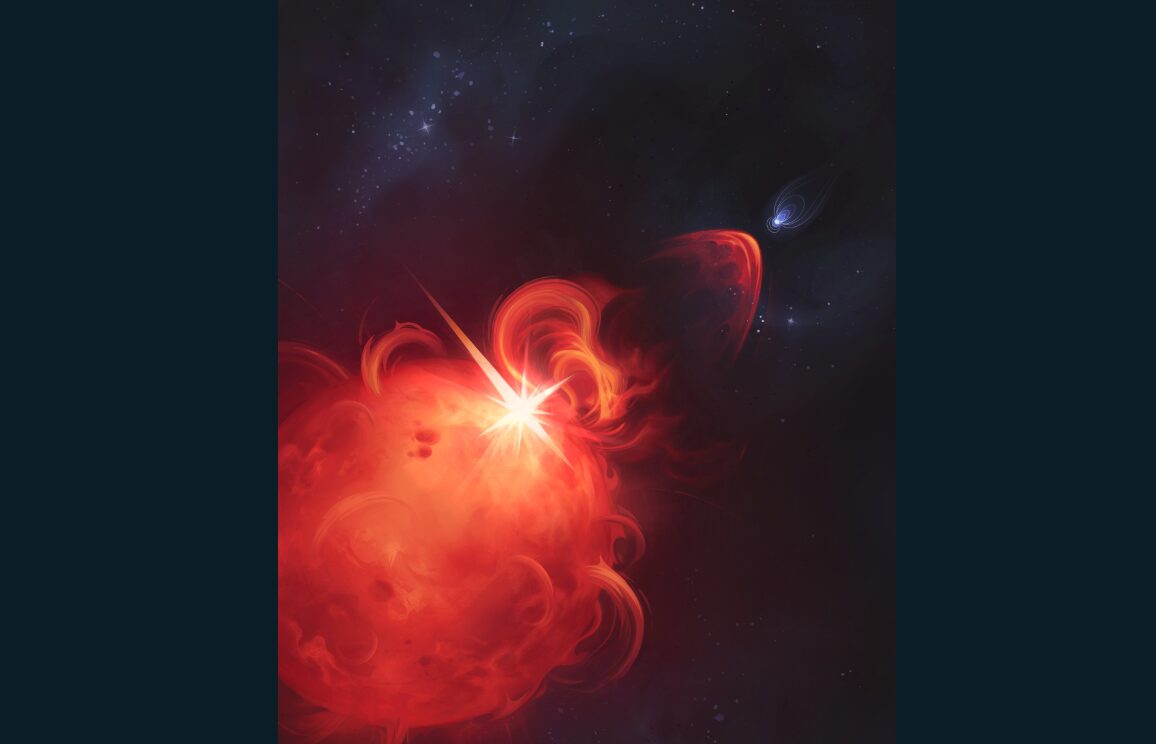
Star TOI-6894 is just like many in our galaxy, a small red dwarf, and only ~20% of the mass of our Sun. Like many small stars, it is not expected to provide suitable conditions for the formation and hosting of a large planet.

Scientists have discovered a giant planet orbiting a tiny red dwarf star, something they believed wasn’t even possible. The planet, TOI-6894b, is about the size of Saturn but orbits a star just a fifth the mass of our Sun. This challenges long-standing ideas about how big planets form, especially around small stars. Current theories can’t fully explain how such a planet could have taken shape. Even more fascinating, this cold planet may have a rare kind of atmosphere rich in methane or even ammonia something we’ve never seen in an exoplanet before.

Star TOI-689...

Read More