The rapid brightening of Sakurai’s object (green circle) allows astronomers to study the final phases of the stellar evolution in only a few decades. The left and right panels show the brightening. The middle panel is an image obtained with the radio telescope ALMA, showing the material ejected after the star re-ignited. The material currently extends over a size similar to our entire solar system. Credit: Stefan Kimeswenger, University of Innsbruck; Peter van Hoof, Royal Observatory Belgium.
Astronomers have confirmed that one of the fastest-changing stars ever observed has entered a new stage of its evolution, offering a rare opportunity to watch a star’s life unfold on human timescales.
Using the European Southern Observatory’s Very Large Telescope (VLT) in Chile, researchers inc...
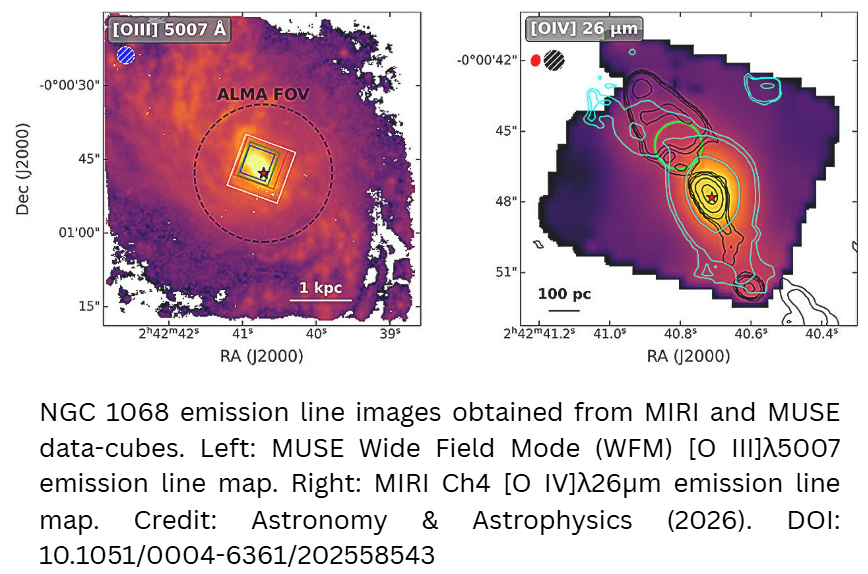
Astronomers have found that a nearby galaxy’s black hole is blasting out a far more powerful and hidden gas outflow than previously realized. Studying NGC1068, a well-known galaxy with an actively feeding black hole at its center, researchers combined new infrared observations with existing data to map how the black hole’s energy is reshaping the surrounding gas. The results are reported in a paper published Aug. 6 in Astronomy & Astrophysics.
Shaping how galaxies evolve As matter falls into supermassive black holes, it releases huge amounts of energy, driving powerful winds or outflows from the galaxy’s center. These outflows can heat the surrounding gas, expel gas and stir up the star-forming material in the galaxy, preventing it from forming new stars...
Credit: The Journal of Physical Chemistry A (2026). DOI: 10.1021/acs.jpca.6c03215
Before there was Earth, there was chemistry. In the unimaginable cold, dark clouds where stars and planets are born, carbon molecules assemble into more complex forms—starting a chemical journey that could eventually deliver some of life’s basic ingredients to young planets. There’s only one problem: These molecules need heat to form. At least that’s what scientists have long believed. But new research from FIU chemist Alexander Mebel reveals such chemistry can actually happen at temperatures nearing absolute zero, which is -460°F (-273°C).
On Earth, these complex carbon molecules are usually associated with extremely hot temperatures, such as those associated with combustion...
Revealing nitrogen-bearing compounds in the sample returned from Ryugu. Credit: Toru Matsumoto et al.
Nitrogen is a key ingredient in the biomolecules that form the building blocks of life. Yet as an unbonded gas, it is far more likely to drift into space than to lock itself into solid compounds, making it difficult for astronomers to trace its journey to Earth in the distant past.
Through new research published in Nature Astronomy, a team led by Toru Matsumoto at Kyoto University has found some of the best evidence yet of how this journey happened, hidden inside grains of dust from the asteroid Ryugu.
Evidence across the solar system Nitrogen-bearing compounds, particularly ammonia, have already been spotted on the dwarf planet Ceres and on several carbon-rich asteroids, hinting ...






Recent Comments