Category Astronomy/Space

Observatories Combine to Crack Open the Crab Nebula

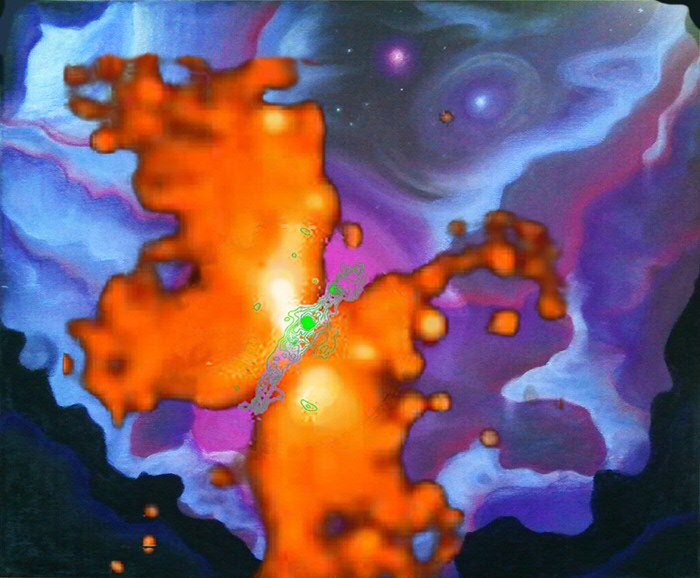
An image of the Crab Nebula, a supernova remnant that was assembled by combining data from five telescopes spanning nearly the entire breadth of the electromagnetic spectrum: the Very Large Array, the Spitzer Space Telescope, the Hubble Space Telescope, the XMM-Newton Observatory, and the Chandra X-ray Observatory. Credit: NASA, ESA, NRAO/AUI/NSF and G. Dubner (University of Buenos Aires)

An image of the Crab Nebula, a supernova remnant that was assembled by combining data from five telescopes spanning nearly the entire breadth of the electromagnetic spectrum: the Very Large Array, the Spitzer Space Telescope, the Hubble Space Telescope, the XMM-Newton Observatory, and the Chandra X-ray Observatory.
Credit: NASA, ESA, NRAO/AUI/NSF and G. Dubner (University of Buenos Aires)

Astronomers have produced a highly detailed image of the Crab Nebula, by combining data from telescopes spanning nearly the entire breadth of the electromagnetic spectrum, from radio waves seen by the Karl G. Jansky VLA to the powerful Xray glow as seen by the orbiting Chandra X-ray Observatory...

Read More

Waves of Lava seen in Jupiter’s Moon Io’s largest Volcanic Crater

Maps of the temperature and lava crust age within Loki Patera, derived from the LBTO observations. The higher temperatures in the southeast (location 3) indicate that new magma was exposed most recently in this location. Credit: Large Binocular Telescope Observatory

Maps of the temperature and lava crust age within Loki Patera, derived from the LBTO observations. The higher temperatures in the southeast (location 3) indicate that new magma was exposed most recently in this location. Credit: Large Binocular Telescope Observatory

Rare occultation of Io by Europa allows detailed infrared mapping of Loki Patera. Taking advantage of a rare orbital alignment between 2 of Jupiter’s moons, Io and Europa, researchers have obtained an exceptionally detailed map of the largest lava lake on Io, the most volcanically active body in the solar system. On March 8, 2015, Europa passed in front of Io, gradually blocking out light from the volcanic moon...

Read More

Surprise! When a Brown Dwarf is actually a Planetary Mass Object

This is an artist's conception of SIMP J013656.5+093347, or SIMP0136 for short, which the research team determined is a planetary like member of a 200-million-year-old group of stars called Carina-Near. Credit: Image is courtesy of NASA/JPL, slightly modified by Jonathan Gagné.

This is an artist’s conception of SIMP J013656.5+093347, or SIMP0136 for short, which the research team determined is a planetary like member of a 200-million-year-old group of stars called Carina-Near. Credit: Image is courtesy of NASA/JPL, slightly modified by Jonathan Gagné.

Sometimes a brown dwarf is actually a planet – or planet-like anyway. A team led by Carnegie’s Jonathan Gagné, and including researchers from the Institute for Research on Exoplanets (iREx) at Université de Montréal, the American Museum of Natural History, and University of California San Diego, discovered that what astronomers had previously thought was one of the closest brown dwarfs to our own Sun is in fact a planetary mass object.

Smaller than stars, but bigger than giant planets, brown dwarfs are too small...

Read More

Astronauts experience Decrease in Blood Vessel function during Spaceflight

Astronauts aboard the International Space Station have decreased physical fitness because of a decrease in the way oxygen moves through the body, according to a Kansas State University kinesiology study.

Astronauts aboard the International Space Station have decreased physical fitness because of a decrease in the way oxygen moves through the body, according to a Kansas State University kinesiology study.

Astronauts aboard ISS have decreased physical fitness because of a decrease in the way oxygen moves through the body, according to a Kansas State University kinesiology study. Carl Ade, assistant professor of exercise physiology, and collaborators partnered with the Johnson Space Center to find that astronauts’ exercise capacity decreases between 30 and 50% in long-duration spaceflight because the heart and small blood vessels are not as effective at transporting oxygen to the working muscle.

“It is a dramatic decrease,” Ade said...

Read More