Category Astronomy/Space

Beyond Neptune, a chunk of Ice is orbiting the Sun in the Wrong Direction

Beyond Neptune, a chunk of ice is orbiting the sun in the wrong direction

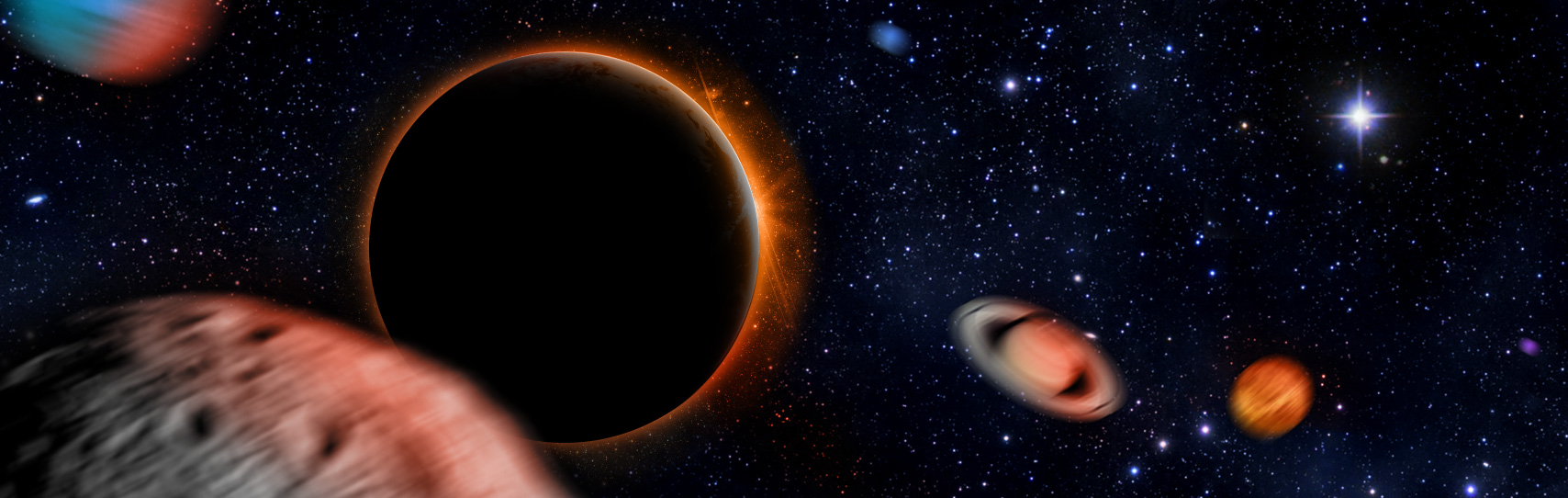
An artist’s concept of a trans-Neptunian object(TNOs). The distant sun is reduced to a bright star at a distance of over 3 billion miles. Credit: NASA

The mysterious Trans-Neptunian Object (TNOs) lie beyond the orbit of Neptune. For years, astronomers have been discovering bodies and minor planets in this region which are influenced by Neptune’s gravity, and orbit our sun at an average distance of 30 Astronomical Units. In recent years, several new TNOs have been discovered that have caused us to rethink what constitutes a planet, not to mention the history of the solar system.

The most recent of these mystery objects is called “Niku”, a small chunk of ice that takes its name for the Chinese word for “rebellious”...

Read More

Van Allen Probes catch rare glimpse of Supercharged Radiation Belt

This is an artist concept of accelerated electrons circulating in Earth's Van Allen radiation belts. Credit: NASA's Goddard Space Flight Center; Tom Bridgman, animator

This is an artist concept of accelerated electrons circulating in Earth’s Van Allen radiation belts. Credit: NASA’s Goddard Space Flight Center; Tom Bridgman, animator

Our planet is in the center of 2 immense, concentric doughnuts of powerful radiation: Van Allen radiation belts, which harbor swarms of charged particles that are trapped by Earth’s magnetic field. On March 17, 2015, an interplanetary shock – a shockwave created by the driving force of a coronal mass ejection, CME, from the sun – struck Earth’s magnetic field, the magnetosphere, triggering the greatest geomagnetic storm of the preceding decade. And NASA’s Van Allen Probes were there to watch the effects on the radiation belts.

One of the most common forms of space weather, a geomagnetic storm describes any event in which the...

Read More

Brown Dwarfs reveal Exoplanets’ Secrets

Brown dwarfs are smaller than stars, but more massive than giant planets. As such, they provide a natural link between astronomy and planetary science. However, they also show incredible variation when it comes to size, temperature, chemistry, and more, which makes them difficult to understand, too. New work surveyed various properties of 152 suspected young brown dwarfs in order to categorize their diversity and found that atmospheric properties may be behind much of their differences. Credit: Jacqueline Faherty and David Rodriguez

Brown dwarfs are smaller than stars, but more massive than giant planets. As such, they provide a natural link between astronomy and planetary science. However, they also show incredible variation when it comes to size, temperature, chemistry, and more, which makes them difficult to understand, too. New work surveyed various properties of 152 suspected young brown dwarfs in order to categorize their diversity and found that atmospheric properties may be behind much of their differences. Credit: Jacqueline Faherty and David Rodriguez

Brown dwarfs are smaller than stars, but more massive than giant planets. As such, they provide a natural link between astronomy and planetary science...

Read More

Fifth force of nature? Light particle may be key to understanding dark matter in universe

Physicists at the Institute for Nuclear Research in Debrecen, Hungary, say this apparatus — an electron-positron spectrometer — has found evidence for a new particle.

Physicists at the Institute for Nuclear Research in Debrecen, Hungary, say this apparatus — an electron-positron spectrometer — has found evidence for a new particle.

Recent findings indicating the possible discovery of a previously unknown subatomic particle may be evidence of a fifth fundamental force of nature. “If true, it’s revolutionary,” said Prof. Jonathan Feng. “For decades, we’ve known of 4 fundamental forces: gravitation, electromagnetism, and the strong and weak nuclear forces. If confirmed by further experiments, this discovery of a possible fifth force would completely change our understanding of the universe, with consequences for the unification of forces and dark matter.”

The UCI researchers came upon a mid-2015 study by experimental nuclear physicists at the Hungarian...

Read More