Category Astronomy/Space

NASA spots the ‘Great Pumpkin’: Halloween asteroid a treat for Radar astronomers

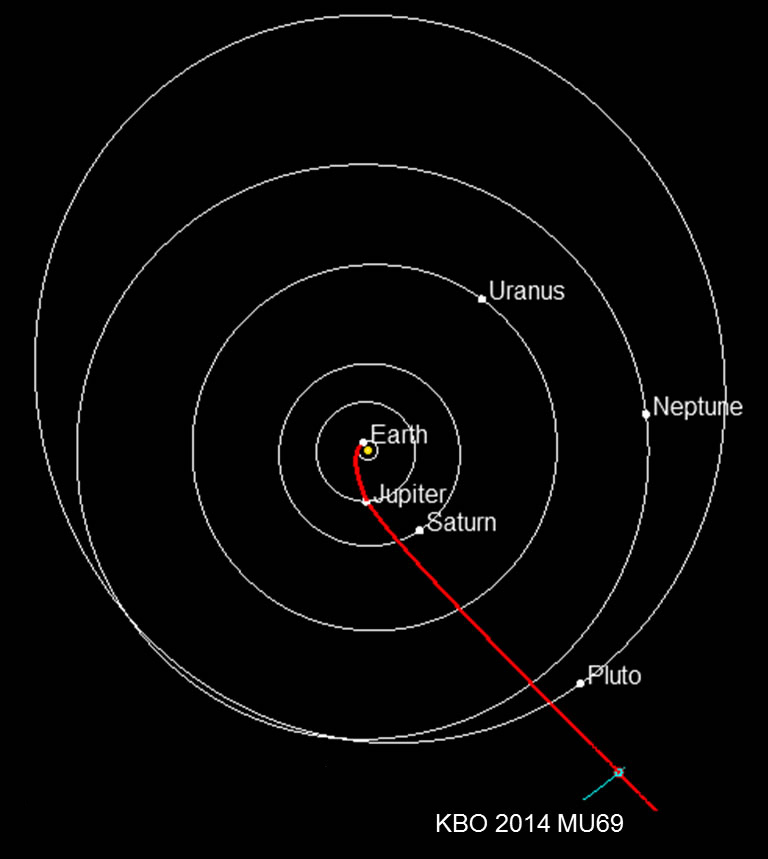
This is a graphic depicting the orbit of asteroid 2015 TB145. The asteroid will safely fly past Earth slightly farther out than the moon's orbit on Oct. 31 at 10:05 a.m. Pacific (1:05 p.m. EDT and 17:05 UTC). Credit: NASA/JPL-Caltech

This is a graphic depicting the orbit of asteroid 2015 TB145. The asteroid will safely fly past Earth slightly farther out than the moon’s orbit on Oct. 31 at 10:05 a.m. Pacific (1:05 p.m. EDT and 17:05 UTC). Credit: NASA/JPL-Caltech

NASA scientists are tracking the upcoming Halloween flyby of asteroid 2015 TB145 with several optical observatories and the radar capabilities of the agency’s Deep Space Network at Goldstone, CA. The asteroid will fly past Earth at a safe distance slightly farther than the moon’s orbit on Oct. 31 at 10:01 am PDT. The flyby of the estimated 1300-ft-wide asteroid is a science target of opportunity, allowing instruments on “spacecraft Earth” to scan it during the close pass.

Asteroid 2015 TB145 was discovered on Oct...

Read More

Huge Spiral Patterns around some Newborn Stars (few million yo) may be evidence for presence of Giant unseen Planets

A computer model reproduces the two-spiral-arm structure; the "x" is the location of a putative planet. The planet, which cannot be seen directly, probably excites the two spiral arms. Credit: NASA, ESA, ESO, M. Benisty et al. (University of Grenoble), R. Dong (Lawrence Berkeley National Laboratory), and Z. Zhu (Princeton University)

A computer model reproduces the two-spiral-arm structure; the “x” is the location of a putative planet. The planet, which cannot be seen directly, probably excites the two spiral arms. Credit: NASA, ESA, ESO, M. Benisty et al. (University of Grenoble), R. Dong (Lawrence Berkeley National Laboratory), and Z. Zhu (Princeton University)

This idea not only opens the door to a new method of planet detection, but also could offer a look into the early formative years of planet birth. Though astronomers have cataloged thousands of planets orbiting other stars, the earliest stages of planet formation are elusive because nascent planets are born and embedded inside vast, pancake-shaped disks of dust and gas encircling newborn stars, known as circumstellar disks.

The conclusion that planets may betr...

Read More

Simulation of 3D Exotic Clouds on an Exoplanet

Size comparison between Earth and the exoplanet GJ1214b. Credit: NASA/JPL-Caltech/R. Hurt (SSC)

Size comparison between Earth and the exoplanet GJ1214b. Credit: NASA/JPL-Caltech/R. Hurt (SSC)

A nearby exoplanet has an atmosphere that might be similar to Earth’s before life evolved. Scientists have catalogued nearly 2,000 exoplanets around stars near and far. While most of these are giant and inhospitable, improved techniques and spacecraft have uncovered increasingly smaller worlds.

But size alone is insufficient to judge a globe. Though Earth and Venus are nearly identical in size, the latter’s surface is hot enough to melt lead. Astronomers must gather information about an exoplanet’s atmosphere, often through observing how the planet scatters or absorbs light from its parent star. But, that information is not always useful – as is the case with the exoplanet GJ1214b.

“When an exop...

Read More

Astrophysicists produce 1st Age Map of the Halo of the Milky Way

This chronographic map of the Milky Way's halo system shows a color gradient that is associated with an age difference of roughly 2-2.5 G yrs. The oldest stars are the darkest and are concentrated in the central part of the galaxy, the darkest portion of the bottom of the map

This chronographic map of the Milky Way’s halo system shows a color gradient that is associated with an age difference of roughly 2-2.5 G yrs

The 1st chronographic (age) map of the halo of the Milky Way galaxy has been created. The halo, along with the disk and bulge, are the primary components of the galaxy. Using a sample of 4,700 blue horizontal-branch (BHB) stars from the Sloan Digital Sky Survey, the research team showed that the oldest stars are concentrated in the central region of the galaxy, confirming predictions from numerical simulations of galaxy assembly. The researchers have also shown that chronographic maps such as theirs can also be used to identify complex structures of stars still in the process of being added to the halo system of our galaxy.

The researchers used the...

Read More