Category Biology/Biotechnology

Researchers create Artificial Enzyme for Fast Detection of Disease-related Hormone in Sweat

Sanjida Yeasmin, photo by Johanna Carson

Researchers in the Oregon State University College of Engineering have developed a handheld sensor that tests perspiration for cortisol and provides results in eight minutes, a key advance in monitoring a hormone whose levels are a marker for many illnesses including various cancers.

Findings were published in the journal ACS Applied Materials & Interfaces. The material and sensing mechanism in the new device could be easily engineered to detect other specific hormones, the researchers say — for example, progesterone, a key marker for women’s reproductive health and pregnancy outcomes.

“We took inspiration from the natural enzymes used in blood glucose meters sold at pharmacies,” said Larry Cheng, associate professor of electrical engineer...

Read More
Novel Drug makes Mice Skinny even on Sugary, Fatty Diet

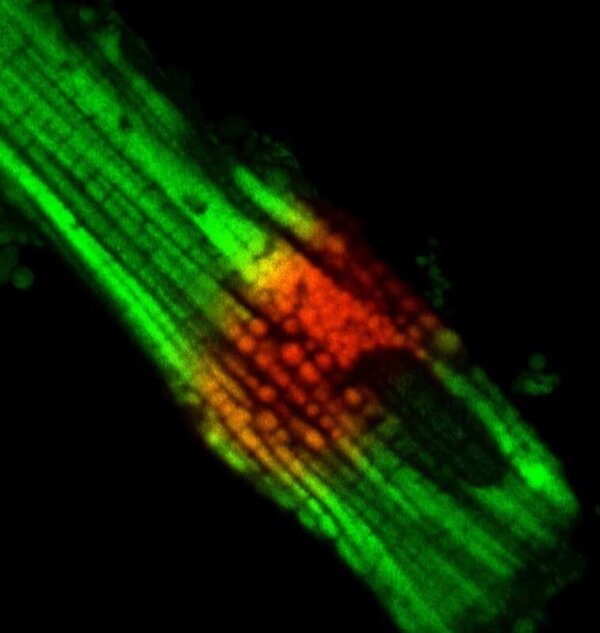
Mitochondria in a single heart cell. Mitochondria highlighted in red were exposed to ultraviolet light. Credit: National Heart, Lung and Blood Institute, National Institutes of Health

Researchers from The University of Texas Health Science Center at San Antonio (UT Health San Antonio) have developed a small-molecule drug that prevents weight gain and adverse liver changes in mice fed a high-sugar, high-fat Western diet throughout life.

“When we give this drug to the mice for a short time, they start losing weight. They all become slim,” said Madesh Muniswamy, Ph.D., professor of medicine in the health science center’s Joe R. and Teresa Lozano Long School of Medicine.

Findings by the collaborators, also from the University of Pennsylvania and Cornell University, were published Feb...

Read More

New Intracellular ‘Smoke Detector’ discovered

Human skin cells with "healthy" mitochondria (light blue):
Human skin cells with “healthy” mitochondria (light blue): – The NLRP10 “smoke detector” (yellow-green) is distributed over the entire contents of the cell, apart from the nucleus (blue-violet).© Image: Kim S. Robinson/Skin Research Institute Singapore

Researchers at the Universities of Bonn and Singapore have discovered a new intracellular “smoke detector.” The sensor warns of damage to the mitochondria. If it does not function properly, chronic skin diseases can result. The sensor may also be important for unimpaired heart and bowel function. The results have now been published in the journal Nature Immunology.

Every cell in the body has numerous sensors that monitor its function...

Read More

UW Scientists use Tardigrade Proteins for Human Health breakthrough

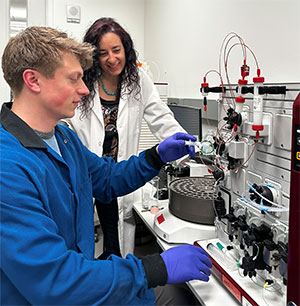
man and woman working with lab equipment
UW student Maxwell Packebush, of Littleton, Colo., works with Silvia Sanchez-Martinez, a senior research scientist, to purify one of the tardigrade proteins used in a study showing that the proteins can be used to stabilize an important pharmaceutical for people with hemophilia and other conditions without the need for refrigeration. (Thomas Boothby Photo)

University of Wyoming researchers’ study of how microscopic creatures called tardigrades survive extreme conditions has led to a major breakthrough that could eventually make life-saving treatments available to people where refrigeration is not possible.

Thomas Boothby, an assistant professor of molecular biology, and colleagues have shown that natural and engineered versions of tardigrade proteins can be used to stabilize an impo...

Read More