Category Biology/Biotechnology

Dietary Fiber in the Gut may Help with Skin Allergies

A Monash University study exploring the emerging gut-skin axis has found that microbial fermentation of dietary fibre in the gut can protect against allergic skin disease. The research could potentially lead to novel treatments to prevent or treat allergies.

Professor Ben Marsland from the Central Clinical School’s Department of Immunology, together with Swiss colleagues at the University Hospital of Lausanne (CHUV), showed that the fermentation of fibre in the gut by bacteria and subsequent production of short-chain fatty acids (SCFAs), in particular butyrate, protected against atopic dermatitis in mice.

The research was published today in Mucosal Immunology.

While it is well established that the gut microbiome shapes the immune system, the influence it has on the skin is le...

Read More

Forever Chemicals linked to Hypertension in Middle-Aged Women

Infographic: PFAS associated with higher risk of hypertension
This infographic shows common synthetic chemicals called per- and polyfluoroalkyl substances (PFAS) are associated with a higher risk of hypertension. They are found in fast food packaging, PFAs contaminated drinking water and PFAs contaminated food and states PFAS are detectable in almost everyone. The corresponding line graph shows the survival probability from age 45 to 70 with the following numbers. The hazard ratio of 95% confidence intervals by PFAs. Tertiles 3 versus 1 is 1.71 (1.15, 2.54). Tertile 2 versus Tertile 1 is 1.31 (1.07, 1.59).  
copyright Hypertension, an American Heart Association journal and Ning Ding, Ph.D., M.P.H. 

In a large, prospective study, the levels of per- and polyfluoroalkyl substances (PFAS), w...

Read More

Three Distinct Brain Circuits in the Thalamus contribute to Parkinson’s Symptoms

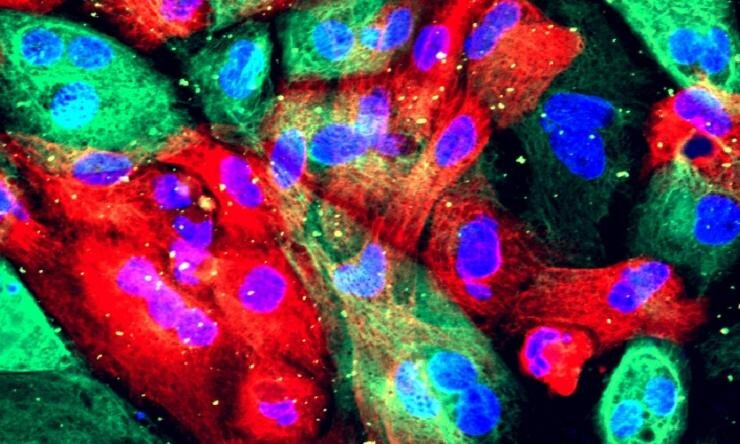
image of the parafascicular (PF) thalamus
Caption: In this image of the parafascicular (PF) thalamus, the blue cells participate in reward processing/depression, the red cells are critical for motor learning, and the green cells are important for general locomotion. The ‘fr’ stands for a fiber bundle.
Credits:Image: Ying Zhang and Dheeraj Roy

Targeting these circuits could offer a new way to reverse motor dysfunction and depression in Parkinson’s patients. In a study of a small region of the thalamus, MIT neuroscientists have now identified three distinct circuits that influence the development of both motor and nonmotor symptoms of Parkinson’s. Furthermore, they found that by manipulating these circuits, they could reverse Parkinson’s symptoms in mice.

The findings suggest that those circuits could be good targets for new d...

Read More

Nanotechnology used to Destroy and Prevent Relapse of Solid Tumor Cancers

 B7 co-stimulation enhances the anti-PD1-based immunosuppression reversal.

As people across the globe look forward to longer life expectancies, malignant cancers continue to pose threats to human health. The exploration and development of immunotherapy aims to seek new breakthroughs for the treatment of solid tumours.

The successful establishment of anti-tumour immunity requires the activation, expansion and differentiation of antigen-specific lymphocytes. This process largely depends on specific interactions between various T cells and antigen-presenting cells (APCs) in the body. However, existing tumour vaccines, such as neoantigen vaccines and various vector vaccines, all rely on random interactions with APCs in the body...

Read More