Category Biology/Biotechnology

All gas, no brakes: Testosterone may act as ‘Brake Pedal’ on Immune Response

In doing so, a researcher has found it could protect men from stomach inflammation. Autoimmune diseases have something in common with horses, bachelor’s degrees and daily flossing habits: women are more likely to have them.

One reason for autoimmune diseases’ prevalence in women may be sex-based differences in inflammation. In a new study, West Virginia University researcher Jonathan Busada investigated how sex hormones affect stomach inflammation in males and females. He found that androgens — or male sex hormones — may help to keep stomach inflammation in check.

“Stomach cancer is primarily caused by rampant inflammation,” said Busada, an assistant professor in the School of Medicine and researcher with the Cancer Institute...

Read More
How Fasting Diets Could Harm Future Generations

Fasting diets have risen in popularity in recent years, however little is known about the long-term impact of these diets, particularly for future generations.

New research, published today in the journal Proceedings of the Royal Society B, reveals that reduced food intake in roundworms (Caenorhabditis elegans) has a detrimental effect on three generations of offspring — particularly when those descendants have access to unlimited food.

Lead researcher Dr Edward Ivimey-Cook, from UEA’s School of Biological Sciences, said: “We know that reduced food intake increases the lifespan in many animals and can potentially improve health in humans. However, little is known about the long-term effects of reduced food intake, including time-limited fasting, on distant descendants.

“We wa...

Read More

Tiny, Wireless, Injectable Chips use Ultrasound to Monitor Body Processes

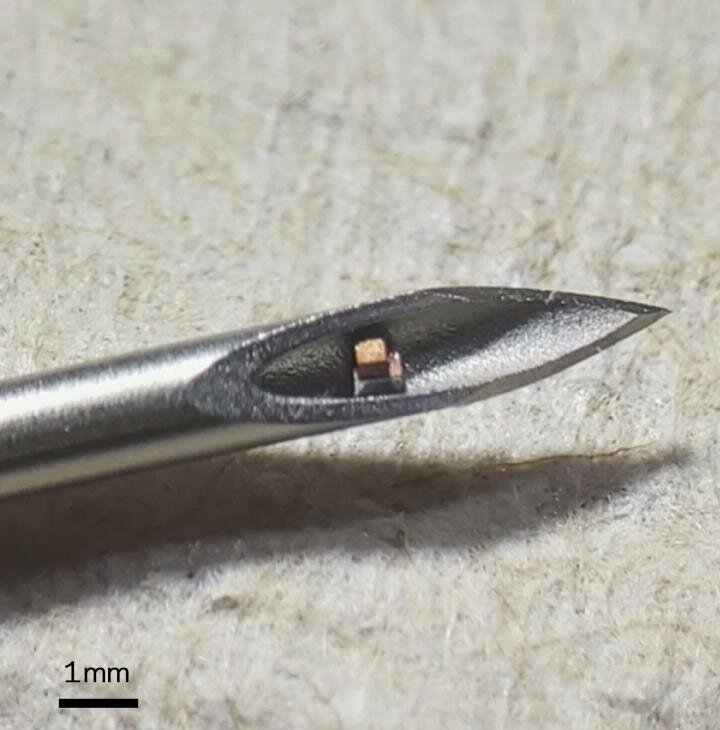
Tiny, wireless, injectable chips use ultrasound to monitor body processes

Widely used to monitor and map biological signals, to support and enhance physiological functions, and to treat diseases, implantable medical devices are transforming healthcare and improving the quality of life for millions of people. Researchers are increasingly interested in designing wireless, miniaturized implantable medical devices for in vivo and in situ physiological monitoring. These devices could be used to monitor physiological conditions, such as temperature, blood pressure, glucose, and respiration for both diagnostic and therapeutic procedures.

To date, conventional implanted electronics have been highly volume-inefficient—they generally require multiple chips, packaging, wires, and external transducers, and batteries are often needed for energy storage...

Read More

New Genetic Copycatchers Detect Efficient and precise CRISPR Editing in a Living Organism

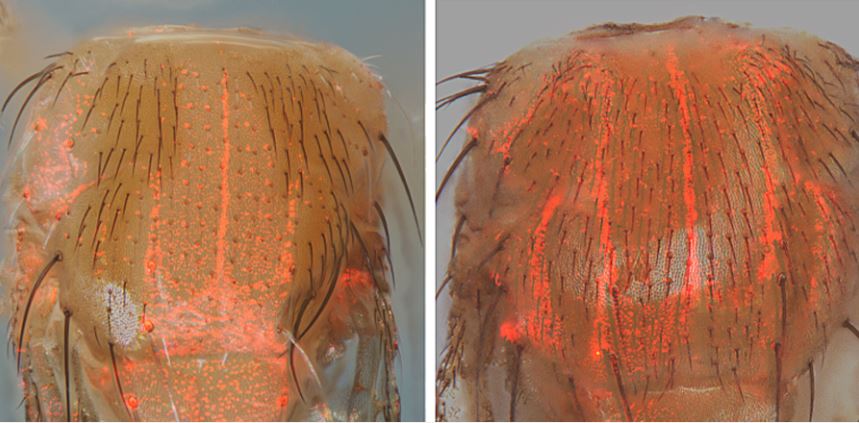
Red fluorescent detector proteins in fruit flies reveal detection from an actual copying experiment (left) and how perfect copying would appear (right). Fluorescent cells in the left panel also lack the function of a pigmentation gene called “pale” due to copying of the CopyCatcher element, which eliminates function of both copies of the pale gene. Control flies in the right panel, which have only one copy of the pale gene disrupted by insertion of the CopyCatcher (one functional copy of the gene), have bright red cells and normal bristle pigmentation throughout the body. Credit: Zhiqian Li

Proof-of-principle research shows that genes can be accurately edited in cells throughout the body...

Read More