Category Biology/Biotechnology

Glioblastoma Nanomedicine crosses into Brain in mice, Eradicates recurring brain Cancer

Macroscopic pathology of glioblastoma multiforme. Image credit: CC BY-SA 4.0 – Sbrandner

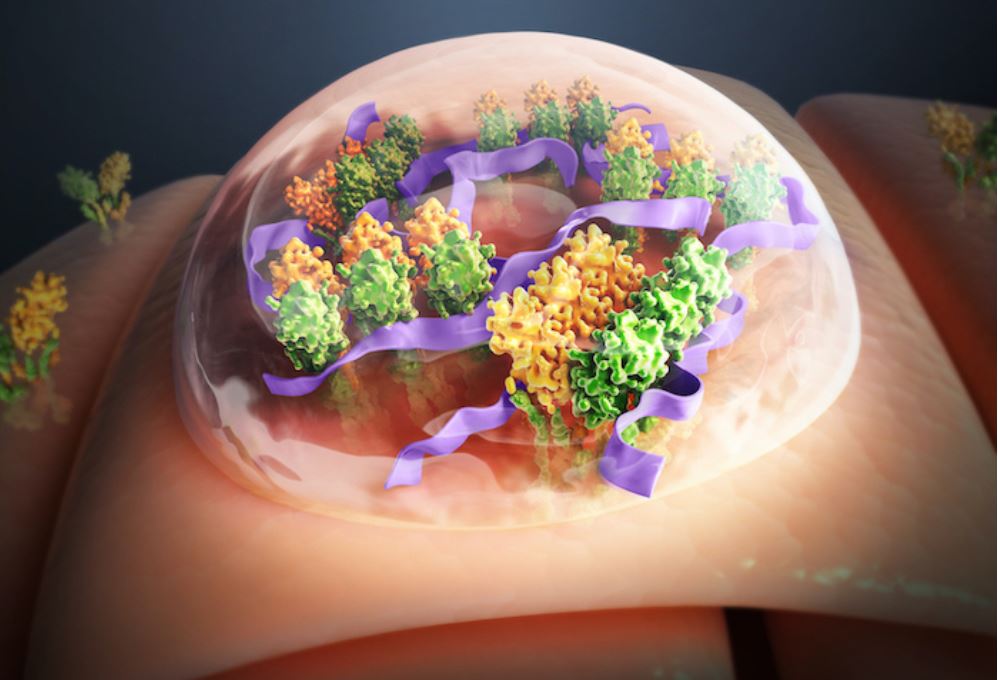
A new synthetic protein nanoparticle capable of slipping past the nearly impermeable blood-brain barrier in mice could deliver cancer-killing drugs directly to malignant brain tumors, new research from the University of Michigan shows. ‘I’ve worked in this field for more than 10 years and have not seen anything like this.’

The study is the first to demonstrate an intravenous medication that can cross the blood-brain barrier.

The discovery could one day enable new clinical therapies for treating glioblastoma, the most common and aggressive form of brain cancer in adults, and one whose incidence is rising in many countries...

Read More

Researchers 3D print Biomedical Parts with Supersonic Speed

Cells adhering to titanium alloy
This image shows cells adhering to a titanium alloy created by cold-spray 3D printing, which demonstrates the material’s biocompatibility.

Forget glue, screws, heat or other traditional bonding methods. A Cornell University-led collaboration has developed a 3D printing technique that creates cellular metallic materials by smashing together powder particles at supersonic speed.

This form of technology, known as “cold spray,” results in mechanically robust, porous structures that are 40% stronger than similar materials made with conventional manufacturing processes. The structures’ small size and porosity make them particularly well-suited for building biomedical components, like replacement joints.

The team’s paper, “Solid-State Additive Manufacturing of Porous Ti-6Al-4V by Supe...

Read More

Researchers 3D print Biomedical Parts with Supersonic Speed

Cells adhering to titanium alloy
This image shows cells adhering to a titanium alloy created by cold-spray 3D printing, which demonstrates the material’s biocompatibility.

Forget glue, screws, heat or other traditional bonding methods. A Cornell University-led collaboration has developed a 3D printing technique that creates cellular metallic materials by smashing together powder particles at supersonic speed.

This form of technology, known as “cold spray,” results in mechanically robust, porous structures that are 40% stronger than similar materials made with conventional manufacturing processes. The structures’ small size and porosity make them particularly well-suited for building biomedical components, like replacement joints.

The team’s paper, “Solid-State Additive Manufacturing of Porous Ti-6Al-4V by Supe...

Read More

Bringing Drugs to the brain with Nanoparticles to treat Neurodegenerative diseases

After several years of research on effective and safe nanoparticles, the research team will continue laboratory testing, targeting the delivery of active ingredients to other animal models with ultimate clinical applications.

Researchers from the Institut national de la recherche scientifique (INRS) have shown that nanoparticles could be used to deliver drugs to the brain to treat neurodegenerative diseases.

The blood-brain barrier is the main obstacle in treating neurodegenerative diseases such as Alzheimer and Parkinson. According to a recent study conducted by Jean-Michel Rabanel, a postdoctoral researcher under the supervision of Professor Charles Ramassamy, nanoparticles with specific properties could cross this barrier and be captured by neuronal cells...

Read More