
Category Biology/Biotechnology

Learning and Staying in Shape key to Longer Lifespan, study finds

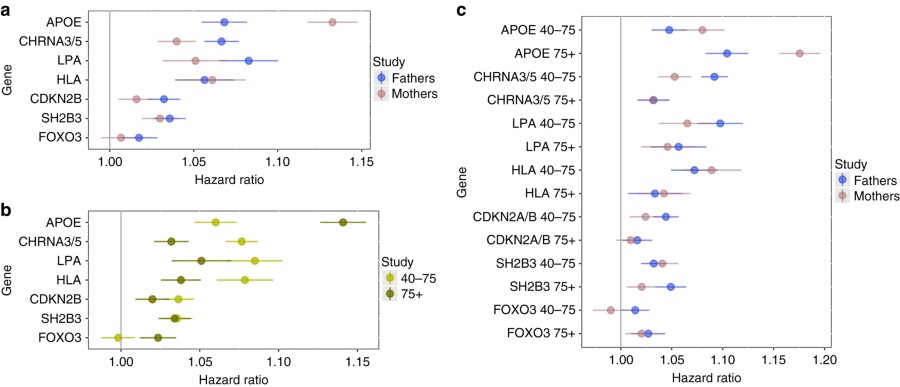
Age-specific and sex-specific effects of the 4 GWS associations in LifeGen and the validated candidate loci. The four GWS and three suggestive replicated loci were analysed for age-specific and sex-specific effects on lifespan. a The variants at APOE and CHRNA3/5 exhibit sexually dimorphic effects on parental mortality, while all other variants exhibit more modest often non-significant sex-specific differences. b The effects of each gene on male and female lifespan were meta-analysed and studied in the cases that died aged between 40 and 75 or after 75. APOE exerts a much greater effect in the older age group, while most of the other genes exhibit the opposite effect. FOXO3 appears neutral, if not positive, in the earlier age group. c Effects on mortality were studied in both age groups for both sexes. APOE has the strongest effect on females aged 75+, CHRNA3/5 acts on males aged 40−75 and all other genes display more ambiguous trends

Age-specific and sex-specific effects of the 4 GWS associations in LifeGen and the validated candidate loci. The four GWS and three suggestive replicated loci were analysed for age-specific and sex-specific effects on lifespan. a The variants at APOE and CHRNA3/5 exhibit sexually dimorphic effects on parental mortality, while all other variants exhibit more modest often non-significant sex-specific differences. b The effects of each gene on male and female lifespan were meta-analysed and studied in the cases that died aged between 40 and 75 or after 75. APOE exerts a much greater effect in the older age group, while most of the other genes exhibit the opposite effect. FOXO3 appears neutral, if not positive, in the earlier age group...

Read More
KLF-mediated lifespan extension is dependent on autophagy. Klf-3 transcript levels in wild-type animals subjected to 2 days of chronic dietary restriction (sDR, OP50 diluted to 108 cfu/ml) (a) or inhibition of TOR signaling by RNAi against let-363 (b) starting from day 1 of adulthood. All lines were raised and maintained at 20 °C. *P-value < 0.05 by Student’s T-test, N = 3 biological replicates. c qPCR analysis of a panel of autophagy-related genes in day 1 klf-3 o/e and loss of function of both klf-3 and klf-1 animals compared to wild type. Double loss of function of klf-3 and klf-1 was performed as described previously utilizing the klf-3(ok175) mutant and simultaneous RNAi feeding targeting klf-1. All lines were raised and maintained at 20 °C. *P-value < 0.05 by Student’s T-test, N = 3 biological replicates (d, representative picture). e Autophagy in klf-3 o/e animals as determined by numbers of GFP::LGG-1 punctae in seam cells (red arrow denotes GFP-positive puncta) with knockdown of bec-1 in both wild-type and klf-3 o/e animals. *P-value < 0.05, # P-value ≤ 0.1 after one-way analysis of variance followed by the Tukey’s post hoc test. N = 10–20 animals counted. (f, wild-type representative image, g, klf-3 o/e representative image) Electron microscopy images of klf-3 o/e and wild-type animals in animals aged 9 days. Arrowheads indicate sizeable (≥500 nm) autolysosomes as recognized by single-membrane limited vacuolar structures with visible mixed cytoplasmic contents. Full images reproduced in Supplementary Fig. 11, with additional images. h Lifespan analysis of wild-type and klf-3 o/e animals fed RNAi bacteria targeting bec-1 from day 1 of adulthood. All lines were raised and maintained at 20 °C. P-value < 0.05 by Mantel–Cox log-rank tests. See also Supplementary Table 6 for details of lifespan analyses and replicate experiments. All error bars represent standard error of the mean (SEM)

KLF-mediated lifespan extension is dependent on autophagy. Klf-3 transcript levels in wild-type animals subjected to 2 days of chronic dietary restriction (sDR, OP50 diluted to 108 cfu/ml) (a) or inhibition of TOR signaling by RNAi against let-363 (b) starting from day 1 of adulthood. All lines were raised and maintained at 20 °C. *P-value < 0.05 by Student’s T-test, N = 3 biological replicates. c qPCR analysis of a panel of autophagy-related genes in day 1 klf-3 o/e and loss of function of both klf-3 and klf-1 animals compared to wild type. Double loss of function of klf-3 and klf-1 was performed as described previously utilizing the klf-3(ok175) mutant and simultaneous RNAi feeding targeting klf-1. All lines were raised and maintained at 20 °C. *P-value < 0...

Read More

Like it or not: Broccoli may be Good for the Gut

Dietary broccoli impacts microbial community structure and attenuates chemically induced colitis in mice in an Ah receptor dependent manner. Journal of Functional Foods, 2017; 37: 685 DOI: 10.1016/j.jff.2017.08.038

Dietary broccoli impacts microbial community structure and attenuates chemically induced colitis in mice in an Ah receptor dependent manner. Journal of Functional Foods, 2017; 37: 685 DOI: 10.1016/j.jff.2017.08.038

For the broccoli haters of the world, researchers may have more bad news: the vegetable may also help promote a healthy gut. In a study, when mice ate broccoli with their regular diet, they were better able to tolerate digestive issues similar to symptoms of leaky gut and colitis than mice that were not placed on a broccoli-supplemented diet, according to Gary Perdew, the John T. and Paige S. Smith Professor in Agricultural Sciences, Penn State. He added that other vegetables, like brussels sprouts and cauliflower, may also have similar gut health properties.

“There are a lot of...

Read More

Future Smartwatches could Sense Hand Movement using Ultrasound imaging

This is ultrasonic imaging of the forearm. Credit: Copyright BIG, University of Bristle 65

This is ultrasonic imaging of the forearm.
I8

New research has shown future wearable devices, such as smartwatches, could use ultrasound imaging to sense hand gestures. Computers are growing in number and wearable computers, such as smartwatches, are gaining popularity. Devices around the home, such as WiFi light bulbs and smart thermostats, are also on the increase. However, current technology limits the capability to interact with these devices. Hand gestures have been suggested as an intuitive and easy way of interacting with and controlling smart devices in different surroundings. For instance, a gesture could be used to dim the lights in the living room, or to open or close a window...

Read More