
Category Biology/Biotechnology

Monitoring Microbes to Keep Marsonauts Healthy

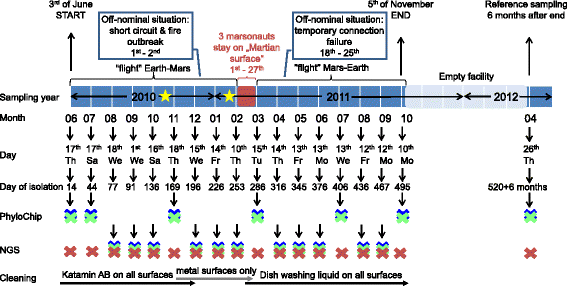
Timeline of the Mars500 experiment from the beginning (3rd of June, 2010) until the end (5th of November, 2011). The schematic drawing also indicates important steps and events during the confinement (above timeline) including the two off-nominal situations (critical situation simulations) and sampling dates from 18 sampling events. Red area/font denotes the stay of three marsonauts in the simulated Martian surface complex, whereas light blue area represents the timeframe where the facility was untenanted. One reference sampling was performed 6 months after confinement. Crosses represent samples that were used for PhyloChip analyses or NGS, respectively. Samples from each sampling were subjected to cultivation experiments. Red: medical module EU-100; green: habitable module EU-150; blue: utility module EU-250. Yellow stars indicate changing of NANO-filters and cleaning events of the primary filters on day 162 (11th of November, 2010) and 243 (2nd of February, 2011) of isolation

Timeline of the Mars500 experiment from the beginning (3rd of June, 2010) until the end (5th of November, 2011). The schematic drawing also indicates important steps and events during the confinement (above timeline) including the two off-nominal situations (critical situation simulations) and sampling dates from 18 sampling events. Red area/font denotes the stay of three marsonauts in the simulated Martian surface complex, whereas light blue area represents the timeframe where the facility was untenanted. One reference sampling was performed 6 months after confinement. Crosses represent samples that were used for PhyloChip analyses or NGS, respectively. Samples from each sampling were subjected to cultivation experiments...

Read More

Why do we Fall Asleep when Bored?

Slow-wave sleep is controlled by a subset of nucleus accumbens core neurons in mice. Nature Communications, 2017; 8 (1) DOI: 10.1038/s41467-017-00781-4

Slow-wave sleep is controlled by a subset of nucleus accumbens core neurons in mice. Nature Communications, 2017; 8 (1) DOI: 10.1038/s41467-017-00781-4

As humans, we often defy sleepiness and stay awake when attention is necessary, but also experience an inescapable desire to sleep in boring situations. The brain mechanisms governing the regulation of sleep by cognitive and emotional factors are not well understood. A new paper published in the journal Nature Communications finds that a part of the brain that is associated with motivation and pleasure – the nucleus accumbens – also can produce sleep. The new findings may explain why we have the tendency to fall asleep in the absence of motivating stimuli, i.e., when bored.

Researchers at the University of Tsukuba’s International Institute ...

Read More

Electrically Heated Textiles now possible via UMass Amherst Research

A three-layered glove developed by materials chemist Trisha Andrew has one layer coated by the conducting polymer PEDOT and is powered by a button battery weighing 1.8 grams. Credit: UMass Amherst

A three-layered glove developed by materials chemist Trisha Andrew has one layer coated by the conducting polymer PEDOT and is powered by a button battery weighing 1.8 grams. Credit: UMass Amherst

Vapor deposition method for nano-coating fabric to create sewable, weavable, electrically heated material. Skiers, crossing guards and others who endure frozen fingers in cold weather may look forward to future relief as manufacturers are poised to take advantage of a new technique for creating electrically heated cloth. Researchers have made gloves that keep fingers as warm as the palm of the hand.

The three-layered glove, with one layer coated by the conducting polymer poly(3,4-ethylenedioxytiophene), also known as PEDOT, are powered by a button battery weighing 1.8 grams...

Read More

Protein that could Improve Symptoms and Reduce Mortality in Flu

Structural characterization of retrocyclin. (a) CD spectrum demonstrating the similarity in structure between retrocyclin and RTD-1, both at 0.5 mg/ml in a 1:1 mixture of trifluoroethanol in PBS at pH 7.4. (b) A hypothetical model of retrocyclin made by templating its sequence on the backbone of a similar peptide from porcine neutrophils, protegrin-1 (PDB accession code: 1PG1). (c) A cartoon version of b, wherein arginines are black, cysteines are gray, and the other residues are identified by single letter code. (d) A similar cartoon of rhesus RTD-1, indicating the similarity in structure with retrocyclin.

Structural characterization of retrocyclin. (a) CD spectrum demonstrating the similarity in structure between retrocyclin and RTD-1, both at 0.5 mg/ml in a 1:1 mixture of trifluoroethanol in PBS at pH 7.4. (b) A hypothetical model of retrocyclin made by templating its sequence on the backbone of a similar peptide from porcine neutrophils, protegrin-1 (PDB accession code: 1PG1). (c) A cartoon version of b, wherein arginines are black, cysteines are gray, and the other residues are identified by single letter code. (d) A similar cartoon of rhesus RTD-1, indicating the similarity in structure with retrocyclin.

New research in the Journal of Leukocyte Biology identifies potential protective agent against flu infection...

Read More