
Category Biology/Biotechnology

Sea Urchin Protein provides insights into Self-Assembly of Skeletal Structures

Scanning electron microscopy image of a calcite crystal generated in the presence of the sea urchin protein rSM50 on a silicon wafer showing organized nanotexturing on exposed surfaces

Scanning electron microscopy image of a calcite crystal generated in the presence of the sea urchin protein rSM50 on a silicon wafer showing organized nanotexturing on exposed surfaces

Researchers are investigating a protein found inside the spicules of a sea urchin embryo to understand what makes these proteins such efficient ‘brick organizers’. Calcium carbonate, or CaCO3, comprises more than 4% of Earth’s crust. Its most common natural forms are chalk, limestone, and marble, produced by the sedimentation of the shells of small fossilized snails, shellfish, and coral over millions of years. NYU Dentistry researchers are studying how nature creates 3D CaCO3 inorganic/organic based materials to form seashells, invertebrate exoskeletons, and vertebrate bone, dentine, and enamel.

John Evans,...

Read More
Type of Sugar may Treat Atherosclerosis, mouse study shows

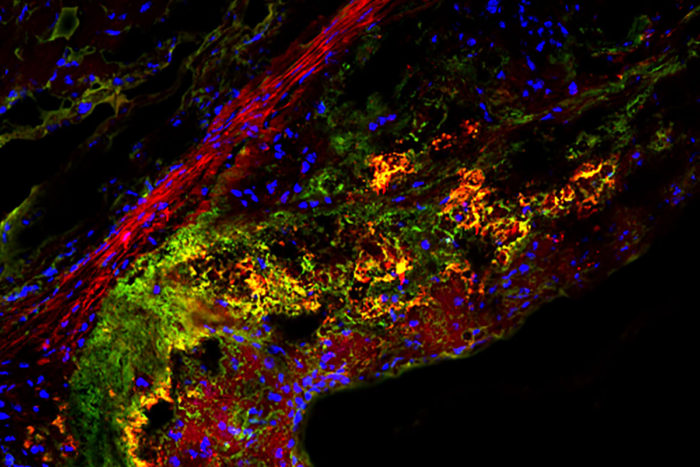
A new study shows that a type of natural sugar called trehalose triggers an important cellular housekeeping process in immune cells that helps treat atherosclerotic plaque. The image shows a cross section of a mouse aorta, the main artery in the body, with a large plaque. Straight red lines toward the upper left are the wall of the aorta. Yellow areas are where housekeeping cells called macrophages are incinerating cellular waste. Credit: Ismail Sergin

A new study shows that a type of natural sugar called trehalose triggers an important cellular housekeeping process in immune cells that helps treat atherosclerotic plaque. The image shows a cross section of a mouse aorta, the main artery in the body, with a large plaque. Straight red lines toward the upper left are the wall of the aorta. Yellow areas are where housekeeping cells called macrophages are incinerating cellular waste. Credit: Ismail Sergin

Trehalose triggers cellular housekeeping in artery-clogging. Researchers have long sought ways to harness the body’s immune system to treat disease, especially cancer...

Read More

Starving Prostate Cancer with what you eat: Apple peels, red grapes, turmeric

In vivo effect on HMVP2 tumor growth of treatment with CUR, UA, RES and their combinations. HMVP2 cell spheroids were injected subcutaneously into the flank of male FVB/N mice. Mice were fed ad libitum with semipurified AIN76A-based diet containing CUR, UA, RES or their combinations of two natural compounds. Body weight (a), food consumption (b), tumor volume (c) and tumor weight (d) are shown as mean ± SEM. One-way ANOVA with significance at p < 0.05 was used. Statistical significance is shown as different from control (a), CUR (b), UA (c) and RES (d)

In vivo effect on HMVP2 tumor growth of treatment with CUR, UA, RES and their combinations. HMVP2 cell spheroids were injected subcutaneously into the flank of male FVB/N mice. Mice were fed ad libitum with semipurified AIN76A-based diet containing CUR, UA, RES or their combinations of two natural compounds. Body weight (a), food consumption (b), tumor volume (c) and tumor weight (d) are shown as mean ± SEM. One-way ANOVA with significance at p < 0.05 was used. Statistical significance is shown as different from control (a), CUR (b), UA (c) and RES (d)

When you dine on curry and baked apples, enjoy the fact that you are eating something that could play a role starving – or even preventing – cancer...

Read More

Battery-Less Pacemaker:

The internal components of a battery-free pacemaker introduced this week by Rice University and the Texas Heart Institute. The pacemaker can be inserted into the heart and powered by a battery pack outside the body, eliminating the need for wire leads and surgeries to occasionally replace the battery. Courtesy of Rice Integrated Systems and Circuits

The internal components of a battery-free pacemaker introduced this week by Rice University and the Texas Heart Institute. The pacemaker can be inserted into the heart and powered by a battery pack outside the body, eliminating the need for wire leads and surgeries to occasionally replace the battery. Courtesy of Rice Integrated Systems and Circuits

Researchers test microwave-powered device. A wireless, battery-less pacemaker that can be implanted directly into a patient’s heart is being introduced by researchers from Rice University and their colleagues at the Texas Heart Institute (THI) at the IEEE’s International Microwave Symposium (IMS) in Honolulu June 4-9...

Read More