
Category Biology/Biotechnology

‘Molecular prosthetics’ can replace missing Proteins to treat disease

The small molecule hinokitiol transports iron across cell membranes where transport proteins are missing. Credit: Julie McMahon and Liz Ahlberg Touchstone, University of Illinois

The small molecule hinokitiol transports iron across cell membranes where transport proteins are missing. Credit: Julie McMahon and Liz Ahlberg Touchstone, University of Illinois

“If you’re sick because you have too much protein function, in many cases we can do something about it. But if you’re sick because you’re missing a protein that does an essential function, we struggle to do anything other than treat the symptoms. It’s a huge unmet medical need,” said Burke, who also is a medical doctor. Burke’s team found that a small molecule called hinokitiol, derived from a species of cypress tree found in Japan, can transport iron across cell membranes that are missing transport proteins.

In a healthy system, transport proteins move iron across cell membranes to uptake iron from the gut or mak...

Read More
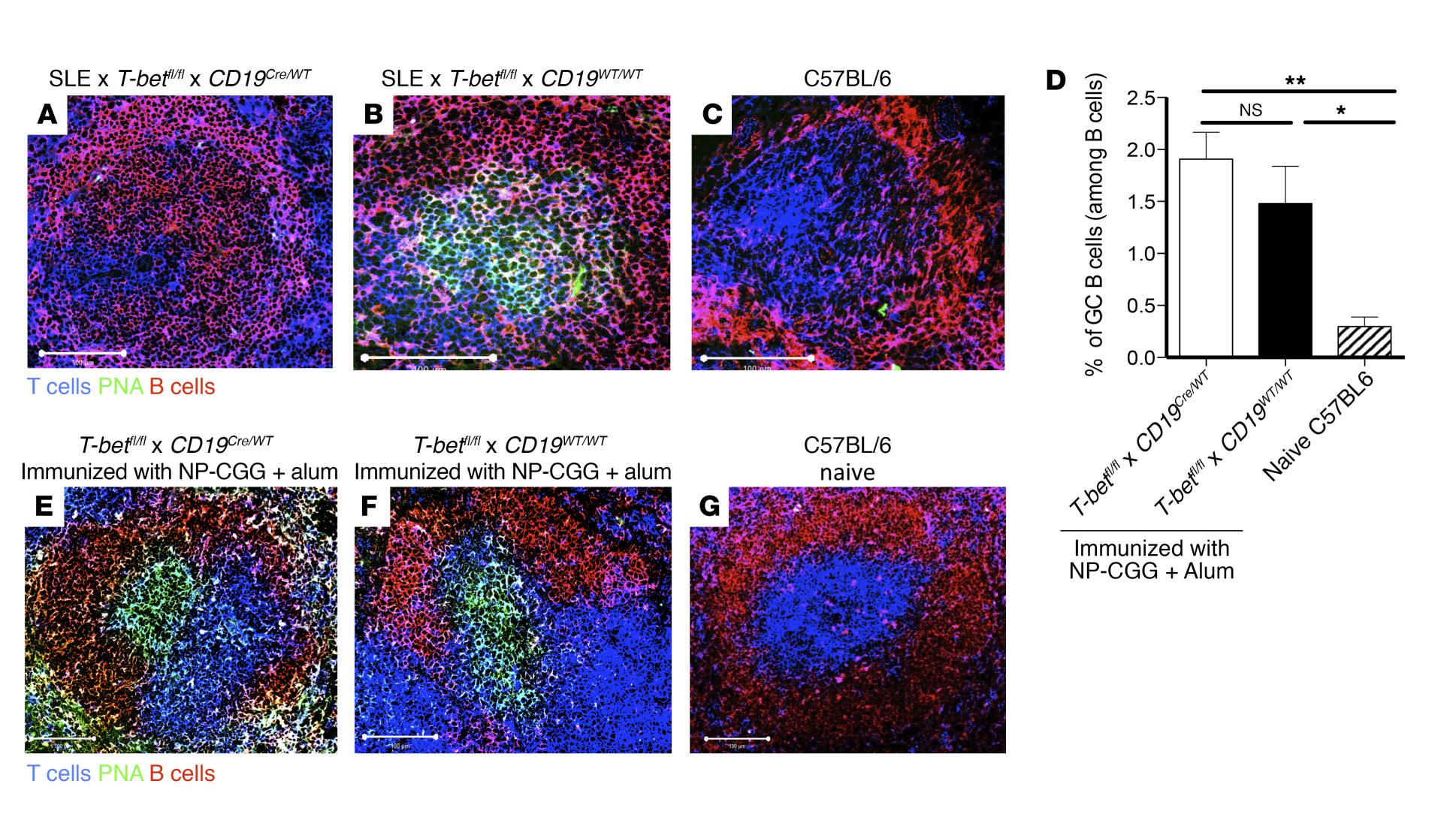
Trigger for Autoimmune Disease eg Lupus, Crohn’s, MS Identified

T-bet expression in B cells is required for the formation of spontaneous GCs, but is dispensable for the formation GCs following deliberate immunization. (A–C) Representative immunofluorescent staining of 5 spleen sections obtained from (A) SLE × T-betfl/fl × CD19Cre/WT, (B) SLE × T-betfl/fl × CD19WT/WT, or (C) C57BL/6 mice. (D) Percentage of GC B cells identified by FACS as B220+CD19+CD4–CD8–GL7+CD95+ and (E–G) representative immunofluorescent staining of spleens sections obtained from (E) T-betfl/fl × CD19Cre/WT, (F) T-betfl/fl × CD19WT/WT mice immunized with NP-CGG and alum (day 11) (n = 4 mice per group), or (G) naive C57BL/6 mice. n = 4 mice per group, representative of 3 independent experiments. Scale bars: 100 μm. *P < 0.05, **P < 0.01 by 1-way ANOVA followed by Newman-Keuls analysis. NS, not significant; PNA, peanut agglutinin.

T-bet expression in B cells is required for the formation of spontaneous GCs, but is dispensable for the formation GCs following deliberate immunization. (A–C) Representative immunofluorescent staining of 5 spleen sections obtained from (A) SLE × T-betfl/fl × CD19Cre/WT, (B) SLE × T-betfl/fl × CD19WT/WT, or (C) C57BL/6 mice. (D) Percentage of GC B cells identified by FACS as B220+CD19+CD4–CD8–GL7+CD95+ and (E–G) representative immunofluorescent staining of spleens sections obtained from (E) T-betfl/fl × CD19Cre/WT, (F) T-betfl/fl × CD19WT/WT mice immunized with NP-CGG and alum (day 11) (n = 4 mice per group), or (G) naive C57BL/6 mice. n = 4 mice per group, representative of 3 independent experiments. Scale bars: 100 μm. *P < 0.05, **P < 0...

Read More

3D-Printed ‘Bionic Skin’ could give Robots the Sense of Touch

Screenshot of video (https://youtu.be/GCT0KwFw-pM) showing 3D printing of stretchable electronic sensory devices that could give robots the ability to feel their environment and is a major step forward in printing electronics on real human skin. Credit: Shuang-Zhuang Guo and Michael McAlpine, University of Minnesota

Screenshot of video (https://youtu.be/GCT0KwFw-pM) showing 3D printing of stretchable electronic sensory devices that could give robots the ability to feel their environment and is a major step forward in printing electronics on real human skin. Credit: Shuang-Zhuang Guo and Michael McAlpine, University of Minnesota

Uni of Minnesota engineering researchers have developed a revolutionary process for 3D printing stretchable electronic sensory devices that could give robots the ability to feel their environment. The discovery is also a major step forward in printing electronics on real human skin. “This stretchable electronic fabric we developed has many practical uses,” said A/Prof. Michael McAlpine...

Read More

Link between Common Brain Disease and Gut Microbiome

MRI of a patient with (cerebral cavernous malformation) CCM disease. Credit: Issam Awad, University of Chicago

MRI of a patient with (cerebral cavernous malformation) CCM disease. Credit: Issam Awad, University of Chicago

Bacteria in the gut microbiome drive the formation of cerebral cavernous malformations (CCMs), clusters of dilated, thin-walled blood vessels in the brain that can cause stroke and seizures, according to new research published this week in Nature by researchers from the Perelman School of Medicine at the University of Pennsylvania.

Altering the microbiome in CCM patients may be an effective therapy for this cerebrovascular disease. CCM disease, which occurs in about 1 in 100 to 200 people, can present in 2 forms. One is sporadic, accounting for 80% of cases, and is most frequent in older individuals. The remaining 20% are familial, inherited cases...

Read More