
Category Biology/Biotechnology

Scientists Decipher the Nanoscale Architecture of a Beetle’s Shell

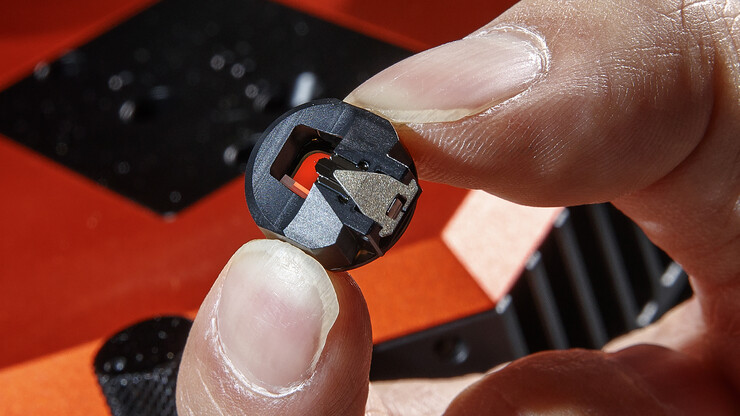
Yang holds a piece of the atomic force microscope used to measure the beetle's surface. A small wire can barely be seen in the middle of the piece. Unseen is a two-nano-size probe attached to the wire, which does the actual measuring.

Craig Chandler | University Communication Yang holds a piece of the atomic force microscope used to measure the beetle’s surface. A small wire can barely be seen in the middle of the piece. Unseen is a two-nano-size probe attached to the wire, which does the actual measuring.

A better understanding of beetle exoskeletons could help engineer lighter, stronger materials. Such materials could, for example, reduce gas-guzzling drag in vehicles and airplanes and reduce the weight of armor, lightening the load for the 21st-century knight. But revealing exoskeleton architecture at the nanoscale has proven difficult. Nebraska’s Ruiguo Yang, assistant professor of mechanical and materials engineering, and his colleagues found a way to analyze the fibrous nanostructure.

The lightweight exoskeleton i...

Read More

CAR T cells more powerful when built with CRISPR

Chimeric antigen receptors (CARs): (a) anatomy and evolution of CAR design, and (b) CAR T cells recognize specific antigens on cancer cell surface and trigger T-cell–mediated killing. - See more at: http://www.targetedonc.com/publications/targeted-therapies-cancer/2015/june-2015/engineered-t-cells-for-leukemia-a-review-of-current-approaches-and-applications#sthash.j8qfDAeT.dpuf

Chimeric antigen receptors (CARs): (a) anatomy and evolution of CAR design, and (b) CAR T cells recognize specific antigens on cancer cell surface and trigger T-cell–mediated killing.

Researchers from Memorial Sloan Kettering Cancer Center have harnessed the power of CRISPR/Cas9 to create more-potent chimeric antigen receptor (CAR) T cells that enhance tumor rejection in mice. The unexpected findings uncover facets of CAR immunobiology and underscore the potential of CRISPR/Cas9 genome editing to advance immunotherapies for cancer.

CRISPR is a genome-editing tool that enables scientists to cut and manipulate a cell’s DNA with high precision. In the Nature paper, MSK investigators show that CRISPR technology can deliver the CAR gene to a very specific location in the genome of the T cell...

Read More

Proteins Biomarkers in your Runny Nose could Verify Viral infection from Cold or Flu

Study design and experimental workflow. A two-phased strategy was employed to identify and characterize candidate protein biomarkers of ARV infection from NPL samples collected from participants in four experimental ARV challenge cohorts. For phase 1 discovery analysis, four NPL pools were prepared from H3N2 #1 cohort and analyzed using unbiased 2D-LC-MS/MS. The numbers of subject (N) with samples included in each pool are shown (Uninf = uninfected individuals; Inf = infected individuals; BL = baseline; T = time of maximal symptoms). For phase 2, the original and three additional independent challenge cohorts were assayed by targeted MRM. Quantitative peptide expression data from 80 individuals and 156 total samples were used in the derivation of an NPL ARV classifier, and classification performance was assessed in independent challenge cohorts using LOOCV.

Study design and experimental workflow. A two-phased strategy was employed to identify and characterize candidate protein biomarkers of ARV infection from NPL samples collected from participants in four experimental ARV challenge cohorts. For phase 1 discovery analysis, four NPL pools were prepared from H3N2 #1 cohort and analyzed using unbiased 2D-LC-MS/MS. The numbers of subject (N) with samples included in each pool are shown (Uninf = uninfected individuals; Inf = infected individuals; BL = baseline; T = time of maximal symptoms). For phase 2, the original and three additional independent challenge cohorts were assayed by targeted MRM...

Read More

Longevity-promoting Superstar gets revealed in Caenorhabditis Reproducibility Project

(a–c) Dose response effects on the median lifespan of select C. briggsae strains after treatment with chemicals that exhibited strong positive effects on the C. elegans strains. Dosing was performed only on strains that failed to respond positively in the initial tests (single dose experiments), as we did not attempt to identify peak responses, instead we only sought to identify whether positive effects could be obtained by altering doses. Chemical doses were chosen to center around the effective dose identified for C. elegans strains and were sometimes expanded after preliminary rounds of testing. ThT exhibited a positive effect on strain JU1348 at 25 μM, but was profoundly toxic to all strains at and above 100 μM

(a–c) Dose response effects on the median lifespan of select C. briggsae strains after treatment with chemicals that exhibited strong positive effects on the C. elegans strains. Dosing was performed only on strains that failed to respond positively in the initial tests (single dose experiments), as we did not attempt to identify peak responses, instead we only sought to identify whether positive effects could be obtained by altering doses. Chemical doses were chosen to center around the effective dose identified for C. elegans strains and were sometimes expanded after preliminary rounds of testing. ThT exhibited a positive effect on strain JU1348 at 25 μM, but was profoundly toxic to all strains at and above 100 μM

The amyloid dye Thioflavin T emerged as the superstar when age rese...

Read More