
Category Biology/Biotechnology

Cold Plasma will Heal Non-Healing Wounds

Low-temperature plasma generator. Left: (1) gas flow, (2) SHF electrode, (3) plasma jet, (4) power source, (5) ground electrode. Right: (6) metal tube, (7) power, (8) plasma jet. Credit: MIPT

Low-temperature plasma generator. Left: (1) gas flow, (2) SHF electrode, (3) plasma jet, (4) power source, (5) ground electrode. Right: (6) metal tube, (7) power, (8) plasma jet. Credit: MIPT

Scientists have found that treating cells with cold plasma leads to their regeneration, rejuvenation. This result can be used to develop a plasma therapy program for patients with non-healing wounds. Non-healing wounds make it more difficult to provide effective treatment to patients and are therefore a serious problem faced by doctors. These wounds can be caused by damage to blood vessels in the case of diabetes, failure of the immune system resulting from an HIV infection or cancers, or slow cell division in elderly people.

Cold atmospheric-pressure plasma refers to a partially ionized gas (the prop...

Read More
Halting Arrhythmias with Gentle Beams – not harsh Electric Shocks

This is an illustration depicting EKG readings before, during and after the use of light -- optogenetic deffibtillation -- to restore a normal heartbeat to an arrhythmic heart. Credit: Patrick M. Boyle/Johns Hopkins University

This is an illustration depicting EKG readings before, during and after the use of light — optogenetic deffibtillation — to restore a normal heartbeat to an arrhythmic heart. Credit: Patrick M. Boyle/Johns Hopkins University

Using high-tech human heart models and mouse experiments, scientists at Johns Hopkins and Germany’s University of Bonn have shown that beams of light could replace electric shocks in patients reeling from a deadly heart rhythm disorder. The findings could pave the way for a new type of implantable defibrillators. Current devices deliver pulses of electricity that are extremely painful and can damage heart tissue. Light-based treatment should provide a safer and gentler remedy for patients at high risk of arrhythmia that can cause sudden cardiac death within minutes.

Th...

Read More

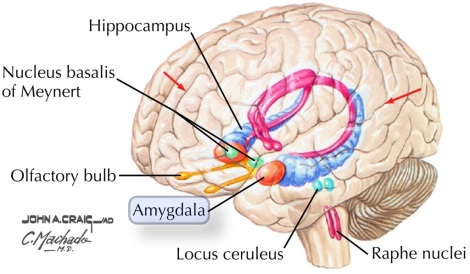
Learning to Turn Down your Amygdala can Modify your Emotions

The amygdala of the human brain is placed somewhat strategically at dorsomedial part (above and inside) of temporal lobe, anteriorly (in front) of the hippocampus and close to the tail of the caudate nucleus.

The amygdala of the human brain is placed somewhat strategically at dorsomedial part (above and inside) of temporal lobe, anteriorly (in front) of the hippocampus and close to the tail of the caudate nucleus.

Training the brain to treat itself is a promising therapy for traumatic stress. The training uses an auditory or visual signal that corresponds to the activity of a particular brain region, called neurofeedback, which can guide people to regulate their own brain activity. However, treating stress-related disorders requires accessing the amygdala that is difficult to reach with typical neurofeedback methods. This activity has only been measured using fMRI, which is costly and poorly accessible.

“The major advancement of this new tool is the ability to use a low-cost and accessible imag...

Read More

Team finds Existing Drug may Halt Breast Tumor Growth, points way toward more effective Treatments

Researchers have discovered that the drug pioglitazone, used to treat diabetes, shows some ability to halt the overexpression of the protein NAF-1, which has been associated with the proliferation of breast cancer. (Credit: Illustration by Fang Bai/Rice University) - See more at: http://news.rice.edu/2016/09/12/new-tools-join-breast-cancer-fight/#sthash.zm6eX3P2.dpuf

Researchers have discovered that the drug pioglitazone, used to treat diabetes, shows some ability to halt the overexpression of the protein NAF-1, which has been associated with the proliferation of breast cancer. (Credit: Illustration by Fang Bai/Rice University)

Dialing down the level of the protein NAF-1 and the activity of the iron-sulfur clusters it transports may be key to halting tumor growth. The researchers suggest a drug that is typically used to treat type 2 diabetes, pioglitazone, has proven effective at controlling NAF-1 levels. They also discovered that a single mutation to NAF-1 almost completely blocked the ability of cancer cells to proliferate, a result they said supports the idea that lowering NAF-1 expression can help stop tumors...

Read More