Category Biology/Biotechnology

Transplant Drug may provide benefits after Spinal Cord Injury

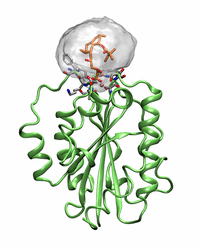
The structure of rapamycin. (Fvasconcellos/Wikimedia Commons)

The structure of rapamycin. (Fvasconcellos/Wikimedia Commons)

New research in mice indicates that a drug commonly used to suppress the immune system in recipients of organ transplants may also reduce tissue damage and neuropathic pain after spinal cord injury. Rapamycin, which is an inhibitor of the mammalian target of rapamycin (mTOR) signaling pathway, has a variety of cellular functions and is known to possess both immunosuppressant and anti-tumor properties. In their previous work, investigators at the Tohoku University Graduate School of Medicine in Japan found that rapamycin treatment can reduce nerve damage and locomotor impairment after spinal cord injury...

Read More

Where did it all go wrong? Scientists identify ‘Cell of Origin’ in Skin Cancers

The green-labelled cells show a basal cell carcinoma in mouse tail epidermis derived from a single mutant stem cell and expanding out of the normal epidermis stained in red. Credit: Adriana Sánchez-Danés

The green-labelled cells show a basal cell carcinoma in mouse tail epidermis derived from a single mutant stem cell and expanding out of the normal epidermis stained in red. Credit: Adriana Sánchez-Danés

Scientists have identified for the first time the ‘cell of origin’ – in ie the first cell from which the cancer grows – in basal cell carcinoma, the most common form of skin cancer, and followed the chain of events that lead to the growth of these invasive tumours. Our skin is kept healthy by a constant turnover. The process is maintained by ‘progenitor’ cells – the progeny of stem cells – that divide and ‘differentiate’ into fully-functional skin cells to replenish dying skin...

Read More

New Neurons reveal Clues about an Individual’s Autism

Salk researchers have turned the skin cells of people with autism spectrum disorder into neurons. These cells show specific defects compared with those neurons derived from healthy people, including diminished ability to form excitatory connections with other neurons (indicated by red and green dots in the neuron). Credit: Salk Institute

Salk researchers have turned the skin cells of people with autism spectrum disorder into neurons. These cells show specific defects compared with those neurons derived from healthy people, including diminished ability to form excitatory connections with other neurons (indicated by red and green dots in the neuron). Credit: Salk Institute

The brains of some people with autism spectrum disorder grow faster than usual early on in life, often before diagnosis. A new study co-led by Salk Institute scientists has employed a cutting-edge stem cell technique to unravel the mechanisms driving the mysterious phenomenon of excess brain growth, which affects as many as 30% of people with autism...

Read More

Missing Link in Epigenetics could explain Conundrum of Disease Inheritance

Simvastatin acts as a stopper, plugging the adhesion molecules in the immune system.

Simvastatin acts as a stopper, plugging the adhesion molecules in the immune system.

Simvastatin, which is one of the most commonly used pharmaceuticals in the world, also has a beneficial effect on the immune defense system with regard to diseases such as type 1 diabetes, multiple sclerosis and rheumatoid arthritis. Danish researchers have now explored why this is so, and their findings may result in improved treatment.

In the case of multiple sclerosis, the immune defense system destroys the central nervous system, while the inflammation affects the kidneys, eyes and sense of touch in both type 1 and type 2 diabetes, leading to a variety of complications...

Read More