
Category Biology/Biotechnology

Alzheimer’s Researchers find Clues to Toxic forms of Amyloid beta

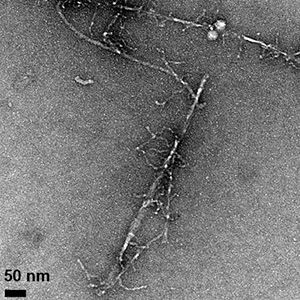
Fibrils formed by the aggregation of the amyloid beta protein can be seen in these transmission electron microscope images, which show differences in fibril morphology between the normal protein (above) and an altered protein with one amino acid replaced by its mirror image. The altered protein also forms fibrils more slowly and is more toxic to cells. (Image credit: Warner et al., CEJ 2016)

Fibrils formed by the aggregation of the amyloid beta protein can be seen in these transmission electron microscope images, which show differences in fibril morphology between the normal protein (above) and an altered protein with one amino acid replaced by its mirror image. The altered protein also forms fibrils more slowly and is more toxic to cells. (Image credit: Warner et al., CEJ 2016)

Subtle change to amyloid beta protein affects its aggregation behavior, stabilizes an intermediate form with enhanced toxicity. Much of the research on Alzheimer’s disease has focused on the amyloid beta protein, which clumps together into sticky fibrils that form deposits in the brains of people with the disease...

Read More

New Drug Clears Psoriasis in Clinical Trials

Psoriasis on elbow. Credit: © hriana / Fotolia

Psoriasis on elbow. Credit: © hriana / Fotolia

Improvement persists for more than a year. About 80% of patients with moderate to severe psoriasis saw their disease completely or almost completely cleared with a new drug called ixekizumab, according to 3 large, long-term clinical trials led by NW Medicine. “This group of studies not only shows very high and consistent levels of safety and efficacy, but also that the great majority of the responses persist at least 60 weeks,” said Dr. Kenneth Gordon.

Affecting about 3% of the world’s population, psoriasis is an immune-mediated inflammatory disease that causes itchy, dry and red skin. It is also associated with an increased risk for depression, heart disease and diabetes, among other conditions...

Read More

Diet lacking in Zinc is detrimental to human, animal health

sourcesofZn

Even moderate zinc deficiency is bad for digestion. The trace element zinc has an impact on the essential metabolic functions of most living organisms. New research carried out by the Chair of Animal Nutrition at the Technical University of Munich (TUM) has found that reduced zinc impairs digestion, albeit without any typical symptoms such as skin problems or fatigue. Hence, short-term zinc deficiency in the diet should be avoided.

The test series established even slight zinc deficiency in an animal’s diet impedes pancreatic digestive activity even at an early stage.

Scientist Brugger charted a new path since all previous studies had compared the functions of animals with clinical zinc deficiency to those of animals that had adequate amounts of this trace element in their bodies...

Read More

Stress Exposure during Pregnancy observed in Mothers of children with Autism: Gene-stress interaction

Representation of the long/short polymorphism of the 5-HTT gene and the release, reception and recycling of serotonin in neurons. Adapted from Canli and Lesch

Representation of the long/short polymorphism of the 5-HTT gene and the release, reception and recycling of serotonin in neurons. Adapted from Canli and Lesch

Stress during pregnancy has been linked to several conditions, including some instances of autism spectrum disorder. Now, researchers at the Uni of Missouri School of Medicine have observed a variant of a stress-sensitive gene and exposure to stress during pregnancy among two groups of mothers of children with autism. The researchers believe the finding could be a step toward helping identify women who have greater risks for having children with autism when exposed to stressors during a specific time window during pregnancy.

“Autism was thought to be largely a genetic disorder, but previous research has shown that environmental influ...

Read More