
Category Biology/Biotechnology

Chemists offer more evidence of RNA as the Origin of Life

RNA molecule

This is a computer graphic of an RNA molecule. Credit: Richard Feldmann/Wikipedia

A team of chemists at Ludwig Maximilian University of Munich has shown how the purines adenine and guanine can be synthesized easily and in reasonable yields, offering more evidence that RNA could have served as the origin of life on Earth. The team describes the process they took in looking for evidence that RNA could have been the first self-replicating molecule that eventually led to all life on our planet and what they found.

Four Nitrogenous Bases in RNA: Adenine, Guanine, Cytosine

Four Nitrogenous Bases in RNA: Adenine, Guanine, Cytosine

For several years many scientists have supported the idea that life got its start on our planet due to a series of events that led to the creation of RNA molecules—it seems like a strong candidate because it is able to both st...

Read More
Brain Cells that Aid Appetite Control Identified

Pharmacological and genetic ablation of NG2-glia, but not microglia, leads to obesity •NG2-glial ablation causes LepR processes in the median eminence to degenerate •Arcuate nucleus LepR neurons lose responsiveness to leptin after NG2-glia ablation •X-irradiation aimed at the median eminence is sufficient for weight gain induction

Pharmacological and genetic ablation of NG2-glia, but not microglia, leads to obesity •NG2-glial ablation causes LepR processes in the median eminence to degenerate •Arcuate nucleus LepR neurons lose responsiveness to leptin after NG2-glia ablation •X-irradiation aimed at the median eminence is sufficient for weight gain induction

Discovery opens door to development of new drugs to control weight gain and obesity. 4 years ago, Kokoeva and her team set out to explore which brain cells might play a role in the process of leptin sensing and weight gain. The answer, it turns out, lies in the median eminence, a brain structure at the base of the hypothalamus.

The McGill team has now discovered that without NG2-glia cells in place in the median eminence, the leptin receptors in the brain n...

Read More

Another reason for Wine Lovers to toast Resveratrol

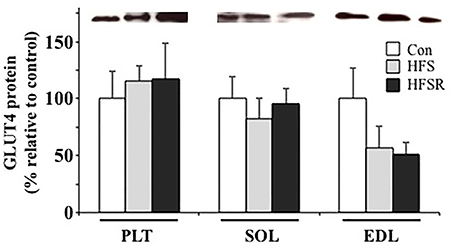
Average changes in GLUT4 protein in the plantaris (PLT), soleus (SOL), and ECL muscles of rhesus macaques. Protein expression is shown as a multitude of the control value. There were no age-related statistical differences detected between young and old groups and, therefore, values were combined into a single control (Con) group. Values are means ± S.E.M. HFS, high fat/high sugar; HFSR, high fat/high sugar with resveratrol supplementation.

Average changes in GLUT4 protein in the plantaris (PLT), soleus (SOL), and ECL muscles of rhesus macaques. Protein expression is shown as a multitude of the control value. There were no age-related statistical differences detected between young and old groups and, therefore, values were combined into a single control (Con) group. Values are means ± S.E.M. HFS, high fat/high sugar; HFSR, high fat/high sugar with resveratrol supplementation.

Resveratrol found in red wine could help counteract the negative impact of high fat/high sugar diets. Red wine lovers have a new reason to celebrate. Researchers have found a new health benefit of resveratrol, which occurs naturally in blueberries, raspberries, mulberries, grape skins and consequently in red wine.

While studying the effects of resveratr...

Read More

Rapid Eye Movement Sleep: Keystone of Memory Formation

Dreaming. REM sleep is understood to be a critical component of sleep in all mammals, including humans. Credit: © Anton Maltsev / Fotolia

Dreaming. REM sleep is understood to be a critical component of sleep in all mammals, including humans. Credit: © Anton Maltsev / Fotolia

For decades, scientists have fiercely debated whether rapid eye movement (REM) sleep – the phase where dreams appear – is directly involved in memory formation. Now researchers provide evidence that REM sleep does, indeed, play this role – at least in mice. “We already knew that newly acquired information is stored into different types of memories, spatial or emotional, before being consolidated or integrated,” says Sylvain Williams, a researcher and professor of psychiatry at McGill.

“How the brain performs this process has remained unclear – until now...

Read More