
Category Biology/Biotechnology

Saturated Fat ‘Short-Circuits’ Immune Cells to Trigger Inflammation

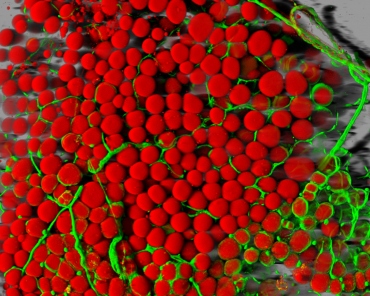
A mouse's fat cells are shown surrounded by a network of blood vessels.

A mouse’s fat cells (red) are shown surrounded by a network of blood vessels (green). Source: Daniela Malide, National Heart, Lung, and Blood Institute, National Institutes of Health

UC SF scientists have found a surprising new avenue for potential therapies to reduce risk of type 2 diabetes and other metabolic disorders associated with chronic tissue inflammation in obesity. Inflammation in obesity may be caused, at least in part, by a completely different mechanism from the one that controls normal immune responses. The research shows saturated fats “short-circuit” both mouse and human immune cells, producing an inappropriate inflammatory response as a consequence...

Read More

Skin has the Nerve to tell you to Scratch

Two skin cells of a mouse show the flow of calcium into the cell in response to a dose of histamine (lower panel). Duke researchers have shown that an ion channel called TRPV4 is the beginning of a chain of messages that ends up signaling "itch" to the brain. Credit: Yong Chen, Duke University

Two skin cells of a mouse show the flow of calcium into the cell in response to a dose of histamine (lower panel). Duke researchers have shown that an ion channel called TRPV4 is the beginning of a chain of messages that ends up signaling “itch” to the brain. Credit: Yong Chen, Duke University

A potential drug target for itching sensations has been developed by researchers. Their work shows that skin cells – when exposed to certain itch-producing chemicals – can powerfully regulate nearby sensory nerve cells and facilitate transmission of the itchy feelings to the brain. The ion channel TRPV4 functions in skin cells as a pivotal switch in this newly revealed signaling pathway. Prof. Wolfgang Liedtke, M.D., Ph...

Read More

Newly Identified Immunity Pathway Protects Mammals from Virus-caused Cancer

Representative high-magnification photomicrographs of H&E-stained sections of abdominal skin tumor specimens from DOX-treated ikGPCR+;Becn2+/+ and ikGPCR+;Becn2+/− mice. (Scale bars, 10 μm.)

Representative high-magnification photomicrographs of H&E-stained sections of abdominal skin tumor specimens from DOX-treated ikGPCR+;Becn2+/+ and ikGPCR+;Becn2+/− mice. (Scale bars, 10 μm.)

Building upon earlier research, UT Southwestern Medical Center and their collaborators have identified a new innate immunity pathway that protects mammals from viral oncogenesis, the process by which viruses cause normal cells to become cancerous. Given the prevalence of virus-related cancers in humans, the discovery is significant – and could eventually contribute to development of new cancer therapies.

“More than 20% of human cancers – as well as a number of other diseases – are linked to chronic viral infections,” said Dr. Xiaonan Dong.
This study revealed that the autophagy-related protein becli...

Read More

Want a Younger Brain? Education and Stair-climbing can significantly Slow down Grey-matter Aging

Researchers found that brain age decreases by 0.95 years for each year of education, and by 0.58 years for every daily flight of stairs climbed. Credit: © lzf / Fotolia

Researchers found that brain age decreases by 0.95 years for each year of education, and by 0.58 years for every daily flight of stairs climbed. Credit: © lzf / Fotolia

In a study recently published in the journal Neurobiology of Aging, researchers led by Jason Steffener, a scientist at Concordia University’s Montreal-based PERFORM Centre, show that the more flights of stairs a person climbs, and the more years of school a person completes, the “younger” their brain physically appears. Brain age decreases by 0.95 years for each year of education, and by 0.58 years for every daily flight of stairs climbed – i.e., the stairs between 2 consecutive floors in a building.

“There already exist many ‘Take the stairs’ campaigns in office environments and public transportation centres,” says Steffe...

Read More